Learning from Kenneth Goldsmith

By Jan Baetens

In 1972, Robert Venturi helped us to “learn from Las Vegas”, and architecture was no longer the same. Since more than two decades, Kenneth Goldsmith forces us to rethink writing, and one cannot insist enough on the necessity to learn from him.

kennethgoldsmith2

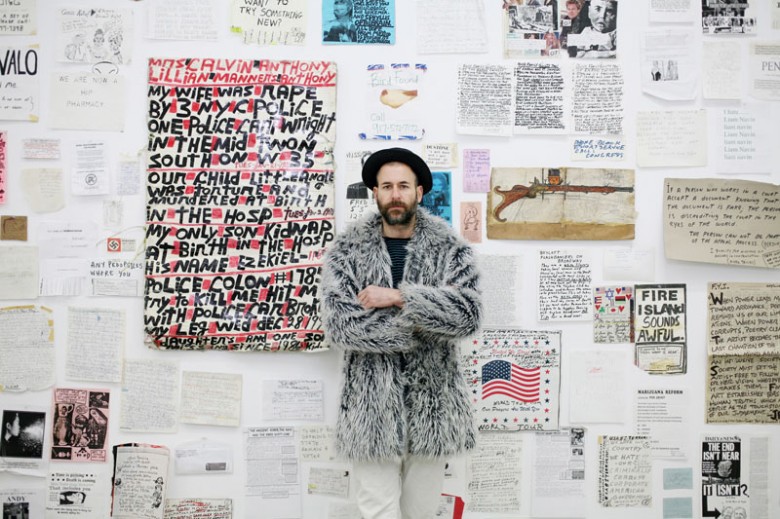
But who is Kenneth Goldsmith? First of all a pioneer of digital archiving. The “Ubuweb” (Ubu being both an institutional reference –University of Buffalo– and a nod to Alfred Jarry’s “merdre” character) he created – almost singlehandedly – is the most important multimedia archive of historical and contemporary avant-garde documents (all in open access, all for free). Second, one of the most outstanding practitioners of “uncreative writing” –a term coined in collaboration with Marjorie Perloff, the author of a groundbreaking study, Uncreative Genius (Chicago UP, 2010), on all those who invent by reusing, reappropriating, and reshaping existing textual material. Goldsmith has made important theoretical contributions to this strand of theory and criticism as well, but he is best known for the stunning “uncreative” works he produced himself, such as for instance Seven American Deaths and Disasters (Powerhouse books, 2013), in which he transcribes historic radio and television reports of national tragedies as they unfurl. The result appears to be dramatically different from what we expect, for these reports are discussing much more than just the actualities: they offer an inside view of ways of speaking and thinking that go unnoticed but that here come to the forefront. Third, he is also one of those who have radically blurred the twin fields of writing and imaging, refusing to make distinctions between our way of making pictures (with cameras) and texts (with word processing machines).

But what does Kenneth Goldsmith actually do when he starts copying and pasting texts? The most important rule he follows is that of completeness. Instead of taking out fragments or excerpts, he tries to reproduce complete files (he is infamously known for having transcribed literally every word of a single issue of the NYT in his book Day (Figures, 2003). Exhaustive? Yes. Exhausting? Yes. Boring? Yes. Fascinating. Absolutely…

Goldsmith’s reuse of a given archive, which is of course never chosen at random, involves a double shift. The first one is formal. Normally, when we reuse archives, we are looking for items that we can put after that in lists. This approach is mainly lexical. Goldsmith, on the contrary, emphasizes issues of syntax, the main problem being the rearranging and reordering of the material. The second one is semantic. Normally, archive fans are always in search of “jewels”, be they aesthetically or historically rewarding and exceptional or just weird or bizarre. In short, the archive is a kind of reservoir of masterpieces, and once these masterpieces have been identified one is allowed to forget about the rest. Unlike this anthologizing approach, Goldsmith’s work is interested in the crude repetition of what is apparently and untenably banal, yet this very repetition often produces totally unforeseen and surprising effects.

No one goes as much against the grain as Kenneth Goldsmith, even in an era where everybody claims to do something with ready-mades, sampling and reappropriationist art. What his work teaches us, is not to look for the “exceptional”, but to produce it by looking very closely at the totally unexceptional.

A concluding remark: does all this have something to do with “big data”? Not at all? For “big data” research does not ask the questions Goldsmith is asking. It does not work with the archive as a real text (a big data archive is just a reservoir for something different, which by the way offers only rarely surprising findings). It does not take risks, for example, of being boring.

(this text is the complete “transcription” of a pitch given at the Leuven hackathon of “E-Space Photography” on Feb. 25th 2016)

http://espacephotography.com/2016/02/26/e-space-photo-hack-leuven-kick-off/

The Dr. Guislain Museum: Ten Inscriptions

Arnout De Cleene (°1986) works at the Dr. Guislain Museum in Ghent (Belgium) as a scientific employee. He studied cultural studies at Maastricht University and did research on outsider literature at Leuven University.

This blog appeared first on the “Public Disability History” blog on 02/02/2016 http://www.public-disabilityhistory.org/2016/02/the-dr-guislain-museum-ten-inscriptions.html


By Arnout De Cleene

1.
The Dr. Guislain Museum is located in the city of Ghent (Belgium). The museum can be found in the well-preserved buildings of Belgium’s first psychiatric asylum. At first sight one would consider this an ideal situation as the museum specializes in the history of psychiatry.

2.
[1947]

3.
The Dr. Guislain Museum opened its doors in 1986. In those days visitors needed to go to the attic in one of the old buildings of the Hospice pour hommes aliénés. The Hospice was a specialized psychiatric institution founded in 1857. The institute was commonly namedHospice Guislain after its founder, Belgium’s first psychiatrist Joseph Guislain (1797-1860). Today, the Dr. Guislain Museum encompasses a permanent exhibition on the history of psychiatry, a broad collection of outsider art and temporary exhibitions on subjects related to the history of psychiatry (such as melancholia, trauma, shame, etc.). The museum tries to be a place where scientific research and expertise (on psychiatry, mental illness, madness, etc.) can be translated into (mostly visual) presentations that aim to reach a large and diverse public.
One of the intriguing and problematic aspects the museum continuously is confronted with is the following: the building used in order to present the exhibitions seems to interfere with what is being shown and how it is interpreted.
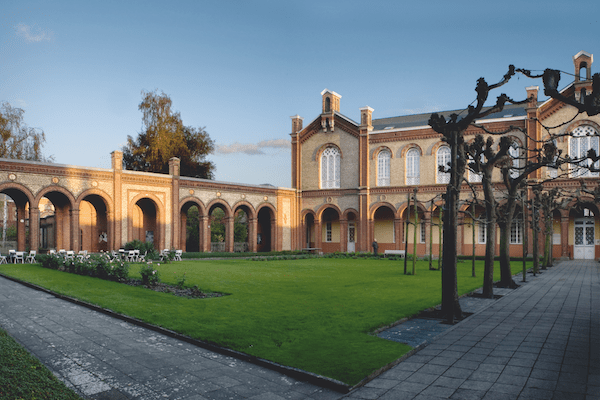
The museum’s central court and one wing of the nineteenth-century buiding. The court has a green lawn, several trees, roses and a terrace. © 2012, Guido Suykens.

4.
[GALTON]

5.
The building of the Hospice Guislain indeed is one of the most telling “objects” that can be found in the collections of the Dr. Guislain Museum. The different wards, the chapel, the remnants of a fire in 1928, the gardens, all offer overwhelming visual historical evidence. At the same time, however, the building is being used in order to house several exhibitions. It thus also encloses the objects, artworks, books, testimonies, etc. on display. For curators, visitors as well as for the items on display, this situation creates opportunities, as well as frictions and difficulties. Not all objects or items used in the exhibitions are directly connected to the history of psychiatry. However, being placed in a context that so to say breaths psychiatric knowledge and actions, the objects are interpreted as belonging to the history of psychiatry. They kind of become psychiatric themselves. As such, everyday objects are enriched and charged with meaning: by putting them in the Hospice Guislainthey immediately become relevant to the history of psychiatry.
However, what can be considered as an enormous opportunity – being located in the building of a well-known psychiatric institution – also can be looked at differently. The building indeed is a pervasive framework from which it is hard and seemingly impossible to escape. It is very difficult to tell a story inside the Dr. Guislain Museum that does not immediately acquire psychiatric interpretations. As such, the range of potential meanings an object, artwork or story can acquire, is not only enriched, but also limited, precisely because they are presented in the Hospice Guislain.
To put it bluntly: if you put a portrait on display in the Dr. Guislain Museum, it can become a psychiatric portrait. If you see an artwork, you’ll perhaps think of it as outsider art. If you see a pencil on the museum floor, you just might think it was a mad(man’s) pencil.
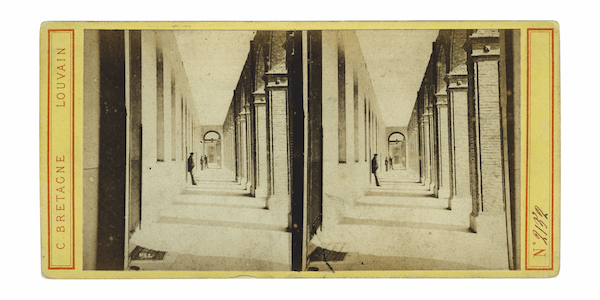
Early twentieth century picture representing one of the corridors adjacent to the central court. Halfway the corridor a man is leaning to the wall. At the back two more figures are visible. The photograph is duplicated and placed on a piece of yellow paper on which the following inscriptions can be found: N°2132, C. Bretagne, Louvain.

6.
[IIIII][IIIII][IIIII][IIIII][II ]

7.
The light that shines through the windows of the Hospice Guislain and falls on the objects and stories on display, colours them in a specific way. The spatial structure of every exhibition necessarily repeats the ground pattern of the wards. The bricks and metal fences order and organize, limit, colour, direct and produce the meaning that the public can ascribe to the gathered objects.
The building provides the visitor with a tangible context. It can be gazed at, walked upon, strolled through, felt. The Hospice Guislain indeed is an object within the context of the history of psychiatry as well as it is the context in which items relevant to that history are presented. It mirrors the mechanisms of a museum – as an institutional space that orders, selects, omits, sanctifies, contextualizes. As such, the Dr. Guislain Museum, as a (former) psychiatric and (present-day) cultural institution, is highly visible.
The question curators of the Dr. Guislain Museum time and again are confronted with is whether one can one escape from the institutionalizing effects the walls, bricks, wards and architecture seem to have (and had in the past). And if so, whether this is something one really wants. Would it be possible for the Hospice Guislain to become a dynamic, malleable environment, despite the sturdiness of its walls? And would it be possible to conceive the relationship between the public, the curators and the material context of the exhibitions other than in terms of visibility?

8.
[I H O]
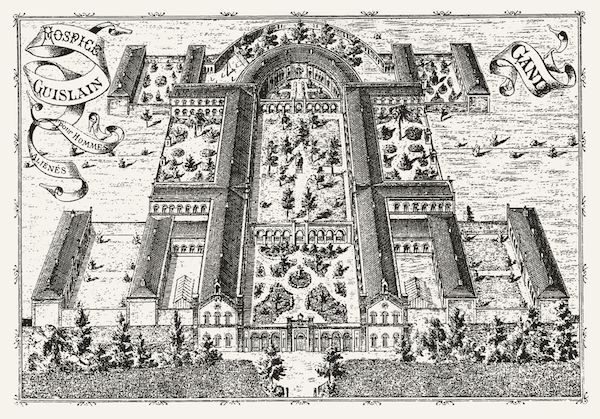
Black and white nineteenth century drawing of the complete Hospice Guislain site. Collection Dr. Guislain.

9.
Carved in the bricks of the outside walls of the Dr. Guislain Museum one can find crosses, dates, names, etc. It remains unclear what caused these inscriptions on the museum’s surface: man-made, weather-influenced or other origin. It is impossible to know who has written these signs, what they were supposed to mean, to whom they were directed. These inscriptions could be written by patients, museum visitors, doctors, gardeners, etc. An inscription reading [1947] could have been written in 2014, and vice versa. A name can be the tag of a woman, or the name of the relative she longed for. Twenty-two vertical stripes are twenty-two days since admission, and they are twenty-two birds that flew across the sky. They are twenty-two stripes written by twenty-two different persons, referring to twenty-two different things. And so on.
We often do not pay attention to these brittle signs. Our gaze is directed towards the items on display. History should be looked at intentionally, so it seems. There’s little, not to say, no space left for an unintentional encounter with our past. Perhaps this is what can be derived from the inscriptions represented and talked about here: that what matters in the Dr. Guislain Museum is not only what can be looked at from behind safety glass. It is also what becomes clear when the eye drifts away to the space that is not curated by the museum staff.
The inscriptions also invite us to reflect on their more general implications. The building of the Hospice Guislain in which the Dr. Guislain Museum is housed, literally bears the stamp of its public. The environment in which the exhibitions take place, is inscribed by the visitors that have walked the grounds of the building for more than 150 years. The walls are eroded, inscribed, altered, and waiting to be deciphered and interpreted. The reader perhaps will recall the famous distinction made by Roland Barthes between ‘textes lisibles’ and ‘textes scriptibles’.1 The first texts were those that seemed to have a fixed meaning one could accept or reject. The second kind of texts needed some more work and energy. Those texts kind of were written again when being read. Can the Museum Dr. Guislain be considered such a ‘texte scriptible’? Would it be possible to think of a history of psychiatry – of histories of psychiatry – presented within the Dr. Guislain Museum, as a museum that is (re)written while it is being read, curated while being visited, as a ‘musée scriptible’?

10.
[X]


Original post: http://www.public-disabilityhistory.org/2016/02/the-dr-guislain-museum-ten-inscriptions.html

Recommended Citation
Arnout De Cleene (2016): The Dr. Guislain Museum: Ten Inscriptions. In: Public Disability History 1 (2016) 2.


1 Roland Barthes, S/Z. Paris: Seuil, 1970.

Bringing back the true meaning of universitas

By Dr Caroline Stockman, Research Fellow

Some questions in life cut across traditional divisions in academia. What is culture? Who is the global citizen, if he exists at all? What is considered progress and decay in our society? Such questions lie at the heart of the values held by all human kind. They cannot be ‘owned’ by a particular discipline. They are deeply personal, and yet shared.

Academic research has recognised the great merits of interdisciplinary studies, and certainly Cultural Studies (or cultural studies?) welcomes a broad horizon. Now also in the educational organisation of higher education, a critical investigation of these questions can take place in a non-departmental set-up, and a liberated teaching mode.

The University of Winchester has celebrated the launch of the Institute for Value Studies, which has now run its first term with modules such as Culture: High and Low, and Cosmopolitanism: Political Values in the Age of Globalization. Each of its modules is open to all students and staff at the university, from any department or faculty. Crucial is the commitment to liberal education, of which ‘value studies’ is one form.  It was developed by Dr Peter Hajnal, Dr Thomas Nørgaard and their colleagues at the European College of Liberal Arts (ECLA) in Berlin between 2003 and 2011. The work was supported by the Endeavor Foundation in New York. Based on the Value Studies curriculum, ECLA was recognized as a German university in 2011. (Soon after, ECLA got a new owner and became Bard College Berlin.)

So in each module, a small group (maximum 12 in total)  of staff and students from different departments convene weekly to engage with value questions about politics, culture, ethics, art, religion, education and humanity in general. Key to the teaching philosophy is genuine and democratic conversation around primary reading. The atmosphere is intimate and yet totally open, personal, yet rationally grounded. It is a social space of collaborative reflection.

So imagine a class of fully engaged academics (students and staff alike), an active conversation between like-minded people, around questions which intrinsically matter to us all. In Culture: High and Low, this means active engagement with primary texts of Matthew Arnold, Ruth Benedict, TS Eliot, Raymond Williams, Neil Postman, McKenzie, Roger Scruton, Terry Eagleton, and many more. From the course description: “The distinction between high and low, or highs and lows, runs like a red thread throughout the module and invites us to reflect on our basic assumptions about progress, decadence and hierarchy.

The core premise is that we are intrinsically linked through that invisible web of meaning that shapes our life. Therefore we all have equal rights to engage with theory, and perhaps a moral duty to address the central values and questions of human life together, in a free-flowing, meaningful conversation. A community of learning tackling “the whole, total, the universe, the world” through reading, reflection and conversation. Bringing back the true meaning of universitas.

We welcome collaboration and new ideas – get in touch if you’re interested.

The Routledge Companion to the Cultural Industries

By Jan Baetens

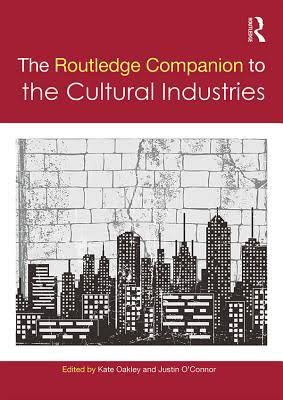
The Routledge Companion to the Cultural Industries

Eds Kate Oakley and Justin O’Connor

New York: Routledge, 2015, 575 p.

ISBN-13: 978-0415706209

Hardback, $142.55

There are many reasons to consider this book, for now alas only available in a hardback, library-only version, the most important publication in cultural studies of the year 2015. True, the scope of this collection is not cultural studies, but at the same time it makes very clear how much the current reflection to the cultural industries owes to existing work in cultural studies as well as political economy – the former having a strong focus on issues of representation, popular culture, and minorities, the latter being centered on the role of media and communication systems in the organization of capitalist systems. In all recent scholarship on cultural studies, the gradual merger with political economy has become more or less self-evident, which can only be seen as a wise and sound evolution.

routledge companionThe same can also be said of the increasing proximity, if not merger of the fields of cultural studies and cultural industries. The best available handbook at the time being, David Hesmondalgh’s The Cultural Industries (3 successive editions since 2002) is very clear in this regard, and here as well this is an evolution that can only be welcomed. There is, however, an ongoing mix-up of the notions of “cultural” and “creative” as far as the “industries” are concerned. Besides the many qualities of the separate contributions in this incredibly rich and very up to date overview, Oakley and O’Connor’s book also proves invaluable in demonstrating the necessity to avoid any confusion between creative industries on the one hand and cultural industries on the other hand.

Not an easy task, given the profound vagueness of both terms (“culture” is everything, and who doesn’t want to be “creative”?). Yet the difference between both types of industries can be neatly explained in two ways. It is first of all internal: creative industries have as their target the production of ideas, techniques, goods and services, that can be legally protected as “intellectual properties”, which is not necessarily the case in the cultural industries. But it is also, if one can say so, external: the goal of a creative industry is to make money (and the authors of this book are clever enough to stress that there is nothing wrong with this), whereas the basic horizon of a cultural industry is not automatically such (many cultural industries try for instance to “produce culture” rather than to make profit in the first place).

The Routledge Companion to the Cultural Industries is therefore a publication that can be cited as a model to all modern cultural studies research. It offers a broad synthesis, not only of the various cultural industries that exist today, but also – and more importantly – of the various theoretical and disciplinary frames essential for a correct understanding of what is happening in this field. In addition, and this is no less crucial, it also makes a strong plea for the cultural specificity of these industries, always in danger of being absorbed by the economically more interesting branch of the creative industries.

(Another reason to recommend the reading of this book is the strong presence of the work by our former MA student Christiaan De Beukelaer, currently teaching at Melbourne University whose publications are mentioned no less than 6 times in the general introduction.)

Five Years: Portrait of the Chameleon as a Craftsman

By Gert-Jan Meyntjens

Last week, in order to get into the right and enthusiastic frame of mind about the then forthcoming Bowie-album Black Star, I saw Francis Whately’s  2013 documentary David Bowie: Five Years. It was evening, I had been reading Richard Sennett’s The Craftsman that day, and watching this documentary about five decisive years in Bowie’s career seemed a good way to unwind.Bowie

Even though I am not a fan of music documentaries – their tendency to idolize can be quite hard to bear – I found this documentary rather compelling. Contrary to what its trailer suggests, Five Years shows and not only tells about Bowie’s merits. Having Sennett’s ideas fresh in my mind, here I could see fragments of the craftsman at work.

In Richard Sennett’s views, the craftsman is he or she who does work well for the sake of the work itself. Craftsmanship implies individual skill developed to a high degree through repetition and practice, as well as an attitude of receptivity. Amongst other things, this attitude of receptivity refers to the capacities to cooperate with others in the setting of the craftsman’s workshop, to work with new technologies and to be inspired by knowledge and practices from other domains than the one the craftsman is working in. Combined with expertise, this attitude of receptivity allows the craftsman to deal with the resistance and problems he or she inevitably encounters as well as to continue developing his or her skills.

Few people will dispute that David Bowie understood his craft. He knew how to write songs and how to perform. However, what Five Years interestingly reveals are Bowie’s other skills. Skills that precisely allow someone with the right know-how to have a long career in the arts.

Most importantly maybe, Bowie knew how to cooperate. He carefully selected with whom he wanted to work, but then left those around him enough space to do what they did best. He listened to them, was open to suggestions, but at the same time he was the one making the final decisions. Sennett suggests that it is such a combination of openness to individual initiative and authority (based on know-how) which forms the backbone of the good craftsman’s workshop.

Furthermore, Bowie’s dealing with new technologies (not repudiating them, but working with them), his tendency to complicate things for himself (a condition sine qua non to feed the craftsman’s interest in his or her own work), his openness towards other domains both in and outside of music, are all characteristic for the good craftsman.

On the day of his passing away, many compared Bowie to a chameleon that constantly changed his persona and music. As much as this is true, Five Years shows how Bowie was equally a skilful craftsman who could organize a workshop and nourish his own and his audience’s interest by being open to external influences. In the thin white duke’s own words: “My work gives the impression of changing a lot, but actually I am probably quite consistent.”


Francis Whately, David Bowie: Five Years, 2013.

Richard Sennett, The Craftsman, London: Penguin Books, 2008.

A Critical Return on Guy Debord


By Jan Baetens

On: Jean-Marie Apostolidès, Debord, le naufrageur (Paris, Flammarion: 2015)

The founding father of situationism, a highly politicized neo-avant-garde movement that is said to have played a decisive role in the May 68 turmoil (see the database “Situationist International Online:  http://www.cddc.vt.edu/sionline/) and author of the influential essay The Society of the Spectacle (various editions online, see for instance: http://library.nothingness.org/articles/SI/en/pub_contents/4 ), Guy-Ernest Debord is considered one of the most important French thinkers of the second half of the 20th Century. One can guess students know him best from one of the most radical May 68 graffiti: “Ne travaillez jamais” or “Never work”, a principle Debord has held during all his life, for it was always others –family, friends, sponsors– who helped him make his living. The mysteries that surround Debord are numerous: first there is the enigma of the societal impact of his work, hardly known till the publication of his major work in 1967 and certainly much less noticed in that period than that of most other left-wing philosophers and activists; second, there is also the puzzle of his life, which has been the subject of intense efforts of mythification and self-mythification.

It does not come as a surprise that the most recent biography of Debord is written by Jean-Marie Apostolidès, professor emeritus of Stanford University. A specialist of French literature, drama, and cultural theory and history, Apostolidès had already widely published on Debord and situationism, both in fiction and nonfiction (for an example of the former, see for instance his play Il faut construire l’hacienda, 2006, which reconstructs the amazing encounter between Ivan Chtcheglov, a fellow situationist, and Pierre Elliott Trudeau, former prime minister of Canada –and father of the current prime minister of the country, see: http://www.lesimpressionsnouvelles.com/catalogue/hacienda/). DebordMoreover, his work as cultural historian had made Apostolidès very sensitive to some of the basic aspects of Debord’s key influence on society, such as for instance the shift from a patriarchal society to an anti-patriarchal society and the consequences of that shift for social structures either based on or rebuking authority. In his reading of Debord’s life, Apostolidès ceaselessly stresses a decisive paradox in this regard: the very authoritarian character and behavior of the man (but according to the author: the Peter Pan like capricious and megalomaniac child that Debord has always remained).

The current publication of nearly 600 pages is not only the revised and expanded version of previous, shorter biographical and fictional essays, it is also a critical return on the figure of Debord. The focus of the book is less on the literary and cinematographic work of the author than on his life, meticulously described but also systematically interpreted in light of certain childhood and adolescent traumas (absence of the father, overprotection by competing women, conflict with the stepfather and lasting influence of lost and self-constructed identities). The resulting portrait is devastating, at least from a biographical point of view. Apostolidès does not deny at all the literary and intellectual qualities of his model, but his judgment of the man –crudely egoistic, constantly manipulative–  is extremely negative. In that sense, this fascinating biography only increases the mystery of Debord’s publications, whose style and content leave no one indifferent.

How to overcome a writer’s block: Writing Without Teachers

writingwithoutteachers

By Gert-Jan Meyntjens

Writing without teachers is one of the few handbooks for writing and composition that is frequently used in American creative writing classes. The outcome of the notes that Peter Elbow, professor emeritus of English literature and creative writing at the University of Massachusetts Amherst, took during the long years during which he was experiencing a writer’s block, contains exercises that mainly aim at getting and keeping the writing going. Quintessential for these purposes are the 10 minute free-writing exercises. These teach the aspiring writer the importance of letting go of control and of trusting his own intuition. Only when the writer learns to briefly stop worrying about writing nonsense (“to invite garbage”), will he be able to write and maybe even to write well.

Free-writing, however, is only Elbow’s starting point. In order to compose a clear and coherent text, the writer will have to learn how to “cook” and “grow”. “Growing” implies a change of perspective on the writing process. Instead of considering writing as a two-step transaction that consists of forming ideas in the mind and then putting them on paper, Elbow points out the importance of the writing act itself for the creative process. One cannot compose and create only in the mind. Putting words on paper is essential in helping ideas and texts to grow and evolve. On a more practical level, Elbow advices to divide the writing process into four different stages, namely “start to write”, “chaos and disorientation”, “centres of gravity” and finally “editing”. Crucial here is of course that editing only takes place in the later stages. In this way, words and ideas really do get a chance to grow.

While “growing” has to do with the overarching process of writing, “cooking” deals with specific ways in which the writer can make his text grow. These rely mainly on putting contrasting elements together and letting them clash. The writer should not only accept, but also look for contradictions and paradoxes in his writing and thinking. He should analyse the images and metaphors he uses and be open for free association. Most importantly, he has to switch regularly between writing the text and analysing the text. These interactions are paramount if he wants his material to start cooking.

In addition to advice for the individual writer, Elbow makes suggestions to those who want to start what he calls a “teacherless writing class”. If such an endeavour is to succeed, one should for example make sure that all members have the discipline to show up for about ten weeks in a row and to hand in a piece of writing each time, that they are open to the views of others and willing to share their own views, and that a healthy degree of dissensus is present during the class.

Writing Without Teachers is a practical book, one that is made to be used. It does not lay down rules for specific literary genres, but tries to help the struggling writer through giving him an insight in the mechanisms at work during the creative process, as well as through giving specific exercises.

August Sander. Masterpieces and Discoveries

By Jan Baetens

1449530611635

Die Photographische Sammlung/SK Stiftung Kultur – August Sander Archiv, Cologne; SABAM, Bruxelles, 2015

Curated at FOMU (Fotomuseum Antwerpen, 23 Oct. 2015-14 Feb. 2016) by Cultural Studies alumna Rein Deslé, August Sander. Masterpieces and Discoveries is a must-see exhibition that completely reshapes our idea of the author of People of the 20th Century, the famous portrait album that aimed at giving an overview of the human diversity of contemporary life in the Weimar Republic (it was this diversity, as well as the sharply marked social stratification of the portrayed people, that made this work politically suspect for national-socialist eyes).

Although best known for his work as a portrait photographer and mainly considered a representative of the New Objectivity tendencies of the era, the work by Sander (1876-1974) is of a dizzying multiplicity: industrial publicity, landscape photography, botanical studies, among others. “Pure art” seems to be missing, but to label this as an absence would imply an anachronistic view of photography. The divide of “applied” and “pure” photography, which certainly existed since the 19th Century (not always to the benefit of art, by the way, as demonstrated by the historical error of pictorialist photography), was not always present to the mind of many photographers, who did not experience their commissioned work as something they had to do to make a living and, if possible, to enable them to focus in their spare time on more interesting forms of photography. The dichotomy was not between art and commerce, but between well-made, relevant, attractive and thus meaningful photography and the rest.

Sander is a superlative example of such a practice and such an authorship (and it is necessary to read this term in the strong sense of “auteur”, i.e. of a conscious and ambitious individual trying to express a worldview through the specific use of a given medium), whose pictures are a perpetual source of inspiration for both his peers and his audience. In that sense, he is an example for today’s artists, who have to cope with a new cultural and economic situation in which the gap between art and commerce, so typical of the second half of the 20th Century, has come under strong pressure. As the Sander example demonstrates, the future of art should not be looked for in “more art and less commerce” but in the supersession of this divide.


Links:

Exhibition page: http://www.fotomuseum.be/kalender-fomu.masterdetail.html/p_detail_url/nl/dcul/fotomuseum/kalender/august-sander.period_1.html

Photo gallery at the GETTY Musem: http://www.getty.edu/art/collection/artists/1750/august-sander-german-1876-1964/

Photographic Memories Workshop

By Clarissa Colangelo

Photographic memoriesP1How was life in Leuven a century ago? Where did people meet up? Which was the most frequented shop? What games did kids play? While looking at photographs of the landmarks of Leuven, these are some of the questions that cross our minds. We want the photographs to speak to us and share their memories of past times. We not only want to see how the city used to look like, but we also want to know more about the city’s past inhabitants and their ways of living.

On Friday, November 27th the Europeana Space Photography Pilot coordinated by Professor Fred Truyen will host the “Photographic Memories Workshop” in collaboration with the Leuven City Archive. Seniors, students, citizens of Leuven and surrounding areas are invited: join us for a voyage in time, through the stories hidden in our photographic heritage and a Wet Collodion demonstration, and back to the present with the most modern digitization techniques.

We are looking for traces of this past and we need your help. If you hold photographs, negatives and even glass plates that show the past life in the streets, squares and market places of the city, bring them along to the workshop and tell us more about them. Top digitization specialist Bruno Vandermeulen will be there to digitize your photos using state-of-the-art technology, so have a USB stick* with you to bring back home the beautiful, high-quality, digitized versions of your photos. We only ask you to license the photographs as CC-BY-NC, which means that you allow us to reuse the photographs in a non-commercial context.

You will have the opportunity to get to know better the City Archive and its photographic collections.

At 14:00 professional photographer Frederik Van den Broeck will give a demonstration of the Wet Collodion technique and produce few tintypes and ambrotypes. The Wet Plate Collodion procedure is an early photographic process invented in 1851 by Frederick Scott Archer, and takes its name from the Collodion emulsion used to make the plates sensitive to light. The demonstration will be followed by the digitization of the newly-produced tintypes and ambrotypes by Bruno Vandermeulen: a way for us to connect and show you past photographic technologies and present ones.

Don’t miss the opportunity to witness the past and present of photography come together!

Photographic memoriesP2Programme:

  • 10:00 to 19:00
    • Browse through the City Archive collection
    • Digitization Process by Bruno Vandermeulen
  • 14:00 to 17:00
    • Wet Collodion Demonstration By Frederik Van den Broeck
  • 17:00 to 18:00
    • Digitization of a tintype or ambrotype produced with the Wet Collodion Technique

*recommended size: 8GB. Otherwise we can send you the file(s) via email.


Photo courtesy of Stadsarchief Leuven.

The IdeaLab “The Biopolitical Condition”

By Stijn De Cauwer

Foucault archiveSince Michel Foucault described how life as such became the object of political attention, planning and intervention – a phenomenon he called biopolitics – his theories have attracted a large amount of academic and non-academic interest. The  ideas Foucault developed later in his life have become much more accessible because of the recent publication and translation of his lectures at the Collège de France. Foucault argued that in the 19th century new developments in city planning, the design of institutions and health planning led to the fact that our daily existence, from our most intimate habits to our physical behavior, had become heavily regulated. The modern functioning of power – biopower, as Foucault called it – is to direct our lives in the smallest details, practices or choices. Foucault thus relocates the working of power from the law or the government to simple daily practices, such as the way we walk and talk, spaces we inhabit or the media we use on a daily basis. Such a biopolitics will always go along with increased (self-)disciplining and control. However, because of Foucault’s death, his views on biopolitics remain sparse and fragmented, but it is precisely because of this that many contemporary scholars feel the need to complement or develop Foucault’s valuable suggestions. Gilles Deleuze, for example, argued that the mechanisms Foucault described have become even more extreme and invasive in our times of complex networks and virtual technologies.

The Academische Stichting Leuven provides funding for what they call IdeaLabs: these are groups of doctoral and postdoctoral researchers from different departments and faculties who will organize research activities or public events around a cutting-edge topic. In December 2014, the proposal for an IdeaLab on “The Biopolitical Condition” was approved for a period of two years. This group consists of researchers from Cultural Studies, Literary Studies, Philosophy, Social Sciences and Art History and together we will study the impact of Foucault’s theories of biopolitics on important new scholarship in our research fields. The fact that researchers from different faculties are interested in this topic already shows how great and diverse the influence of Foucault’s theories of biopolitics is: from philosophy of medicine to disability studies, from contemporary political philosophy to sociological studies about the current situation of refugees, from gender studies to biopolitics as a topic in literature and the arts… Especially in contemporary critical theory, with influential scholars such as Giorgio Agamben or Antonio Negri, the notion of biopolitics has become increasingly important. A good selection of some of the most important theoretical texts about biopolitics has recently been published by Duke University Press, titled Biopolitics: a Reader, edited by Timothy Campbell and Adam Sitze.

During the next two years we will organize readings groups in which we discuss key texts and invite relevant speakers. Anyone who is interested in this topic can always join our reading group or come to our events!

For more information about the events of the IdeaLab: https://thebiopoliticalcondition.wordpress.com/

For more information about IdeaLabs and the Academische Stichting (in Dutch): https://www.kuleuven.be/asl/idealab/