Symposium “Transforming Relations: Dance and Difference”

SYMPOSIUM : TRANSFORMING RELATIONS: DANCE AND DIFFERENCE
Friday 26 April. 14:00 – 18:00. Free (without reservation).


Speakers: Antonia Baehr, Clare Croft and Amelia Jones

In the first decades of the 21st century, many traditional stereotypes surrounding gender and sexuality have continued to be scrutinized. The LGBTQA movement, queer theory and #metoo, for instance, have encouraged a growing awareness of those identities and experiences that are marginalized by dominant ways of categorization. Likewise, various genders and sexualities have been gaining visibility in popular culture, as well as in the political arena. The challenge persists, however, to negotiate between the development of categories and structures, and the relational conditions through which notions of difference are continuously reconfigured.

Dance has been particularly responsive to such issues of difference. Fostering an art that thinks through bodies, movement and relation, dance and choreography support an exploration and rethinking of questions of corporeality, sexuality and gender. They carry the potential to frame difference not as a divergence from what is already established in advance, but rather to queer difference as a creative openness that continuously produces new ways of relating.

On April 26th, 2019, the Centre for Cultural Studies (KU Leuven) and STUK – House for Dance, Image & Sound are hosting their fourth annual symposium on choreographic issues, Transforming Relations: Dance and Difference. The event brings together speakers from dance studies and related theoretical fields, as well as practitioners, to reflect on how relations are transformed and how relations transform within the field of dance.   – more info

SCHEDULE
14.00 – 14.15 Welcome and introduction 
14.15 – 15.00 Amelia Jones 
15.00 – 15.45 Antonia Baehr
15.45 – 16.30 Clare Croft
16.30 – 17.00 Coffee break
17.00 – 18.00 Round table

COM-DANS-foto-Symposium-©Joeri-Thiry-STUK-Huis-voor-Dans-Beeld-Geluid-20

Exhibition “Thousands are Sailing”

By Frederik Truyen and Sofie Taes

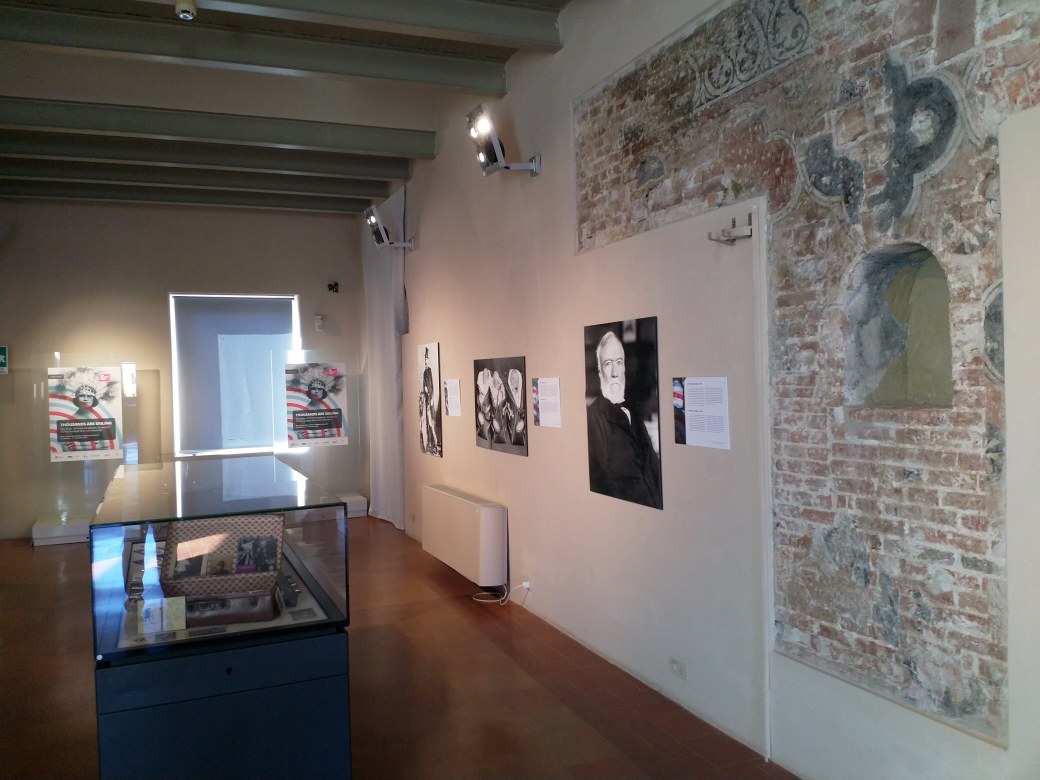
On Friday October 12th the exhibition “Thousands are Sailing” was launched in the Museo della Grafica at the Palazzo Lanfranchi in Pisa. The exhibition is one of the main outputs of the project “Migration in the Arts and the Sciences”, funded by the EC under the Connecting Europe Facilities call “Europeana Generic services 2016”. The call funds projects that want to contribute to Europeana: the main portal to Europe’s cultural heritage.

Pisa1

The exhibition at Palazzo Lanfranchi – photo: Frederik Truyen – CC-BY

This particular project aims at bringing together and at disseminating a collection of digitised materials relating to the theme of migration on Europeana. Several partners contribute new content to this collection: Stichting Europeana (the project coordinator), Stichting Nederlands Instituut voor Beeld en Geluid, Katholieke Universiteit Leuven, Narodowy Instytut Audiowizualny, National Archives of Hungary,  Martynas Mažvydas,  the National Library of Lithuania and Narodna biblioteka Srbije – ustanova kulture od nacionalnog značaja.

The selection and curation is in the hands of KU Leuven, Cultural Studies. Curator Sofie Taes, research assistant at the research unit Literary Theory and Cultural Studies, produced a virtual exhibition and several galleries and blogs on Europeana for the migration theme. She is also the curator of the physical exhibition presented in Pisa.

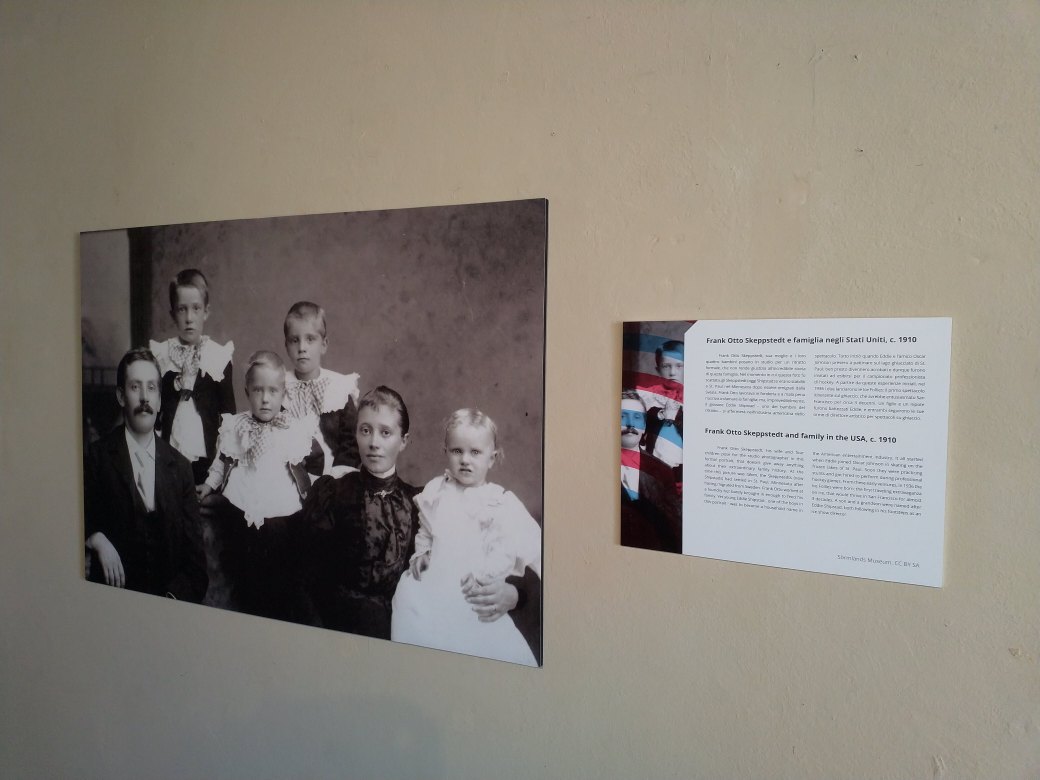
The virtual exhibition “People on the Move” sheds light on how migration has changed the world in six chapters. The first, “Crossing frontiers”, tells the stories of famous migrated scientists, such as Marie Skłodowska Curie and Albert Einstein.  “The land of opportunity”, the second chapter, focuses on migrant workers.  “Mixing traditions” highlights the richness in traditions and culture that migration has brought about, while “Itinerant artists” follows the life of travelling artists. Of course, the “Rising stars” of popular culture deserve their separate chapter.  In “Faces of migration”, the exhibition zooms in on particular stories of individuals and  families whose lives have been heavily impacted by migration.

Pisa2

Frank Otto Skeppstedt and Family in the USA – Sörmlands Museum – CC-BY-SA

In the physical exhibition “Thousands are Sailing” – developed in collaboration with Photoconsortium, the aggregator for photography on Europeana – , the key theme of migration is exemplified in 20 portraits and mini-stories about people’s migration experiences, their motives, hopes and wishes, adventures and accomplishments. The photos are of exceptional quality and have a direct face-to-face appeal. Visitors feel transported in the often precarious but sometimes joyful world of people in their newfound home. At the launch of the exhibition Sofie Taes explained the motives behind the selection and the long journey of discovery to find a set of images that tell a common narrative through individual stories.

Pisa3

Curator Sofie Taes at the opening – photo: Frederik Truyen – CC-BY

With this exhibition, Cultural Studies Leuven continues its work of contributing curated collections and stories to Europeana, in particular to the Thematic Collection on Photography. This effort has recently entered the next stage with the new project “Kaleidoscope: the fifties in Europe”, launched in September 2018.

The opening of the exhibition, which will run until November 11th 2018, coincided with a successful Europeana migration collection day, where citizens were invited to bring an object to share their migration story. We collected a number of very compelling stories which will shortly be published on the Europeana portal!

Pisa4

Collecting objects and stories at the collection day – photo: Frederik Truyen – CC-BY

An Evening with Mike Dibb in Cinema ZED

By Anneleen Masschelein

An Evening with Mike Dibb in Cinema ZED October 10 2018

             Organized by Courtisane and KU Leuven (philosophy, cultural studies and contemporary art history)

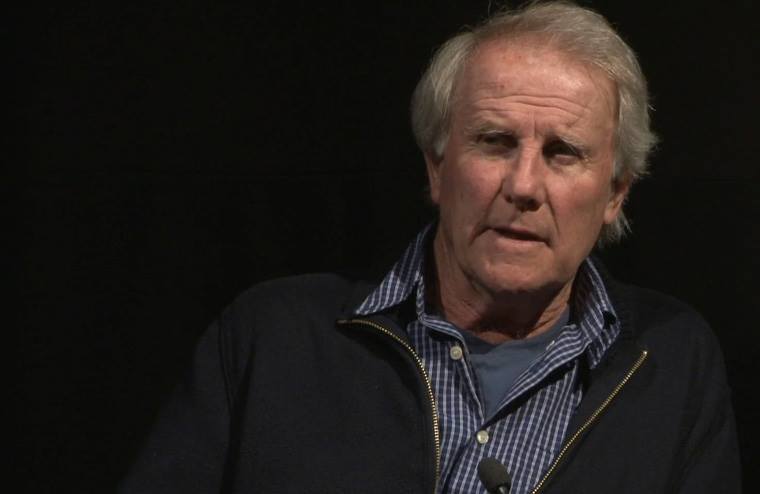
The name Mike Dibb may not immediately ring a bell to younger generations, though his contributions to British television and to British cultural studies cannot be underestimated. Mike Dibb (1940) began his career as a trainee at the BBC in the early sixties and remained there for more than 2 decades as a director and producer for the Music and Arts department, where he made documentaries about literature, music, history, painting and ideas.

Dibb is probably most well-known for the groundbreaking TV series Ways of Seeing (1972) that he made with author John Berger. This award-winning series about the gaze in Western art history and contemporary culture (still available on YouTube) popularized the views of Walter Benjamin for a broad audience. Nearly 50 years old, Berger’s text is still being re-issued time and again by Penguin, but Dibb’s original imagery and playful collages cannot be overlooked. Although Dibb has a healthy suspicion of “academics,” his career testifies to the influence of British Cultural studies in its heyday. In 1976, he made a beautiful, poetic film-essay about Raymond Williams’ classic book, The Country and the City (also on YouTube) and about Beyond Boundaries, the personal and cultural history of cricket, by C.L.R. James, the Trinidadian intellectual. For the BBC, he developed a number of groundbreaking series on ideas, like the notion of ‘play,’ ‘time,’ or ‘drawing.’

In the early 1980s, Dibb left the BBC to work as an independent documentary maker, both for the BBC and for Channel 4. Continuing to explore his lifelong passions – music, literature and history – Dibb also made portraits of some of the defining intellectuals of his time, like oral historian Studs Turkel and literary theorist Edward Said. Dibb typically combines collage with conversation in his work. Sometimes brilliantly original, he also offers a fresh take on very simple forms. His long, in-depth interviews with Edward Said and Stuart Hall, both at the end of their lives, are very moving portraits showing these thinkers doing what they do best: talking in dialogue, extending ideas into the future. We have been able to invite Mike Dibb to STUK in Leuven and will have plenty of time for discussion with him, browsing through fragments of his work. At 20.00, Dibb will also show his latest film, Painted with My Hair, about his search for Donny Johnson, a prisoner who managed to survive more than 20 years in solitary confinement in the US through the discovery of painting.

https://www.cinemazed.be/en/node/4387

Mike Dibb


A Reprint as well as a Novelty: The Castle 2.0

By Jan Baetens

Deprez1

Cover of the first edition

Le Château (“The Castle”) is a two hundred pages mute graphic novel by the Belgian artist Olivier Deprez. First published in 2002, this reinterpretation in expressionist black and white woodcuts of Kafka’s famous novel was immediately recognized as a masterpiece of modern graphic storytelling and had rapidly become a cult album. The longtime out of print status of the book dramatically increased its almost mythical standing, while slowly moving the work from the field of literature to that of visual arts (actually, the only way to access the material was to visit the regular exhibits of Deprez’s work, in Belgium as well as abroad).


The new edition of the book, superbly printed and including some minor edits and a strongly revised cover and flyleaf design, will finally enable a larger audience to discover and appreciate this milestone of the modern graphic novel, radically different from the prototypical features of this kind of narrative.

Deprez2

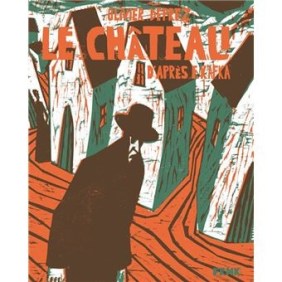
Cover of the new edition

At first sight, one may even have the impression that The Castle rejects most of the elements that distinguish the graphic novel from mainstream comics: no autobiographical voice or plot, no blurring of boundaries between fiction and nonfiction, no attempt to present a narrative that ties in with the daily life and the ordinary concerns of today’s reader. Instead, the book appropriates a very old technique (woodcuts, here directly inspired by the pioneering early 20th Century work by Frans Masereel, the founding father of the wordless graphic novel), and is not afraid of proposing a personal yet faithful adaptation of a literary classic (Kafka’s unfinished novel was only published in 1926, two years after the death of the author).

Yet form and content of Deprez’s work are stunning. The novel’s plot, an endless and open series of waiting and missed encounters, is both cleverly respected and completely reinterpreted in a new way of visual telling. Key in this regard are two elements: first the tension between figuration and abstraction, which appear as two sides of the same coin; second the multiple plays with rhythm, as determined by the fundamental “beat” of the page layout, which generally offers a combination of two large horizontal panels (the notion of “gutter”, the worn-out stereotype of comics analysis which always repeats the importance of the “gap” between panels, is reworked according to the more fundamental logic of montage, the basic unit being the page and the double spread, not the sequentially arranged individual units).

The reading of Deprez’s Kafka book can now finally take a new start. In combination with a series of upcoming exhibits (among them a retrospective at the Wittockiana in Brussels), this new edition will represent a major and lasting contribution to the field of graphic storytelling in print.


Oliver Deprez, Le Château. D’après F. Kafka. Brussels : FRMK

ISBN : 9782390220138

Around the world in 80.000 slides: the Carl Simon collection

By Sofie Taes – PHOTOCONSORTIUM / KU Leuven – CS Digital

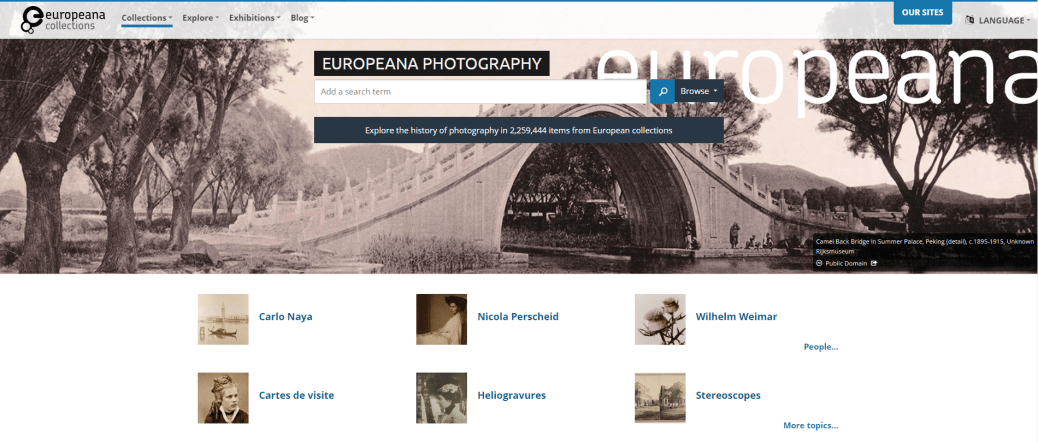
Over the past two years, CS Digital has been partnering up with Europeana – Europe’s most trusted source of digital cultural heritage objects – to promote photographic heritage via the ‘Thematic Collection’ on photography. This subset of photographic records only includes high-quality images, often with a license permitting (free) re-use. Also characteristic to the Thematic Collection are the editorial features that allow for a (re)discovery of masterful photographers, outstanding oeuvres, interesting techniques and previously undisclosed collections.

Working mostly on content selection, curation and online publications, we have been only too happy to embark upon the rollercoaster that is the dive into +2 million early photographs. Because our quest for amazing images, baffling stories and must-see collections has brought on our way a veritable treasure trove of photographic gems and unforgettable characters.
CS1

Europeana Photography Thematic Collection – Homepage

Carl Simon definitely ranges among the latter. Simon (1873-1952) first worked as a procurator at the German photo company Liesegang in Düsseldorf and founded his own photography service company in 1907. He constructed cameras, lent slide projectors and began to collect hand-colored glass slides on a wide array of topics (historical, scientific, geographical, literary, etc).

CS2

A visit to the zoo: the bears Carl Simon United Archives/Archiv Carl Simon. In Copyright

Presenting slide shows with narration and live music eventually became the core of his activities. Simon wanted to show the world to as many people as possible – especially those who didn’t have the means to go and explore themselves –  and put on about 300 shows all across Germany.

By 1945, his collection comprised no less than 80.000 images. After Simon’s demise in 1952, this substantial archive was inherited by his son Karl-Heinz Simon (1920-2002). Karl-Heinz continued to use the material in slide shows, but to the public at large, the collection remained unknown and unseen.

In 2011 – about 6 decades later – the life work of Carl Simon was finally rediscovered in an old storage room in Unterbilk, Düsseldorf (Germany). A year later, United Archives – a photo agency based in Cologne – acquired this unique legacy.

The Carl Simon collection is a most intriguing private archive. Next to 2 original glass slide projectors, 15 lenses and scripts used by Simon in his public presentations, United Archives was able to add c. 23.000 glass slides, arranged in 200 wooden boxes, to its collection.

The range of topics covered by Simon is astonishing: from “Earthquakes and volcanic activity”, “Japan” and “Tibet”, “Faces of Sweden”, “Folk songs” and “Fairy tales”, to “Underwater life”, “A Visit to the Zoo”, “The lives and miracles of the Saints” and “The Dangers of Alcohol”.

Visually, the slides range from child-like drawings to intricate illustrations, photographic images, maps and diagrams. In this image, taken from the ‘Alcoholism’ series, Simon compares the composition of cognac and absinthe in an early example of ‘data visualization’. In a more illustrative style, the ‘metamorphosis’ from healthy young gentleman into inebriated pensioner is depicted here. The worst outcome to be expected, is not left out of the picture show: this etching-style slide shows exactly how a life wasted to alcohol might end…

The compact ‘Tunisia’-series is a beautiful example of a travel report in pictures, with the carefully chosen and applied colors emphasizing the exotic features of the chosen sights. One of the absolute highlights is the ‘Titanic’-story, using a wide range of pictorial styles and touching upon the key points in the narrative, as well as on some intriguing details (ship construction, committee hearing of the ship’s company director, …). In the diptych below, a view of the luxurious dining hall (left) is flanked by a drawing of the wreck at the bottom of the sea.

As a whole, this collection testifies to a media-practice that has transformed significantly over the past few decades. Pitches and presentations often still consist of a well-paced succession of spoken text and visuals (powerpoint, Prezi, ….) yet mostly get reduced to short sequences with an aim to inform or to demonstrate only. Simon’s objective could be best summarized as ‘Bildung’: he wanted to share his finds, his experiences and his stories in a thorough yet engaging manner – an early example of “infotainment” – so as to implant new knowledge with spectators, furthering their level of culture and intellectually empowering them. The written scenarios and the slide projectors add a tactility to his efforts that definitely has a ‘vintage’ feel about it, at the same time underlining his dedication and commitment to the cause.

Thanks to the digitization of this archive, Simon’s mission has now taken on a new, global dimension. Still, our relationship with these glass slides has changed as well: Simon’s archive is no Wikipedia, which we might turn to in search for objective information about a certain person, country or phenomenon. Yet it does provide extremely valuable insights in social conventions and traditions, ethical and aesthetical ideals of the time. So make sure to join us in revisiting Simon’s slides in the Europeana Thematic Collection: we promise it’ll be worth your while.

In a Search of an Oasis

How do we respond to the current ecological issues and how much of environmental consciousness is getting to us? How can we, collectively or individually, improve the natural environment within the city of Leuven? What are the most pollution-free sites in Leuven and how to visit them?

In a Search of an Oasis” is a project created by Cultural Studies Master students Eline Dewaele, Amber Florizoone, Lucie Korbelová and Josef Terlaeken as part of the course ‘Cultural Policy’.

The Faculty of Art’s Erasmus Building is surrounded a by a “literary garden”. Amid the shrubs, trees and occasional flowers, surrounded by a sea of concrete and brick, you’ll find short poems celebrating the beauty of nature. However, the poems paint an idyllic, romanticized, and nowadays old-fashioned understanding of the relationship between human beings and nature.

Hence, we set up to create a counterweight to the “Erasmus Literary Garden” and communicate a less romantic view of nature.

In Search of an Oasis” focuses on the current ecological concerns of the city of Leuven. We have investigated various types of pollution and consequently created an ecological walk in Leuven, displaying the least and the most polluted places in order to find a little “Oasis” within the city of concrete. Moreover, next to an ecological walk that you can physically follow, our booklet contains pages on eco-poetry. This is a kind of poetry that raises awareness of the connection between nature and culture, thus shifting the boundaries between them.

By moving away, physically and metaphorically, from the romanticized idea of nature, we invite everyone to participate in the promotion and facilitation of the ecological philosophy and practice within the city of Leuven.

In search of an oasis

All shades of Brussels. Why So Serious?! – A photo exhibition

Why so serious posterWhat comes to your mind when you hear Brussels? Politics, terrorism, rain? Or Magritte, beer and waffles? We are 5 Cultural Studies Students from KU Leuven who decided to shift the stereotypes about the “heart of Europe” and show the fun side of Brussels. The photo exhibition “WHY SO SERIOUS?!” will be held in the city center from 7th MAY till 24th MAY 2018.
Make laugh, not war

Serious faces on the news, worrying reports from the borders and difficult agreements during the EU summits: the media space makes life in Brussels quite sad. But Belgium and its capital are more than grey skies and grey jackets: the joy of creativity and the unique sense of humor never abandoned this place. Whilst designing the exhibition, we all fell in love with the idea of promoting a positive visual image of Brussels.

How to start?

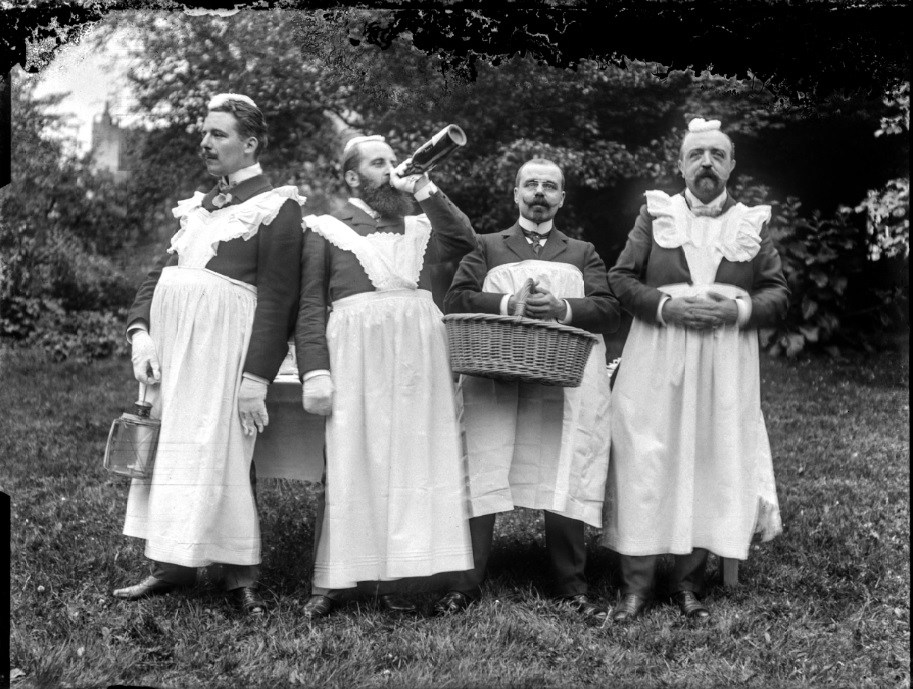
When the initial idea was born, the next step was to dig deeper. And what’s better to dig deeper than jumping into the past: How did the ‘Bruxellois’ have fun 30, 50, 70 years ago? In our quest for the vintage ‘Bruxellois’, we bumped into an immense photo archive – shout-out to EUROPEANA, apparently the place to be when it comes to images. We found photographs that made us laugh: cows in the streets on a leash like they were dogs; well-dressed, seemingly serious men making fun of themselves by jumping over the friend’s back in an elegant suit… No need to say why we wanted to display these pictures.

Why so serious

© KIK-IRPA, Brussel

Competition and the prize

While vintage photographs are a great way to have a look into the past, we realized that  there is much more going on right now in Brussels. We began wondering how we could capture (and display) the fun and humorous side of today’s Brussels, and the answer suddenly presented itself to us: a photo competition. Fun, surreal and completely crazy photos from Brussels’ streets and houses are welcome – anyone can participate. What do you get? To exhibit your picture right in front of the Central Station in the touristic downtown of Brussels. We already received plenty of the most amazing, weird submissions and had lots of fun arguing whether the portable toilet in the middle of the road is more hilarious than the boy carrying a huge zebra on his back. All in all, we are close to the final selection and look forward to seeing your smiles at KU Leuven Campus Brussels very soon!

We willl open the expo with a VERNISSAGE night on the 7th May from 19:00-21:00 where drinks and snack will increase your visual joy of the exhibition.

Do come, have fun and please, don’t forget to reserve your place for the vernissage here: https://www.whysoseriousbxl.com/events/opening-night/form

Riana Musschoot, Margaux Bertier, Elizaveta Dmitrieva,

Mira Caroen and An-sofie Tratsaert


Why So Serious?!

https://www.whysoseriousbxl.com/

FB: https://www.facebook.com/whysoserious.bxl/

Instagram: https://www.instagram.com/whysoserious.bxl/


Address

KU Leuven Campus Brussels

Rue Montagne aux Herbes Potagères 26, 1000 Bruxelles


Dates & Hours

7-24 May

7:00 – 19:00 Monday-Thursday

7:00 – 18:00 Friday

Closed during weekends and public holidays

Robert Doisneau at the Musée d’Ixelles

By Laura Smith

The French twentieth-century photographer Robert Doisneau has become synonymous with his image of Le baiser de l’hôtel de ville (1950), which shows a mise en scène of a couple embracing amidst the street’s hustle and bustle. Fans of Doisneau, or simply visitors of Paris, will recognize many of his black and white photographs from their popular postcard form, most notably his series of café scenes, scenes of daily life, of artists and children. The exhibition, now on at the Musée d’Ixelles, displays both classic and many lesser-known images of his black and white collections spanning roughly 1930-1970, alongside vibrant colourful photographs of Palm Springs, California in the 60’s.

Doisneau

The museum’s interior architecture, which allows for visits of a circular flow, supports the exhibition’s three movements; Le Merveilleux quotidien, which displays photographs including FFI au repos (1944) and La dernière valse du 14 juillet (1949), images of cafés, marriages, and glimpsed moments; Palm Springs 1960, a collection produced for the February 1961 issue of Fortune magazine that shows, in bright blues, yellows and soft pinks the leisure life of Americans on the golf course and by the pool side, and Ateliers d’artistes, which allows for a view inside the studios of Picasso, Utrillo, Giacometti, Le Corbusier and many others. Particular delights from this last section include Tinguely – portrait de l’artiste (1959) and Niki de St Phalle (1971). For Doisneau fans, this exhibition is a chance to see gems from his collection (L’Atelier Robert Doisneau) and to discover unknown, surprising and impressive works by the artist. For those looking to get acquainted with the photographer’s work, this exhibition displays his ability to capture moments of socio-historical importance and the lifestyle of the everyday in Paris and Palm Springs. While the shift from the American golf course to the Parisian atelier at first felt like a cliché new-world/old-world dichotomy, the juxtaposition between the classic iconic black and white images with those vibrant photographs of Palm Springs—the latter of which is set against a wall of bubble-gum pink—highlights a continuity of striking composition and an attentiveness to daily gestures that connects such diverse contexts. Both the fan and the discoverer of Doisneau’s work come away from this exhibition with a renewed sense that it is in the mundane everyday that one catches glimpses of the joy, the humour, and the theatricality of life, if we are attentive. I myself found a new favourite image in, Fête à la maternelle de Gentilly (1934).

The Doisneau exhibition is on now and runs until 04.02.2018 at the Musée d’Ixelles (rue Jean Van Volsem 71, 1050 Bruxelles).

Links:
http://www.museedixelles.irisnet.be/
https://www.robert-doisneau.com/en/atelier/


J.R. Carpenter’s ‘The Gathering Cloud’

By Jan Baetens

J.R. Carpenter
The Gathering Cloud
Axminster, Devon: Uniformbooks, 2017, 112 p., 12 pounds
ISBN 978-1-910010-50-0
(website: http://luckysoap.com/thegatheringcloud/)

Gathering cloud.png

In the field of electronic literature, the name of J.R. Carpenter, a Canadian-born multimedia artist, writer, researcher, and performer, is since many years a major reference. The publication of The Gathering Cloud, a hybrid work that not only combines print and digital creation but includes also other forms of textual communication such as performances, lectures and exhibitions, is an important new step in her work, which should enable this writer to find a larger audience –and at the same time to bring that larger audience to the new media practices that are still considered relatively marginal or alien to literature in general.

The Gathering Cloud is a hybrid creation in a twofold sense. First, because it combines in a nontrivial way online and offline elements, as a kind of “indie” version of what the cultural industry calls “transmedia storytelling”. Second, because it is itself, in each of its mediatic avatars, a mosaic of genres and modes –in this case of essay and poetry, and also of word and image. Taking as its starting point the encounter of something very concrete and literal (cloud formations and the many ways to label and identify them) and something very abstract and metaphorical (cloud computing), J.R. Carpenter rethinks the history of both elements, offering a poetic rewriting of the history of man’s attempts to fix in words and categories what radically exemplifies the idea of mobility, namely real clouds, on the one hand, and addressing the multiple implications of envisioning the digital networks in terms of clouds, on the other hand. She thus intertwines literature, media history, and ecocriticism, clearly showing the impact of poetic creation on digital theory as well as the necessity to stop thinking on literature as having no relationship at all with actual social, environmental and political issues.

More generally speaking, The Gathering Cloud is much more than just another example of the ongoing trend to bridge the gap between fiction and document in literary writing. It is also an innovative case in the age-old dialogue between science and literature, which strikes the right balance between the singularities of each field (science is not reduced to a mere literary theme; poetry is not used in order to vulgarize science). Like Christian Bök’s Crystallography (1994, revised 2003), it is part of a newly emerging canon of art and science creations that help reshape the fundamental unity of the humanities.

Photo-Lit – The Belgian photo novel

By Clarissa Colangelo and Jan Baetens

20170623-100332_p2

In May, “PHOTO-LIT – The Belgian photo novel: local reuse of a European cultural practice“, a research project funded by the BRAIN-be framework, has started; today its website is online: www.photolit-brain.com.

The photo novel is a form of visual narrative with staged photographs, generally printed in magazine format, and was the dominant popular form in postwar pre-television Europe.

At the crossroads of film-novel, comics, melodrama, and serialized romance, the presence and impact of photo novels were unequalled, and its adaptations and re-appropriations in later periods remain an exceptional example of the dynamics of creativity and heritage, where they instantiate the visual turn in the transformations of reading and writing today.

Bonnes-Soirees-555x724

The Belgian contribution to the photo novel, important and very diverse, has been completely overlooked by the existing scholarship. In a joint effort, professors and PhD students of KU Leuven (Jan Baetens, Fred Truyen and Clarissa Colangelo) and of ULg (Michel Delville, Luciano Curreri and Valentina Duminuco) together with professionals from KBR (among which head of digitization Frédéric Lemmers) will study the Belgian photo novel and disclose its form, meaning, relevance and history as an exemplary case of modern heritage in the era of mass media culture and technological modernization.

Don’t miss out on this new, exciting project: surf to our website and subscribe to the newsletter to follow our research and be updated on our future discoveries!