By Jan Baetens
Jean-Christophe Menu
Krollebitches. Souvenirs même pas en bande dessinée
Brussels: Les Impressions Nouvelles, 2017, 176 p.
978-2-87449-456-7
 Jean-Christophe Menu is one of the major voices of alternative comics in France, both as an author and as the co-founder of L’Association, the leading publisher of French comix in the period of his 20 years editorship (he resigned a couple of years ago). He is above all a living paradox: the angry young man of the French bande dessinée scene, he is also the holder of a PhD on the subject (moreover an excellent one, frequently used and quoted in academic research: La Bande dessinée et son double, 2011); the living example of authentic visual thinking, he is also an author who does not make any real distinction between his drawings and his writings. His new book is the perfect yet open synthesis of all these forces and tendencies.
“Krollebitches” (literally: small curls) is a neologism coined by the Belgian comics artist Franquin that refers to what in English is called “emanata”, the small but highly significant symbols that can surround characters in comics and that represent either a movement (speed lines) or certain states of mind (surprise, interrogation, bewilderment, etc.). These “krollebitches” are one of the most typical features of comics as an art of drawing and as such they are the perfect title for a book that aims at disclosing both the specificity of comics as a visual language and the passionate relationship between maker and work as well as between work and reader.
Krollebitches is a vital contribution to comics culture for many reasons. In the first place, it is an autobiography of one of the decisive figures of alternative comics of the last 25 years, who succeeded almost single-handedly to bridge the gap between underground comix and traditional publishing without ever abandoning the creative vitality of the punk spirit. Autobiography in comics has become a cliché nowadays, due to the autobiographical turn of the graphic novel and the rising market of interview books. Krollebitches, however, offers something else: not a graphical novel, but a real text, complemented –rather than illustrated– by a permanent flow of perfectly appropriated emanate (the author himself has been in charge of the book’s layout, which is a stunning example of clever layout). Moreover, the book is not the work of an interviewer or a ghostwriter, but of the artist himself, who proves to be as efficient and surprising a writer as a visual artist. In addition, Krollebitches does not claim to tell it all: it focuses on the formative years of Menu, and one will notice that these years start early since the author was already reading comics before he could actually read. In that sense, the book is an astonishing but very authentic and convincing tribute to some old masters –I already mentioned Franquin, but Menu’s knowledge of the field is breathtaking and his tastes are much more eclectic than one might suppose.
Yet next to the documentary value of the book, which is an ideal introduction to the world of comics as seen through the eyes and the personal experience of a great artist, Krollebitches is also an exceptionally well written piece of literature. Menu is in perfect command of his very direct as well as sober style, which exemplifies the surprisingly classic ideal of “aptness”, and this applies to everything in this book: vocabulary, syntax, rhythm, word and image interaction, touch and feel of the object.
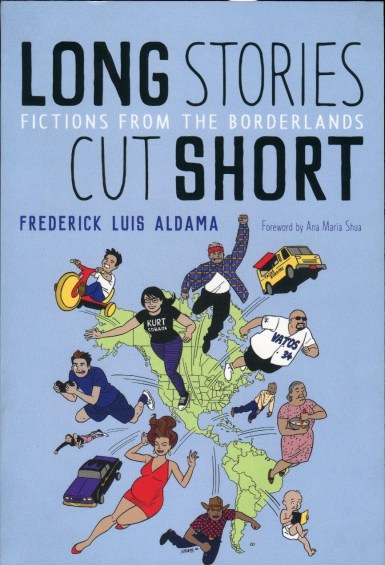 without any concession to the naïve and sentimental utopias that continue to litter our perception of the harsh reality. Aldama’s prose is in your face and Long Stories Cut Short is amongst the most depressing books one can imagine. A welcome reply to all romantic views on the land of milk and honey (“She might be able to go home, the doctor announces. /He can only think: Hurry up and die.”, p. 171).
 They are instead screenplays, but screenplays that explicitly present themselves as unfilmable –less in the sense of parodies of screenwriting (this is what Boris Vian will do twenty years later in his fake scenario for the adaptation of I Will Spit on Your Graves) than as attempts to materialize the abstract idea of the ruin of all things solid in an era whose muse was destruction.

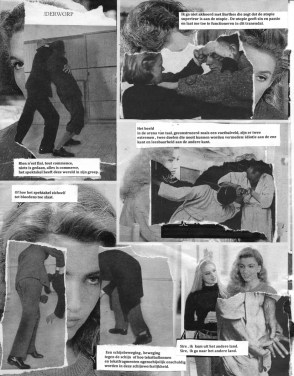 All this to say that I was cruelly disappointed by two recent “new” works, which both claim a certain form of novelty, if not avant-garde aura, but which rapidly collapse in light of the longer history of their art: first “Roman”, a parodic collage (mindlessly labeled “graphic poem” by the journal that devotes a special issue to the newest kid on the graphic novel block) by Luc Fierens (a Flemish artist enthusiastically embraced by the in-crowd as a representative of the post-neo-avant-garde); second Carpet Sweeper Tales, an equally parodic photo-cum-captions collage by Julie Doucet (best known for the feminist punk comics she published in the 1990s).
 and much harder and harsher forms– of parody in the pale and dull remakes by Fierens and Doucet that prove disappointing. No mention here of the Situationnist détournements, those for instance by Marcel Mariën who already in the 60s critically appropriated the aesthetics and ideology of the photonovel. No mention either of Barbara Kruger’s later attacks on consumer society through the combination of photographs and overlaid stereotypical statements. And one could go back to Surrealist Max Ernst (whose collage picture novels are now being reissued) or the political art of John Heartfield –the list is almost endless (in the comics field, why not remember Art Spiegelman’s early collages or the many constrained works produced by the Oubapo group and their many sympathizers).

 Schlanger’s newest book, Trop dire ou trop peu. Essai sur la densité littéraire (Paris, Hermann, 2016) addresses a question that no one who takes writing seriously can ever avoid: Where do I stop? How can I be sure that I have said enough (for to say more would be a bore to the reader)? And how do I know that I have to say something more (for if I don’t my reader will discard my text as opaque or incomprehensible). Very simple questions, but real questions, which can never be fully answered.


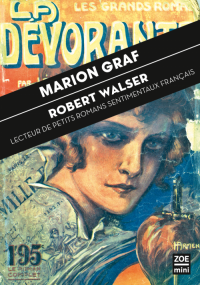 So please read the short essay by Marion Graf on Walser as a romance-reader, and try to do yourself with your bad readings what can be discovered in the examples in the second half of the book, a brief anthology of Walser’s creative reviews. It’s a small and inexpensive book, so you can keep it away from the eyes of those who want you to read Middlemarch or the complete works of Milton.
 Cultural Studies Leuven