Another way of telling

By Jan Baetens

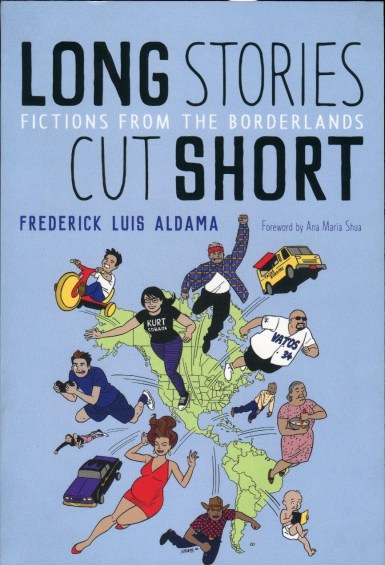
On: Frederick Luis Aldama, Long Stories Cut Short. Fictions From the Borderlands (Tucson: Arizona University Press, 2017, ISBN: 970816533978)

Long Stories Cut Short. Fictions From the Borderlands is an amazing book and probably also the most direct, honest and useful book that I’ve recently read. Content-wise it looks very simple: a collection of “flash fictions” (ranging from the one-sentence fictions à la Augusto Monterroso to very dense, but always very legible, one or two page stories) on the “Latino experience” (that is the bilingual and bicultural life of those crossing all kind of borders from South to North in a multimedia and multilayered world),Long stories cut short without any concession to the naïve and sentimental utopias that continue to litter our perception of the harsh reality. Aldama’s prose is in your face and Long Stories Cut Short is amongst the most depressing books one can imagine. A welcome reply to all romantic views on the land of milk and honey (“She might be able to go home, the doctor announces. /He can only think: Hurry up and die.”, p. 171).

At the same time, the book is a great example of what literature today can or should be: an attempt to shape –which signifies: reshape–  modern life with modern means. Aldama thus brings into dialogue form and content: his borderland prose is not a matter of themes, it is also a matter of textual materiality, his book offering all fictions in two versions (English and Spanish, with no hierarchy between – they are independent and equal versions of each other) as well as in two media (the Chilean Mapache Studios have illustrated in comics style for most of the stories, and this image becomes a mirror story itself). Moreover, the author –a well-known specialist of narrative studies, who has the courage to start writing himself (like many others, he could have made a career by writing fifty articles on free indirect style in Jane Austen) – manages to change the genre he explores. His flash fictions do not only push the genre beyond its usual limits (the diversity of tones, styles, techniques and scopes is impressive), they also offer a complete rethinking of the nature of flash fiction once it appears in a collection. For Long Stories Cut Short is much more than a book of very short stories, it is an encyclopedia of the borderland experience. It does not rely on simple tricks such as the recurrence of characters and places in various stories –an easy way to bridge the gap between the part and the whole–but rather it manages to build a world in which the parts do not fit together –as they don’t in the real world either.

Cultural Studies and Digital Humanities

By Fred Truyen

2024907_photography_ProvidedCHO_Generalitat_de_Catalunya__Arxiu_Nacional_de_Catalunya_ANC_1_994_N_664

Final d’oracio de la V sèrie Caps d’estudi | Artigues i Carbonell, Joan – Generalitat De Catalunya. Arxiu Nacional De Catalunya

Digital Humanities is an area of study involving the use of computers and computational methods in the various disciplines of the humanities. It is also a critical analysis of the impact of technology on culture. Certainly in regards to the latter the field of Digital Humanities is often close to Cultural Studies, of which it borrows key concepts such as ‘intersectionality’ or ‘remediation’.

But also in the first range of activities, pertaining to the use of computational methods in the humanities, there are many ways in which Cultural Studies is affected by the developments in Digital Humanities. One such field is the digitization of Cultural Heritage, a domain we have been very actively involved in here in Leuven.

In the project EuropeanaPhotography, we contributed over 450.000 images of early photography to Europeana, a project involving 14 partners from different European Countries. For Leuven, there were two different tasks: on the one hand the Digital Lab digitized over 20.000 images from our art historic pedagogical collection – with art historians at the University Library providing the descriptive metadata; on the other hand we coordinated the overall project and curated the exhibition “All Our Yesterdays”. The photographs offer both professional as well as amateur photography from 1839 to 1939. Digitizing early photographs brings to life the many reflections in classic texts from authors such as Walter Benjamin, Susan Sontag and Roland Barthes, which are part of the canon of Cultural Studies. It also reveals that digitization is not making merely a copy but actually amounts to what should be called ‘re-photography’.

screenshot2.png

As a sequel to this project we just finished – successfully, it got an excellent rating by the reviewers! – Europeana Space, a project with a very different aim, which brings us even closer to Digital Humanities activities: the creative re-use of cultural heritage content. So, a venture from re-photography to re-use.14808513761496536

It involved, for a number of cultural practices such as Photography, Publishing, TV, Games, Dance and Museum exhibitions, a cycle entailing: development of a pilot demonstrator and re-use tools; organising a hackathon with students, GLAM professionals and developers to exploit these tools; and going with the winning teams through a business modelling workshop and monetizing event. The photography pilot we ran features applications that bring old photography to life in new ways, such as augmented reality overlays, touristic guides or interactive viewers such as MuPop. That a student of Cultural Studies who teamed up with a computer scientist actually was one of the winners of the photo hackathon convinced us even more that a fruitful marriage of Cultural studies and Digital Humanities could yield new venues in our research.

As Digital Humanities always implies a practical component of actually applying digital techniques, the Europeana Space MOOC hosted by KU Leuven offers amateurs and professionals alike the opportunity to try it out – you can have a look at our “tell your own photo storydscf5752 developed in collaboration with LIBIS, our natural partner in Digital Humanities! Offering these digital humanities experiences in higher education doesn’t stop with this MOOC however. Cultural Studies Leuven is also contributing to the KU Leuven MA in Digital Humanities programme, a Master-after-master degree targeting holders of a Master’s degree in the humanities, who want to take this next step in applying computational techniques by actually getting a serious in-depth training in programming. Cultural Studies contributes its Online Publishing course to this Master programme, which has, besides an introductory course in the field of Digital Humanities, a course on programming in Python (Scripting Languages) and a course on Information Structures and Implications. Now that this programme is in its second year and we already have successful graduates – some of whom are now pursuing Phd’s here and at universities abroad – we can say that it actually reaches its goal to offer students with a solid humanities background, such as the MA students of Cultural Studies, the necessary training and background to program their own solutions and applications. It allows for novel ways of doing humanities research, with an experimental touch. Have a look at what of some of the former students of the MA have to say!

MA DH 2.png

Benjamin Fondane or the Unfilmable Scenario

By Jan Baetens

fondane-2

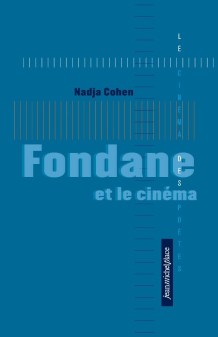
Nadja Cohen, Fondane et le cinéma – Paris, ed. Jean-Michel Place, 2016, 112 P., 10 euros

When new media appear, McLuhan argues, they tend to absorb old media, the latter surviving as “content” of the former. Yet if the medium is the message, as McLuhan’s still challenging slogan claims, this meaning does not only rest on its capacity to supersede an older medium. It has much more to do with the global transformation of the mediasphere that it both disrupts and reshapes and, more generally, with our interaction with the world, which is always medium-based.

Hence the importance of new media theory and practices that try to take into account this larger environment, instead of focusing on fetishlike gadgets or the mere pleasure of the novelty for novelty’s sake. One of the key aspects of the modern media environment is the acceleration of history and the subsequent impossibility to rely on stable media structures.

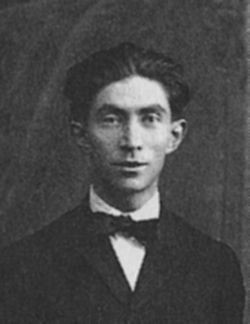
Nadja Cohen’s new contribution to the film and literature debate, after the superb Les Poètes modernes et le cinéma: 1910-1930 (Garnier, 2013), is part of this broader reflection on media change as seen through the lens of Benjamin Fondane (1898-1944). A post-Dada poet and artist, Fondane has elaborated around 1930 a very special kind of literary genre, somewhat uneventfully called “film-poem”, that pushes the new spirit of velocity and impossible stasis to its utmost limits. Fondane’s film-poems are not poems “on” film or “inspired” by cinema, nor are they examples of poetic cinema (whatever this term may signify). fondaneThey are instead screenplays, but screenplays that explicitly present themselves as unfilmable –less in the sense of parodies of screenwriting (this is what Boris Vian will do twenty years later in his fake scenario for the adaptation of I Will Spit on Your Graves) than as attempts to materialize the abstract idea of the ruin of all things solid in an era whose muse was destruction.

Nadja Cohen’s study offers a brilliant contextualization of the figure, the work and the thinking of Fondane, often discarded as a minor Surrealist. It also contains excellent close-readings of some of his film-poems, while astutely exploring Fondane’s lesser known visual collages that are the flip side of his writing production. But above all it, is a marvelously written book, which belongs to the shelves of all poetry and film lovers.

Flamenco, as it “really” is

By Jan Baetens

Flamenco culture, which includes cante (singing), toque (guitar playing), baile (dance), jaleo (vocalizations), palmas (handclapping) and pitos (finger snapping), but which is also inextricably linked with other fields of culture such as poetry and tauromachy (remember Hemingway’s Death in the Afternoon? Still the best possible introduction to this complex cultural network) – all of them having to do with the untranslatable notion of “duende” – is known by most of us as a form of “folklore”. It is therefore virtually highly suspect, given the problematic status of notions such as “authenticity”, the “popular”, “spontaneity”, the “people”, etc.

colita-1

It would be absurd however to deny that “real”, that is both profound and authentic art (but of course the concept of “art” is no longer appropriate here, since the very boundaries between life and art do no longer apply), no longer exists in a modern, mass-media saturated society in which the idea of community has become a caricature, and that it cannot resist and survive the commercial and ideological appropriations that can be made of it. The question is then: how to communicate the “experience” of such an art?  As already argued by John Dewey in his famous book Art as Experience (1932), an often forgotten forerunner of cultural studies, the only way of knowing such an art is byway of experience.

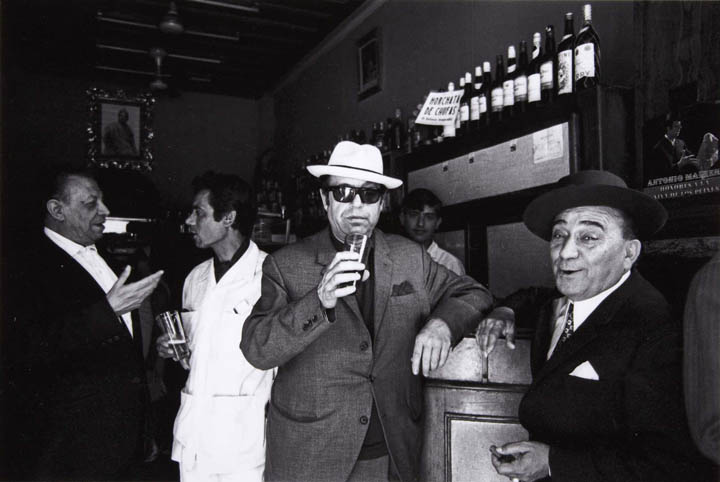
colita-2If you travel to Granada this Spring, don’t go to one of the flamenco shows that litters the touristic areas of the city. Forget about them, and go immediately to the Alhambra; more precisely, the photography exhibition curated by Concha Gόmez (professor at the Carlos III University in Madrid). This exhibition offers an amazing retrospective of the work of Colita – artist name of Isabel Steva (°1940) – one of the first professional female press photographers in Spain who has always been fascinated by the world of the gypsies and flamenco. Speculations on the misrepresentation of real and authentic culture immediately vanish when entering the exhibition, which is a model of great photography as well as curatorial intelligence. What makes the experience so strong is the complete coincidence of the various levels of mediation. One witnesses for example the intimate knowledge of the culture the artist wants to represent (the photographer is not an outsider of the flamenco culture). Furthermore, the curator has built a strong personal relationship with the photographer, as shown by a wonderful filmed interview in the exhibition which refrains from overloading the images with all kinds of didactic captions. There is a strong awareness of the historical and political complexities of flamenco, a longtime marginalized art, created by marginalized people. One cannot therefore simply document flamenco from the outside or by detaching it from the rest of a living culture where current ideas on art prevent us from seeing and feeling what is really happening. An additional level of mediation is the perfect capacity of disclosing the “duende”, the epiphany (?), with an economy of means that is shared by the flamenco artist, the photographer and the curator, and finally, the desire to not only focus on the exceptional value of masterpieces (although neither Colita nor Gόmez tend to hide the empowering presence of exceptional figures).

It is a good thing to be skeptical about “authenticity”, for it is the best way to experience it when it is really “there”.


COLITA FLAMENCO. El Viaje sin fin/Journey without End

Curator: Concha Gόmez

(Alhambra, Palace of Charles V, Jan. 26 to May 6, 2017, free admission)

STUDY DAY: SCREENWRITING, RESEARCH AND STEREOTYPES

Bozar – 09.12.2015 | 14:00 – 19:00 http://www.bozar.be/en/activities/121469-study-day-screenwriting-research-and-stereotypes

(Anglais – Engels – English)

FR En tant que média de masse, la télévision a un rayonnement très large. Bon nombre de séries télévisées de qualité et à succès font référence à l’histoire ou à des débats contemporains, et se basent sur des recherches approfondies pour créer des histoires convaincantes et des univers narratifs captivants et réalistes. À l’occasion de cette journée, nous souhaitons examiner le genre de recherches entreprises par les scénaristes pour créer des univers crédibles pour les séries. Nous désirons également questionner la recherche académique sur la télévision contemporaine. Dans quelle mesure la télévision renforce-t-elle ou conteste-t-elle les stéréotypes dominants (groupe ethnique, genre, sexualité) ? Les séries aspirent-elles à répondre aux problèmes sociopolitiques contemporains et à les influencer ? La culture télévisée contemporaine est-elle diversifiée, tant sur le plan de la production que de la représentation ? Quelles stratégies s’avèrent efficaces pour stimuler la diversité de manière crédible, tout en attirant de vastes publics ? Comment des récits locaux peuvent-ils toucher un public mondial ?

NL Als massamedium heeft de televisie een groot bereik en een grote aantrekkingskracht. Veel succesvolle televisieseries behandelen de geschiedenis en hedendaagse debatten, en steunen op heel wat researchwerk om goede verhalen met pakkende, realistische achtergronden te brengen. In dit gesprek belichten we welk soort research van scenaristen leidt tot boeiende werelden voor series en plaatsen we die research tegenover academisch onderzoek naar hedendaagse televisie. In welke mate bevestigt of weerlegt de televisie de gangbare stereotypes (ras, gender, seksualiteit)? Koesteren series de ambitie om hedendaagse politieke en sociale problemen aan te snijden en te beïnvloeden? Hoe divers is de hedendaagse televisiecultuur, zowel wat betreft de productie als de representatie? Wat zijn efficiënte strategieën om op een geloofwaardige manier diversiteit te stimuleren en toch een breed publiek aan te spreken? Hoe kunnen lokale verhalen en achtergronden een veel breder publiek aanspreken?

EN As a mass medium, television has a great reach and appeal. Many successful quality television series refer to history and contemporary debates, and use a lot of research work to create good stories and compelling, realistic story worlds. In this panel, we want to examine the kind of research that is done by screenwriter sin order to create strong series universes and enter into dialogue with academic research on contemporary television. To what extent does television both confirm and challenge prevailing stereotypes (race, gender, sexuality)? Do series aspire to address and also influence contemporary political and social problems? How diverse is contemporary television culture today, both on the level of production and on the level of representation? What are effective strategies to stimulate diversity in a credible way and still appeal to broad audiences?  How can local stories and histories affect global audiences?

14:00 > 15:00 Frederik Dhaenens (BE) How (not) to represent sexual diversity: From queer over normal to normative

FR Depuis le 21ème siècle, les personnages lesbiens, gays, bisexuels ou transgenres (LGBT) ne sont plus absents ou représentés comme des stéréotypes monodimensionnels dans les séries télévisées. Pourtant, les représentations actuelles sont toujours élaborées pour correspondre au discours occidental normatif dominant sur le genre et la sexualité. Dans cette conférence, je montrerai les différentes manières de représenter des personnages LGBT et expliquerai pourquoi certaines d’entre elles peuvent être considérées comme stéréotypées ou offensantes alors que d’autres sont transgressives et dans l’esprit queer.

NL Sinds de eeuwwisseling zijn LHBT personages in televisie series niet langer afwezig of gerepresenteerd als eendimensionaal, betreurenswaardig of stereotiep. Toch zijn vele van deze representaties gevormd om te passen binnen het dominante, normatief discours rond gender en seksualiteit in de Westerse beschaving. In deze lezing zal ik de verschillende wijzen van voorstelling  bespreken en argumenteren waarom bepaalde representaties stereotiep en aanstootgevend zijn en andere transgressief en zonderling.

EN Since the turn of the twenty-first century LGBT characters are no longer absent or represented as one-dimensional, deplorable or stereotypical in television series. Yet, many of these representations are shaped to fit the dominant and normative discourses on gender and sexuality in Western societies. In this lecture, I will demonstrate the diverse ways used to depict LGBTs and argue why some representations can be considered stereotypical and offensive and others transgressive and queer.

 15:00 > 16:00 Bridget Conor (UK)  ‘It’s getting better’: Debating and researching inequalities in television production studies

FR Lors de cette discussion, Bridget Conor abordera quelques-uns des débats actuels dans la recherche académique, l’élaboration des politiques et la couverture médiatique, à propos des inégalités dans l’industrie culturelle. Elle se penchera en particulier sur la façon dont ces débats transparaissent dans les productions télévisées, en s’appuyant sur ses propres recherches en matière d’écriture scénaristique, de genre et de travail de création.

NL In dit gesprek zal Bridget Conor het hebben over de huidige debatten in het academisch onderzoek naar, de beleidsvorming rond en de mediabelangstelling voor ongelijkheden in de culturele industrieën. Ze zal vooral nader ingaan op de manier waarop deze debatten in televisieproducties worden gevoerd, steunend op haar eigen onderzoek naar scenarioschrijven, gender en creatief werk.

EN In this talk, Bridget will discuss some of the current debates in academic research, policymaking and media coverage which focus on the problem of inequalities in the cultural industries. She will particularly focus on how these debates play out in television production, drawing on her own research on screenwriting, gender and creative labour.

16:30 > 17:30 Keynote Nicola Lusuardi Make it Original. Aesthetical research and innovation in new serial storytelling

FR Depuis 1990, Nicola Lusuardi travaille comme auteur dramatique pour différentes sociétés de production ainsi que comme scénariste, script doctor et superiveur pour les chaines de télévision  RAI, Mediaset, Sky. Il est également consultant  et tuteur au TorinoFilmLab-Interchange  et au Biennale College

NL Nicola Lusuardi werkt sinds 1990 as voor verschillende productiehuizen als story editor en voor televisie netwerken als RAI, Mediaset, Sky. Hij werkt ook als consultant en leraar in TorinoFilmLab-Interchange  en Biennale College.

EN Since 1990, Nicola Lusuardi has been working as a playwright for several production companies and as a screenwriter, story editor and supervisor for television networks RAI, Mediaset, Sky. He also works as a script consultant and tutor in TorinoFilmLab-Interchange and Biennale College.

17:30 > 19:00 Round table Researching Arena Through Characters

With Chris Brancato (Narcos, USA), Nicolas Peufaillit (Les revenants, FR), Helen Perquy (Quiz me Quick, BE) and Nicola Lusuardi (1992, IT), Bridget Conor (UK)
 

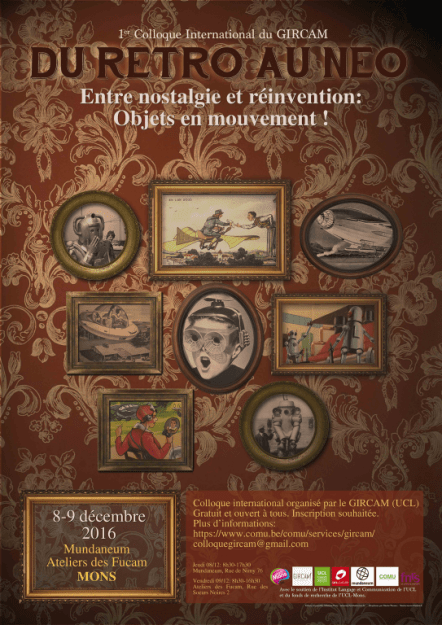
Between Neo and Retro: a conference on nostalgia and reinvention

By Jan Baetens

Today, objects are no longer made to last: their vital (sic) mode of existence is that of obsolescence, for throwing away and replacing all that exists is what makes the world and the economy make go round. At the same time, vintage, nostalgia, recycling are everywhere, and no less present than amnesia, even within digital culture (which would be nothing without skeuomorphs, i.e. derivative objects that retain ornamental design cues from structures that were necessary in the original).

affiche_colloque-smallOn 8 and 9 December, the UCL based research group GIRCAM (a French acronym that refers to the study of cultures “on the move”) organizes a conference on this key issue. The venue is Mons (and as all readers of this blog already know, any opportunity is good to visit this wonderful city), and the diversity of the program is exciting.

All details can be found here and admission is free. Don’t miss the opportunity to hear about the hidden connections between hockey (collectors) cards and houseboats, aquariums and zeppelins, audio- and videocassettes and mooks (and why not also moocs, today’s hype, tomorrow’s nostalgia item).

Back to the future! Be there!

Old Books, New Ideas

By Jan Baetens

Axel’s Castle, an essay by Edmund Wilson on the living literature of its time (the book was published in 1931 and never out of print) is a thrilling read. The subject has everything we can imagine to bore us today: we know, or think we know, what the good modern writing of the first decades of the 20th Century was; the literary essay is no longer a genre with great sex-appeal; the authors under scrutiny are literary monuments that frighten us (Yeats, Valéry, Eliot, Proust, Joyce, and Stein) and what to think of a book that aims to construct a canon, something of which we are now afraid?

Nevertheless, everybody should read this book.

First, is better to address issues of canon formation in an open and direct way, rather than thinking that one can get rid of canons by ignoring them. This applies to literature as well as any other art: without the much criticized institution of the canon, that ultimate example of symbolic power, the power issues and stakes in critical debates remain as fierce as always, and the way they are discussed becomes even more violent and arbitrary. Hence the necessity to shift from emotional to rational criteria, which is always inspiring: if this or that is good, it is not because I like this or that, but for this or that reason.

Second, because it helps us understand that the making of a canon is not the result of the taste of those in power and the subsequent refusal of all the rest. A canon is always multilayered, it may start from the present but look always over its shoulder (each canon results of a struggle of the past, whose traces remain) as well as ahead (the choice of this work or author rather than that one is always risky business and those who try to build canons are perfectly aware of that). In this case, the history of modernist literature is projected onto the age-old dichotomy between romantic and naturalistic tendencies: Modernism appears when Realism has run out of steam, but it does not come back as a farcical return, dixit Marx, of what had been superseded by Realism, namely Romanticism.

Third, because a canon is never a dead object. It is always in the making, and each use, abuse, appropriation, re-appropriation, expansion or continuation involves a passionate debate on the what and the why: what do we want to keep for the future, and why precisely this item or author? This essential stance forces the canon-maker (and later the gunner who will use the canon outside the cultural arsenal, in real life) to make sharp distinctions between failure and achievement, not between authors and works, but within them. Wilson is outstanding in this respect: Ulysses is a masterpiece, but the Lotos-Eaters chapter suffers from serious flaws, while other chapters can quietly be skipped. Stein revolutionizes language, but please reader: do stop after reading five pages. We like Yates, but what a hodgepodge of silly Celtic abracadabra in much of his works, etc.

What Wilson is doing is no longer accepted today. We have become suspicious of canons and even more to canon-making. At least that is what we proudly but stupidly believe. Reading Wilson’s criticism in action, a practice that combines what we are no longer capable of practicing simultaneously, namely creative writing, theory and criticism, should be a great lesson for us.

Faking It? On the pseudo of much neo

By Jan Baetens

Despite all the talk on the end of modernism, our basic cultural regime is still that of the new: what is new is good, the newer is always better and the best is yet to come. The craving for novelty and innovation is definitely worthwhile (after all, it is not easy to find something really new: an original idea is as difficult to find as a good man). Yet the pressure to come up with something different, that is something not yet known to the public, often clashes with the complexity of culture’s history. In many cases, the so-called new, next to be forgotten tomorrow, has already been seen and forgotten many times before. In short: only the flaws of our cultural memory and the excessive emphasis on the present’s creative destruction prevent us from taking a more critical stance toward so-called innovations or experiments.

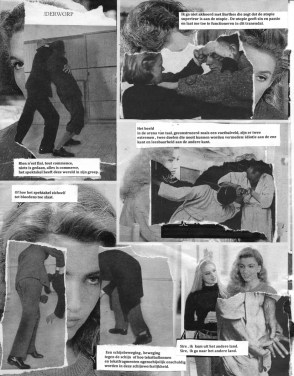
roman-1All this to say that I was cruelly disappointed by two recent “new” works, which both claim a certain form of novelty, if not avant-garde aura, but which rapidly collapse in light of the longer history of their art: first “Roman”, a parodic collage (mindlessly labeled “graphic poem” by the journal that devotes a special issue to the newest kid on the graphic novel block) by Luc Fierens (a Flemish artist enthusiastically embraced by the in-crowd as a representative of the post-neo-avant-garde); second Carpet Sweeper Tales, an equally parodic photo-cum-captions collage by Julie Doucet (best known for the feminist punk comics she published in the 1990s).

Both works roughly apply the same protocol: they cut-and-paste images from old photonovels (at least what they call “old”, for it is clear that the “original” or “primitive” works are overlooked), while adding captions that do not match the images but manage to foreground the ridiculous character of the genre they are parodying. Parody is of course great, but in the case of the photonovel it is anything but new. The parody of the photonovel is as old as the photonovel itself and to imagine that photonovel readers (allegedly lower-class women) are the dupes of their reading is a form of snootiness that is no less questionable than the laughable content of what is more than “only entertainment” (to quote Richard Dyer’s famous defense of that other despised genre, the Hollywood musical). It is the neglect of previous –cover_carpet_sweeper_talesand much harder and harsher forms– of parody in the pale and dull remakes by Fierens and Doucet that prove disappointing. No mention here of the Situationnist détournements, those for instance by Marcel Mariën who already in the 60s critically appropriated the aesthetics and ideology of the photonovel. No mention either of Barbara Kruger’s later attacks on consumer society through the combination of photographs and overlaid stereotypical statements. And one could go back to Surrealist Max Ernst (whose collage picture novels are now being reissued) or the political art of John Heartfield –the list is almost endless (in the comics field, why not remember Art Spiegelman’s early collages or the many constrained works produced by the Oubapo group and their many sympathizers).

There is a moral to be drawn from these fake attempts to sell the new. If Fierens’ “Roman” and Doucet’s Carpet Sweeper Tales can be presented as belonging to the avant-garde of today, it is only because cultural criticism is neglecting one of its duties, which is not only to praise or condemn, but to give the context and the larger framework that explains why we do so.


Luc FIERENS, “Roman”, in DWB 2016, n° 3 (special issue on the graphic poem)

http://www.dwb.be/nieuws/vers-van-de-pers-dw-b-2016-3-graphic-poem

Julie Doucet, Carpet Sweeper Tales (Montreal: Drawn and Quarterly, 2016)

https://www.drawnandquarterly.com/blog/2015/06/dq-25-pr-carpet-sweeper-tales-julie-doucet

A Book, An Endless Love Affair

By Jan Baetens

BUS SPOTTING + A STORY, a collaborative work by Paula Roush (images) and Mireille Ribière (text) is a work to fall in love with. It is also the perfect example of what Borges called a book of sand – that is, a work that is apparently simple but actually infinite, since each time one reopens the book, it proves to have lost the pages one already knew while surprising the reader with new pages that she had never seen before (Borges’s book of sand is of course the symbol of what great literature should be and what it can do with a reader, but this is another discussion).

paula-roush-bus-spotting-photobook-msdm-publications-orphan1-147

Dedicated to ‘transport enthusiasts’ and short-listed for the Photo-Text Award at Les Rencontres de la photographie Arles, the world’s most famous photo festival, BUS SPOTTING + A STORY is generically defined by the authors as a ‘photo-essay’. This term, however, is slightly misleading (but don’t worry: after all this is a book of sand!), for it does not draw attention to another dimension: BUS SPOTTING + A STORY is also an artist book, that is ‘a limited hand-made book, which is usually exhibited and, with a lot of luck, purchased by a museum or a collector (which basically covers the costs of production)’. Roush and Ribière’s work is a superb example of craftsmanship and invention and demonstrates that a book is not only what can be found between two covers. BUS SPOTTING + A STORY has no cover in the traditional sense of the word, it is more a collection of various items of various forms, content and sizes, whose profound unity is the world of bus-spotting (of course the book includes a discussion on why the term of bus-spotting is not appropriated to characterize the love of transport). As a book object, BUS SPOTTING + A STORY is deeply linked with the rediscovery of the sculptural dimension of texts and pictures, which are not only 2D objects, but also 3D objects. There is more than a hidden relationship between BUS SPOTTING + A STORY and Chris Ware’s Building Stories (Pantheon, 2013), which is equally fascinated with the idea of the book as ‘container’ of many different objects and treasures.

At the same time, BUS SPOTTING + A STORY is a very personal and creative appropriation of a vital strand in modern photography and writing, namely found footage, more precisely: found photographs. However, since these pictures happen to contain a dizzying variety of words and inscriptions, found photographs are also found texts (it is, of course, not a coincidence that Mireille Ribière is not only writer but also photographer and that Paula Roush similarly combines word and image in her various assignments). BUS SPOTTING + A STORY is based upon found images of double and single-decker buses, mainly from the fifties and the sixties, which are arranged in such a way that the new sequences – for there is of course more than just one rearrangement – suggest not only a bus ride through time and space (reading the book becomes a kind of armchair bus-spotting) but prove capable of generating a fictional thread, logically linked with the passionate love the original photographers experienced with the subject of their images. The fiction that appears as a kind of watermark through the pictures and that is elaborated in one of the parts of BUS SPOTTING + A STORY is not surprisingly indebted to the world of melodrama, romance and photo novel. Text and image fit so well that one no longer knows whether the latter has inspired the former, or vice versa.

Roush and Ribière have composed a work of endless fascination and of great visual and textual beauty. Moreover BUS SPOTTING + A STORY is an intriguing case of blurring the boundaries between two auras: that of the unique and individual work of art (the book is not part of the trade publishing industry) and that of daily life, to which the authors pay a deeply felt tribute, which calls to mind, among many other things, Georges Perec’s praise of the infra-ordinary – one more thread to follow in this eye-opening creation.

http://www.msdm.org.uk/pr/portfolio/bus-spotting-a-story

Paula Roush and Mireille Ribière, BUS SPOTTING + A STORY (London: msdm publishers, 2016; edition of 250)

paula-roush-bus-spotting-photobook-msdm-publications-orphan1-152

An eternal dilemma: too much or not enough?

By Jan Baetens

Judith Schlanger, a French writer and philosopher and professor emeritus at the University of Jerusalem, is best known for her research on the notion of “invention” (what does it mean to produce “new” knowledge, how can we recognize it, what is the relationship between the new and the old that does not necessarily disappear, etc.). But her work also encompasses a vital rhetorical strand, where she addresses similar questions in a more literary context. I can’t recommend enough the reading of books like La Mémoire des œuvres (2008, new edition), Présence des œuvres perdues (2010) or Le neuf, le different et le déjà là. Une exploration de l’influence (2014) – none of them translated into English, alas. This work is exactly what literary scholarship should be doing today: a fresh and thought-provoking reflection on the stakes of literature, and the forms it should take. In other words: the why and the how, but all in one. William Marx, Gilles Philippe, Pierre Bayard are other examples of what is not a “school” but a living set of (French) examples to follow (in my memoirs I will say more on the examples not to follow, but only retirement will set me free of certain institutional constraints).

61ASEGgGTJLSchlanger’s newest book, Trop dire ou trop peu. Essai sur la densité littéraire (Paris, Hermann, 2016) addresses a question that no one who takes writing seriously can ever avoid: Where do I stop? How can I be sure that I have said enough (for to say more would be a bore to the reader)? And how do I know that I have to say something more (for if I don’t my reader will discard my text as opaque or incomprehensible). Very simple questions, but real questions, which can never be fully answered.

Schlanger takes a double approach toward the “density problem”.  First of all, she reframes the old rhetorical question in modern media-theoretical ways. With the help of McLuhan’s distinction between hot and cold media (a hot medium being a medium that says “too much” and so for that reason “chills” the reader, making her passive and lazy; a cold medium being a medium that “doesn’t” say “enough” and therefore excites the reader, making her curious and challenging her wit and intelligence), she manages to discuss the complex and often very paradoxical relationships between a given form (ranging between too dense and not dense enough) and a given readerly reaction (ranging between excitement and boredom, which Schlanger acknowledges as an essential dimension of reading, just as forgetting is of culture). Second, she then examines the density problem from different point of views (for instance that of genre).

Trop dire ou trop peu is a book in which one learns on every page. Schlanger’s erudition is fabulous, but never heavy. She asks the right questions, problematizes the answers that we think are the good ones, and generously offers us wonderful quotations from very different literary and linguistic traditions. It is also a book that can be read as a user’s manual. One feels throughout that each word, each sentence, each paragraph has been written with the density question in mind. Yet this does not mean that Schlanger simply tries to shorten her text, in order to obtain maximum density. She knows when and where to repeat, and she also knows how do to it in a way that makes repetition and lack of density interesting and appealing (her mastery of the rhetorical figure of synonymic enumeration is breathtaking!).