Anything but a tourist guide

By Jan Baetens

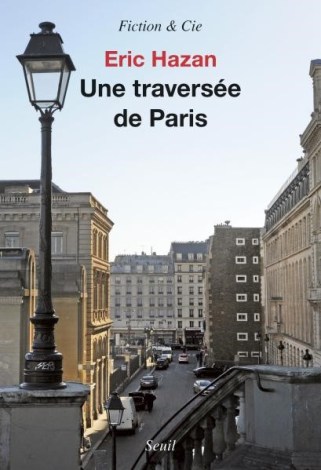
Tourism is big business and “literary” travel guides are often marketed as culturally correct tools to upgrade the experience of the journey, be it abroad or at home. The new book by Eric Hazan (a publisher and political activist born in 1935 whose crisp and provocative ways of writing and thinking can be given as an example to many of those who are much younger than him) is not a book of this kind. A personal and often directly autobiographical expansion of his well-known social history of Paris (The Invention of Paris, translated by Verso in 2011), Une Traversée de Paris (“A Crossing of Paris”, a heavily connoted title which refers to the tradition of Situationist psychogeography as well as to a famous French movie on the black market during the German occupation) is, in the first place, a political book: a challenging contribution to the rich corpus of non-tourist books on Paris (other recent examples can be found in the work by Jean Rolin, Zones, 1997, which exists in a bilingual pocket edition, and Thomas Clerc, unfortunately not yet available in English).

HazanHazan’s crossing of Paris leads him from the south (Ivry) to the north (Saint-Denis) and focuses on the “center” of Paris; that is, the twenty neighborhoods that can be found “inside” the beltway, which both prevents the traditional city to grow and protects it from the dangers of the less wealthy suburban circles that surround it (some French view Saint-Denis the way some Belgians view Molenbeek). Yet the margins are permanently present: geographically, humanly, culturally, politically speaking. The major aim of Hazan’s book is to disclose the “popular” aspects of the capital, which resist the galloping gentrification, and to highlight the continuity of a revolutionary tradition in the city.

Walking though Paris –and Hazan is a wonderful guide, a great observer, an excellent writer– is a very different experience from what tourist offices and their marketing spin doctors describe in countless brochures and reportages (all costs paid by the organizations that commission the writing, of course –and should it be repeated: literary slum tourism is an extremely popular, well paid and highly profitable part of this industry). The book is not at all an aggressive rebuttal of the tourist dream factory. It does what all great literature should do: make us aware of a different reality, and help us look better; that is, to really watch instead of just look around.

On: Eric Hazan, Une Traversée de Paris, éd. du Seuil, 2016, 194 p.

What Do We Want to Know? Alberto Manguel’s ‘Curiosity’

 By Laura Smith

What Is Curiosity? How Do We Question? What Are We Doing Here? What Do We Want to Know? The award-winning Canadian writer Alberto Manguel explores these, and thirteen other equally poignant questions in his book Curiosity, published by Yale University Press (2015). A personal, historical, poetic, and imaginative journey, Manguel’s book invites readers to contemplate some of the questions that—since time immemorial—have driven human beings to display both their best and worst attributes.

Curiosity

Born in Buenos Aires, Manguel grew up in Tel-Aviv, and has since mostly resided in Europe and Canada. The experience of living in multiple countries as the son of a diplomat has inevitably influenced Manguel’s complex sense of identity and culture, his experience as a writer and, foremost, as a reader. For Manguel, the reader pierces through the constraints of a constructed linear experience of time and space and as such forms part of a collective imaginative fabric. Manguel explains that “the intimate conviction of readers is that there are no individually written books: there is only one text, infinite and fragmented, through which we leaf with no concern for continuity or anachronism or bureaucratic property claims” (277). The weaving of history, fiction, and personal memory reveals Manguel’s understanding of thought as a complex temporal and spatial shared geography. “Cartography,” writes Manguel, “is an art of mutual creation” (166). The participation of readers and writers in such a fabric testifies to the individual and shared life of human curiosity—Manguel’s questions are always posed in the first-person plural.

Each thematic chapter begins with a short personal reflection by Manguel. These are the author’s impressed memory-images: finding home in his imagination rather than his ever-changing address; the recognition of a special teacher igniting the spark of his intellectual curiosity; the obligation of sincerity to himself in the presence of his beloved dog; and the appreciation of his own inevitable death as the accelerated end to the story of his life. Against these brief peaks into our guide’s experience, our own sense of a dynamic time inevitably rises to the fore. We are transported to our hybrid real-and-imagined memories or dreams; those, for example, which are intimately intertwined with the pages of our favourite childhood books.

Guiding us in the exploration of these questions, Manguel incites the aid of another traveler: Dante in his, The Divine Comedy. Weaving an intricate narrative of juxtaposed historical, contemporary, personal, and universal, imaginative experience, Manguel’s philosophical questions are mirrored and explored through the adventures of Dante’s epic fourteenth-century poem. Like Manguel, who follows the poet on his quest through the three realms of Hell, Purgatory, and Heaven, we too follow the author of Curiosity into a forest of his making; exploring, in his footsteps, the paradoxes of human existence. In times of hardship, when words fail her, the writer Jeanette Winterson has remarked that she looks to the poets who have “deep-dived [the words] for [her] and brought them back to the surface.”[1] This allusion, perhaps to Hannah Arendt’s description of Walter Benjamin as a ‘pearl diver,’ rings true for the collected insights that Manguel’s book so generously offers.

Like Dante’s poem, there turn out to be few clear answers in Curiosity—this is fine and even must be so. “Nothing in the Commedia is only one thing,” writes Manguel (217). Rather, Curiosity is the journey of engaging the plurality of what drives our human quests, our modes of expression, and our troubled communication. For Manguel, human beings are born storytellers: “we imagine in order to exist,” he states (3). The inevitability of the failure to ‘answer’ fully to our curiosity, however, safeguards against extinguishing what Walter Benjamin described as the ‘living flame’ of a work of literature. Manguel explains:

There is an essential problem with which every writer (and every reader) is faced when engaging with a text. […] Our ability to grasp the text in all its multilayered complexity falls short of our desires and expectations, and we are compelled to return to the text once again in the hope that this time, perhaps, we will achieve our purpose. Fortunately for literature, fortunately for us, we never do. Generations of readers cannot exhaust these books, and the very failure of language to communicate fully lends them a limitless richness that we fathom only to the extent of our individual capabilities (7).

Manguel’s Curiosity is a reflection on difficult questions of a moral, ethical, and philosophical nature. Like all great guides, Manguel offers his readers the tools required to venture forth on a journey of their own making.

EVENT:

Alberto Manguel will be the keynote speaker at the Feestelijke Opening Kunstenbibliotheek, September 30, 2017, in Ghent.

KASK en Conservatorium / School of Arts Gent i.s.m. S.M.A.K., Design museum Gent, HISK, STAM en de Gentse Gidsen. Location: Campus Bijloke, Louis Pasteurlaan 2, 9000 Gent (gratis).

http://schoolofartsgent.be/nl/agenda-nieuws/agenda/feestelijke-opening-kunstenbibliotheek?eCat=7

External links:

The CBC’s host of Ideas Paul Kennedy interviews Alberto Manguel about his book Curiosity:

http://www.cbc.ca/radio/ideas/alberto-manguel-s-curiosity-1.3016846

You can find a selection of Manguel’s essays on his personal website as well as a list of recommended readings – his 100 favourite books.

http://manguel.com/


[1] Jeanette Winterson, talk from the 2010 Edinburgh Book Festival. https://www.brainpickings.org/2017/06/01/jeanette-winterson-edinburgh-book-festival-art/

J.R. Carpenter’s ‘The Gathering Cloud’

By Jan Baetens

J.R. Carpenter
The Gathering Cloud
Axminster, Devon: Uniformbooks, 2017, 112 p., 12 pounds
ISBN 978-1-910010-50-0
(website: http://luckysoap.com/thegatheringcloud/)

Gathering cloud.png

In the field of electronic literature, the name of J.R. Carpenter, a Canadian-born multimedia artist, writer, researcher, and performer, is since many years a major reference. The publication of The Gathering Cloud, a hybrid work that not only combines print and digital creation but includes also other forms of textual communication such as performances, lectures and exhibitions, is an important new step in her work, which should enable this writer to find a larger audience –and at the same time to bring that larger audience to the new media practices that are still considered relatively marginal or alien to literature in general.

The Gathering Cloud is a hybrid creation in a twofold sense. First, because it combines in a nontrivial way online and offline elements, as a kind of “indie” version of what the cultural industry calls “transmedia storytelling”. Second, because it is itself, in each of its mediatic avatars, a mosaic of genres and modes –in this case of essay and poetry, and also of word and image. Taking as its starting point the encounter of something very concrete and literal (cloud formations and the many ways to label and identify them) and something very abstract and metaphorical (cloud computing), J.R. Carpenter rethinks the history of both elements, offering a poetic rewriting of the history of man’s attempts to fix in words and categories what radically exemplifies the idea of mobility, namely real clouds, on the one hand, and addressing the multiple implications of envisioning the digital networks in terms of clouds, on the other hand. She thus intertwines literature, media history, and ecocriticism, clearly showing the impact of poetic creation on digital theory as well as the necessity to stop thinking on literature as having no relationship at all with actual social, environmental and political issues.

More generally speaking, The Gathering Cloud is much more than just another example of the ongoing trend to bridge the gap between fiction and document in literary writing. It is also an innovative case in the age-old dialogue between science and literature, which strikes the right balance between the singularities of each field (science is not reduced to a mere literary theme; poetry is not used in order to vulgarize science). Like Christian Bök’s Crystallography (1994, revised 2003), it is part of a newly emerging canon of art and science creations that help reshape the fundamental unity of the humanities.

Many voices are one voice

By Jan Baetens

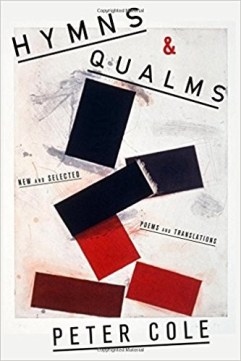
hymns and qualms

Peter Cole

Hymns & Qualms (Poems and Translations, New and Selected)

New York: Farrar, Straus, and Giroux, 2017

ISBN-13: 978-0374173883

Internet culture has made copy and paste, sampling, “uncreative” or “unoriginal” writing, as Kenneth Goldsmith or Marjorie Perloff like to say – in short all kind of modern day versions of imitation – fashionable once again. However, the success of this way of writing should not prevent us from understanding that real imitation always involves a high degree of admiration and awe, but not fear, and this in many cases is the most challenging way to authentic poetic expression. Just as there is something like “deep time”, there is something like “deep theme” as well as “deep form” in poetry, and ambitiously imitative takes on writing are perhaps the best way to address these issues in both modern and sustainable ways.

Born in Paterson, as, among many others, the hero of Jarmusch’s Paterson (see my review: https://lesimpressionsnouvelles.com/une-semaine-dans-la-vie-du-poete/), Peter Cole is a deeply multilingual and multicultural poet, whose work in English is nourished by his knowledge and translations of Hebrew and Arabic. Dividing his time between New Haven (CT) and Jerusalem, he is the author of one of the most remarkable bodies of poetry in English today. His new book, an anthology of old and new work as well as old and new translations that reuses the title of a previous collection from 1998, seamlessly brings together texts from three different languages, many cultures (it would be absurd to reduce the Arabic and Hebrew traditions to monolithic wholes) and a wide range of periods (the book contains translations of texts from late antiquity and the 11th century till very most contemporary creations). In that sense, it is much more than a personal anthology offering wonderful examples of the modern lyric, which in a very accessible but always sharply formulated language blurs the boundaries between the local and the global, the personal and the political, the descriptive and the meditative. The most striking feature of this multi-voiced and multi-layered book is its incredible unity. Not as the result of a modern and subjective streamlining, but as the outcome of a poetic inquiry into what authors, languages, cultures, and epochs may have in common in spite of their welcome differences, the very discovery of what humans share, which only poetry can teach them that it exists.

Hymns & Qualms is a once in a lifetime book for his author, a work of great maturity one can only publish every two, three decades. Readers, don’t miss it!

Photo-Lit – The Belgian photo novel

By Clarissa Colangelo and Jan Baetens

20170623-100332_p2

In May, “PHOTO-LIT – The Belgian photo novel: local reuse of a European cultural practice“, a research project funded by the BRAIN-be framework, has started; today its website is online: www.photolit-brain.com.

The photo novel is a form of visual narrative with staged photographs, generally printed in magazine format, and was the dominant popular form in postwar pre-television Europe.

At the crossroads of film-novel, comics, melodrama, and serialized romance, the presence and impact of photo novels were unequalled, and its adaptations and re-appropriations in later periods remain an exceptional example of the dynamics of creativity and heritage, where they instantiate the visual turn in the transformations of reading and writing today.

Bonnes-Soirees-555x724

The Belgian contribution to the photo novel, important and very diverse, has been completely overlooked by the existing scholarship. In a joint effort, professors and PhD students of KU Leuven (Jan Baetens, Fred Truyen and Clarissa Colangelo) and of ULg (Michel Delville, Luciano Curreri and Valentina Duminuco) together with professionals from KBR (among which head of digitization Frédéric Lemmers) will study the Belgian photo novel and disclose its form, meaning, relevance and history as an exemplary case of modern heritage in the era of mass media culture and technological modernization.

Don’t miss out on this new, exciting project: surf to our website and subscribe to the newsletter to follow our research and be updated on our future discoveries!

Europeana Photography: vintage photography revisited

By Fred Truyen

In May, we launched the Europeana Thematic channel on Photography – “Europeana Photography”. Cultural Studies Leuven was responsible for the curation – being a member of Photoconsortium, the expert hub on photography for Europeana. The channel opens up the richness of photographic heritage in Europeana by telling stories from a point of view that combines a sense for history with a deep understanding of the materiality and the photographic techniques, and how these interact with the way photographers used the medium to produce their magic. Photography is and will always be this raw, “in your face” medium, that directly imprints in the brain a compelling, unescapable “image”. Even though photographs have lied and deceived in so many ways, it is hard to resist their immediacy and supposed “realism”. Photographs have actually shaped our views on “facts”, events, news items and perceptions of conflicts throughout history since their invention in 1839. In Europeana Photography, curator Sofie Taes brings you an insight in the development of this medium and art through the centuries, by telling stories in the form of virtual exhibitions, such as “The Pleasure of Plenty” – in fact a series devised in different seasons as you might expect in the Netflix age -, galleries and so-called “browse entry points” or predefined queries, like the one on “cartes de visite”. Of course, if you are not afraid to browse through thousands and thousands – we can safely say more than 2.3 million images – just use the search box!

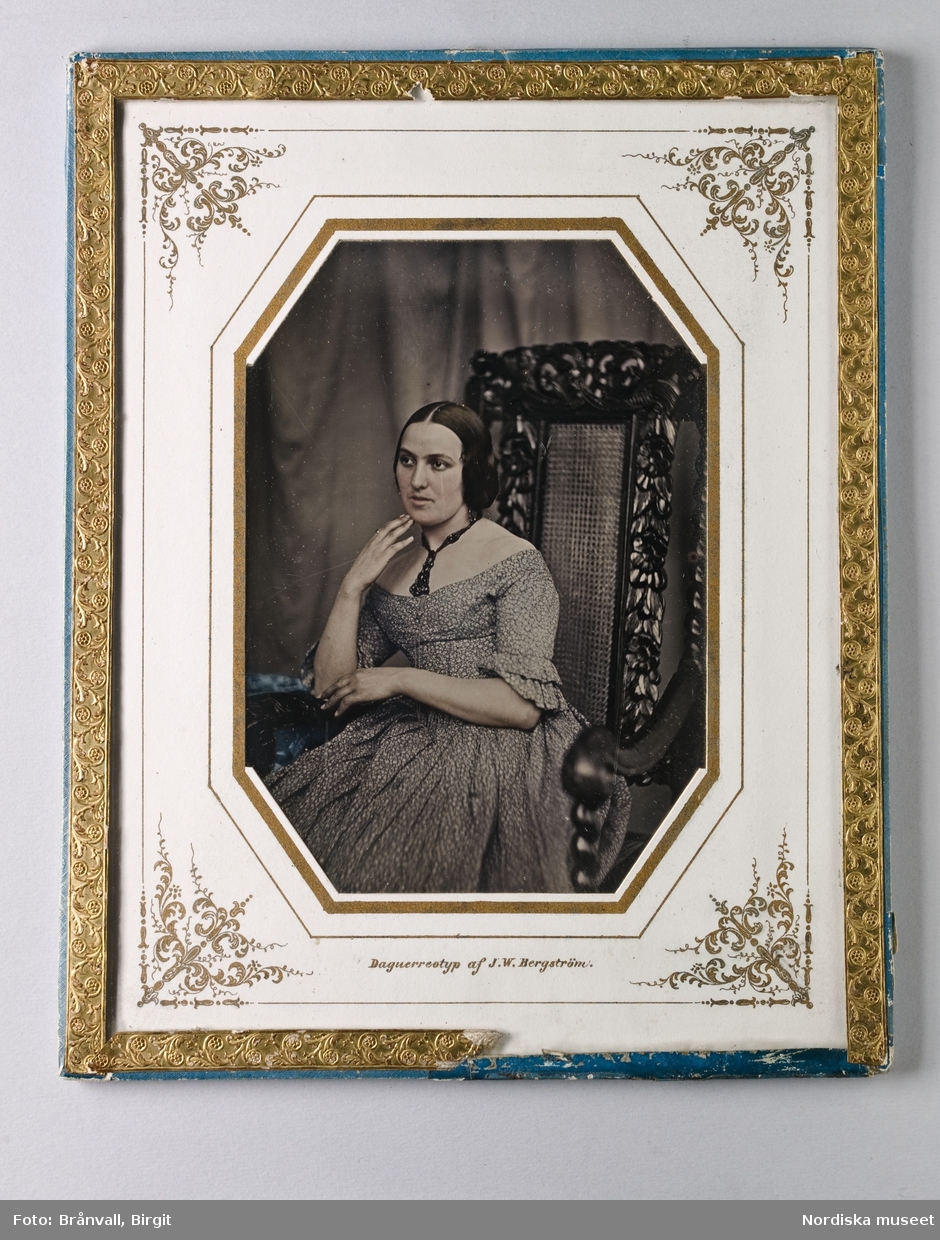
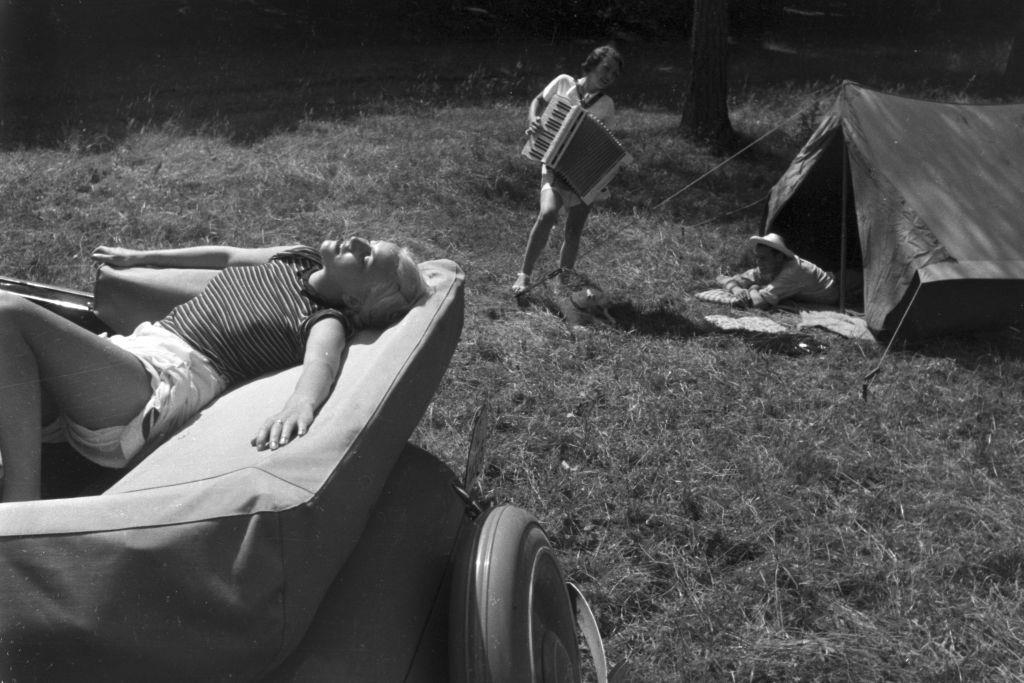
But for this blog post, let’s discuss some old photo techniques and how they define the character of the photograph. Let’s go from the oldest to newer ones. It is still very difficult to do justice to a Daguerreotype, as it is the result of a process that gives amazingly sharp images, with a typical silver brilliance. As it required a sealed glass encasing, Daguerreotypes in their frame are nice, precious objects. However, there is almost no shadow to be seen – Daguerreotypes are only sensitive to ultraviolet light. It has a rather dull, even tonality. This gives the images a kind of clinical, lifeless feeling. The object has a charming “metal” gloss, mostly improved through a gilding process. Often they were coloured in, as the example shown. A Daguerreotype (named after its inventor Louis Daguerre) is normally a mirrored image, although it was possible to reverse this by using prisms. It is very shiny and appears only when viewed from a certain angle.

What a contrast with the process developed by Louis Daguerre’s rival John Talbot, the calotype, which is a two-phased process with a calotype paper negative used to make salt print positives, by direct contact, exposed in the sun. The Daguerreotype produces a unique object, by contrast the calotype/salt print process allows for multiple copies to be made. What a warmth the sun gives to this all, and the paper negatives bring high contrasts and shadows, but also some blurriness and a soft feel. While the Daguerreotype quickly became the photography of science, the calotype won over the hearts and minds of the general public, offering dreamy impressions rather than naked facts.

My favourite photographic process is without any doubt the wet collodion process, commonly called wet plate photography. Collodion is a brownish, viscous fluid, to be poured on a hard support – can be a glass or metal plate –  that contains silver halides which can be sensitized when put in a bath of silver nitrate. That’s why it is “wet” when you take the photo – the whole process taking on average about 15 minutes for one shot. This procedure superseded the older techniques from about 1854 onwards. While it combines the sharpness of the Daguerreotype with a certain ease of use, it is the absolute king of contrast, producing a deep silver black and a richness in shadows.

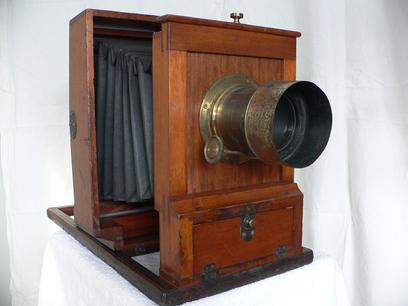
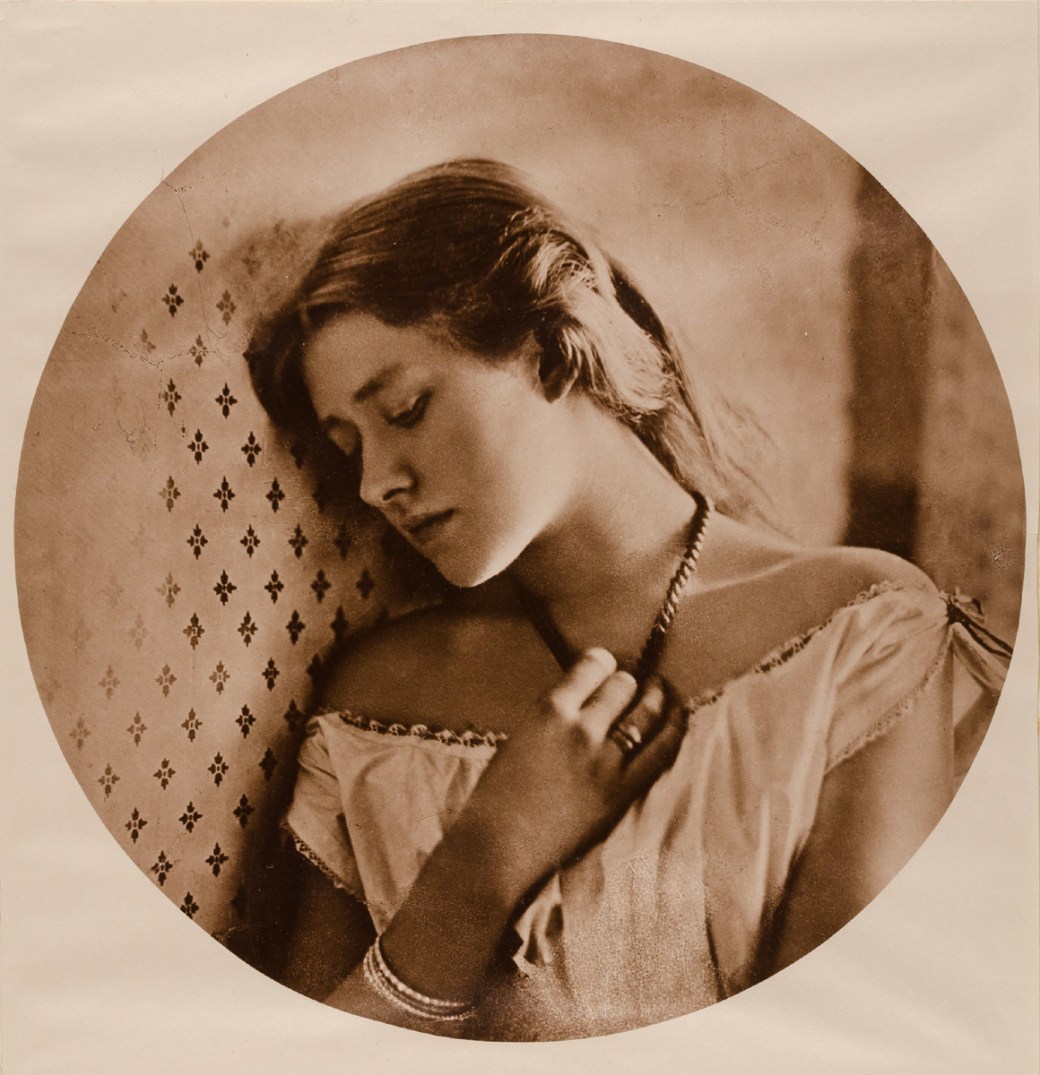
Combine this with the properties of the big cameras used to make these photos – glass or metal plates sized 5×5 up to 14×14 inch and higher – and the big lens with an abhorrent large opening and the resulting very narrow depth of field, you get extremely forceful portraits, as Julia Margaret Cameron showed with such prowess, thereby defining portrait photography as an art in its own right! While the contrast is high, the dynamic range is rather limited, about half of that of digital photography, which in its turn is also not really a champion. A wet collodion photo is brutal: it reveals every detail in a face, due to its sensitivity for ultraviolet light, of which the short waves can perfectly map the slightest irregularities on the skin. A wet collodion photo on glass is called an ambrotype, when it is on a metal sheet it is often called a ferrotype or a tintype. The reproduction below however is a paper print.

Wet plate photography is increasingly popular with current portrait and landscape photographers as it is a relatively safe procedure and adds an astonishing level of detail and quality that are difficult to match by digital cameras.  This is not only the case for professional photography, but also for artistic photography where photographers such as Sally Mann have made decisive contributions to revive the genre.

The subsequent silver gelatine process would become the standard monochrome process in the later nineteenth and twentieth century, until the advent of course of digital photography. This easy to use, safe and scalable process would establish analogue photography. It is super clean and has all the good properties, but to me – and to many vintage enthusiasts rediscovering early photography – it cannot compete with the raw force of the wet collodion based ambrotypes or tintypes, let alone with the poetry of the salt prints. But then again its ease of use – dry plates or celluloid film – and higher sensitivity – resulting in shorter exposure times – boosted the creative development of photography, opening it up to sports, action, movement, depth of field etc., where older photographic techniques were essentially constrained to rather static portraits and landscapes.

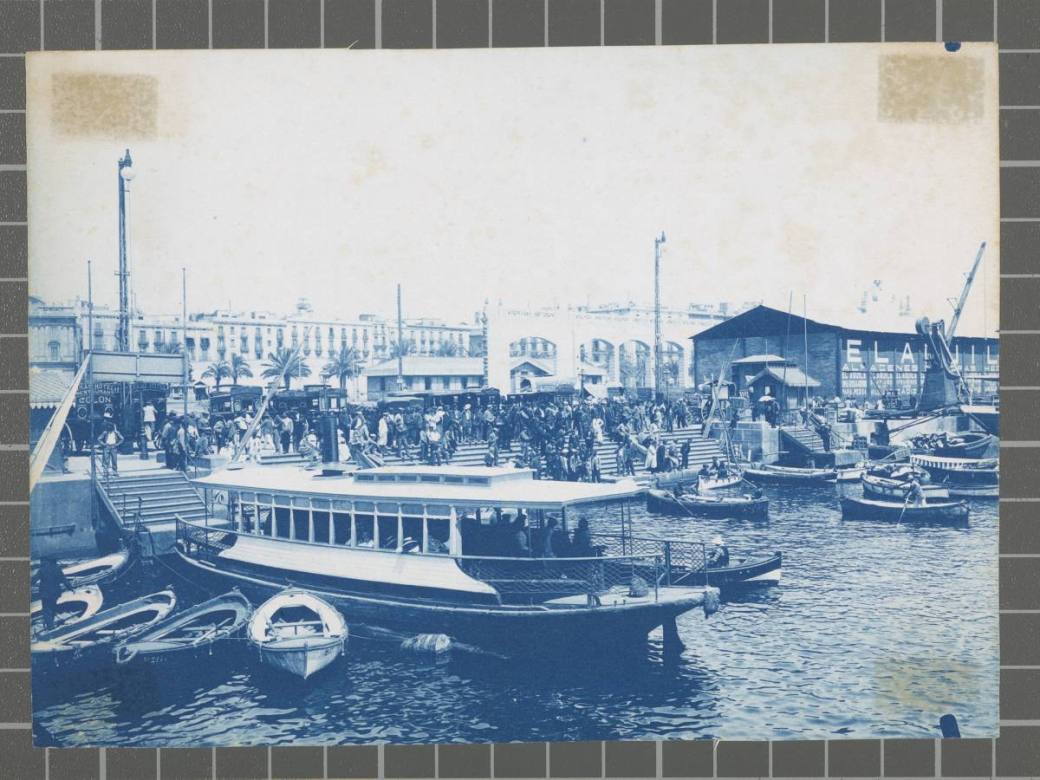
A cyanotype is a specific process producing, as the word says, a “blue” image. There is a nice gallery of those on the channel. As this was an easy process, it was often used to quickly make prints to verify photos before making the actual commercial print. It was also used for the so-called “blue-prints” of designs and drawings. In fact the process was discovered by Sir John Herschell, one of the founding fathers of photography.

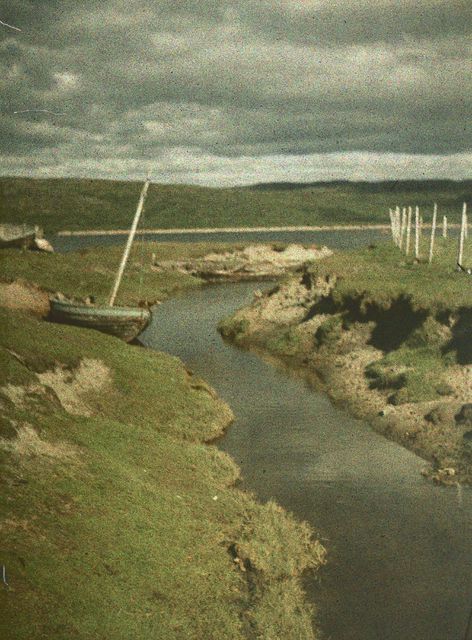
A last technique to mention is an early colour technique, developed by the brothers Lumière. It is the autochrome. In fact, this is a kind of diapositive. Onto the glass plate a layer of coloured starch grains – red, green, blue – is attached, which filters the incoming light. This layer stays with the photograph, which is then shown by backlighting. You get a kind of pointillist effect, and the colours produced have a special warmth that you usually do not find in current, more blueish and colder colour techniques.

Is the growing popularity of vintage photography yet another pointless surge of nostalgia in a world of digital banality and immediacy? A kind of allergic reaction to the emptiness of the selfie? Or is the photograph indeed something else than just the light information captured, but a magic that occurs in the chemistry of the material object that is the vintage print or plate ? This is for you to decide, but hopefully only after spending some hours on Europeana Photography!
A new comix autobiography

By Jan Baetens

Jean-Christophe Menu

Krollebitches. Souvenirs même pas en bande dessinée

Brussels: Les Impressions Nouvelles, 2017, 176 p.

978-2-87449-456-7


KrollebitchesCOUVUNE-707x1024Jean-Christophe Menu is one of the major voices of alternative comics in France, both as an author and as the co-founder of L’Association, the leading publisher of French comix in the period of his 20 years editorship (he resigned a couple of years ago). He is above all a living paradox: the angry young man of the French bande dessinée scene, he is also the holder of a PhD on the subject (moreover an excellent one, frequently used and quoted in academic research: La Bande dessinée et son double, 2011); the living example of authentic visual thinking, he is also an author who does not make any real distinction between his drawings and his writings. His new book is the perfect yet open synthesis of all these forces and tendencies.
“Krollebitches” (literally: small curls) is a neologism coined by the Belgian comics artist Franquin that refers to what in English is called “emanata”, the small but highly significant symbols that can surround characters in comics and that represent either a movement (speed lines) or certain states of mind (surprise, interrogation, bewilderment, etc.). These “krollebitches” are one of the most typical features of comics as an art of drawing and as such they are the perfect title for a book that aims at disclosing both the specificity of comics as a visual language and the passionate relationship between maker and work as well as between work and reader.

Krollebitches is a vital contribution to comics culture for many reasons. In the first place, it is an autobiography of one of the decisive figures of alternative comics of the last 25 years, who succeeded almost single-handedly to bridge the gap between underground comix and traditional publishing without ever abandoning the creative vitality of the punk spirit. Autobiography in comics has become a cliché nowadays, due to the autobiographical turn of the graphic novel and the rising market of interview books. Krollebitches, however, offers something else: not a graphical novel, but a real text, complemented –rather than illustrated– by a permanent flow of perfectly appropriated emanate (the author himself has been in charge of the book’s layout, which is a stunning example of clever layout). Moreover, the book is not the work of an interviewer or a ghostwriter, but of the artist himself, who proves to be as efficient and surprising a writer as a visual artist. In addition, Krollebitches does not claim to tell it all: it focuses on the formative years of Menu, and one will notice that these years start early since the author was already reading comics before he could actually read. In that sense, the book is an astonishing but very authentic and convincing tribute to some old masters –I already mentioned Franquin, but Menu’s knowledge of the field is breathtaking and his tastes are much more eclectic than one might suppose.

Yet next to the documentary value of the book, which is an ideal introduction to the world of comics as seen through the eyes and the personal experience of a great artist, Krollebitches is also an exceptionally well written piece of literature. Menu is in perfect command of his very direct as well as sober style, which exemplifies the surprisingly classic ideal of “aptness”, and this applies to everything in this book: vocabulary, syntax, rhythm, word and image interaction, touch and feel of the object.

Another way of telling

By Jan Baetens

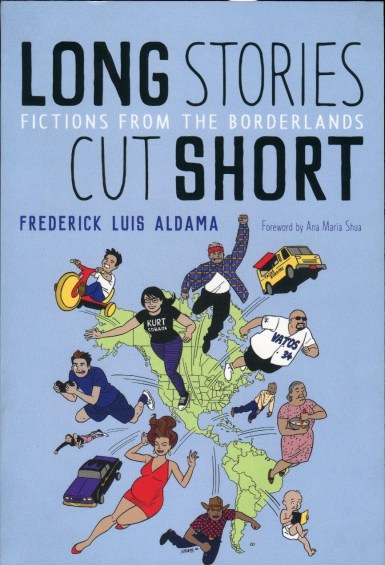
On: Frederick Luis Aldama, Long Stories Cut Short. Fictions From the Borderlands (Tucson: Arizona University Press, 2017, ISBN: 970816533978)

Long Stories Cut Short. Fictions From the Borderlands is an amazing book and probably also the most direct, honest and useful book that I’ve recently read. Content-wise it looks very simple: a collection of “flash fictions” (ranging from the one-sentence fictions à la Augusto Monterroso to very dense, but always very legible, one or two page stories) on the “Latino experience” (that is the bilingual and bicultural life of those crossing all kind of borders from South to North in a multimedia and multilayered world),Long stories cut short without any concession to the naïve and sentimental utopias that continue to litter our perception of the harsh reality. Aldama’s prose is in your face and Long Stories Cut Short is amongst the most depressing books one can imagine. A welcome reply to all romantic views on the land of milk and honey (“She might be able to go home, the doctor announces. /He can only think: Hurry up and die.”, p. 171).

At the same time, the book is a great example of what literature today can or should be: an attempt to shape –which signifies: reshape–  modern life with modern means. Aldama thus brings into dialogue form and content: his borderland prose is not a matter of themes, it is also a matter of textual materiality, his book offering all fictions in two versions (English and Spanish, with no hierarchy between – they are independent and equal versions of each other) as well as in two media (the Chilean Mapache Studios have illustrated in comics style for most of the stories, and this image becomes a mirror story itself). Moreover, the author –a well-known specialist of narrative studies, who has the courage to start writing himself (like many others, he could have made a career by writing fifty articles on free indirect style in Jane Austen) – manages to change the genre he explores. His flash fictions do not only push the genre beyond its usual limits (the diversity of tones, styles, techniques and scopes is impressive), they also offer a complete rethinking of the nature of flash fiction once it appears in a collection. For Long Stories Cut Short is much more than a book of very short stories, it is an encyclopedia of the borderland experience. It does not rely on simple tricks such as the recurrence of characters and places in various stories –an easy way to bridge the gap between the part and the whole–but rather it manages to build a world in which the parts do not fit together –as they don’t in the real world either.

Seminar: “The 3 Ecologies Institute – Anarchiving an Alter-University”

On Thursday, the 18th of May, we have the privilege of welcoming professors Erin Manning (Concordia University) and Brian Massumi (University of Montreal) for a doctoral seminar at the KU Leuven, entitled The 3 Ecologies Institute: Anarchiving an Alter-University. This encounter will take place between 10 a.m. – 12 p.m., at Hoger Instituut voor Wijsbegeerte – Room HIW 01.20 (Kardinaal Mercierplein 2 – 3000 Leuven). Registration is not required, though brief notice of your attendance to arne.vanraes@kuleuven.be would be appreciated.
Poster4Erin Manning and Brian Massumi will discuss their development of ‘The 3 Ecologies Institute’ at SenseLab (www.senselab.ca), a laboratory for thought in motion that explores the active relations between art, philosophy and politics through the matrix of the sensing body in movement.
 
The 3 Ecologies Institute is an experiment in thinking/making, formulated as a speculative proposition for an alter-university. Working with Félix Guattari’s concept of the three ecologies – the conceptual, environmental and social – Manning and Massumi move us to collectively invent what else learning can mean, beyond the model of the neoliberal university.
 
As university education has become increasingly focused on the demands of the job market, its earlier mission as a realm for creative exploration and flexibility of thinking has eroded – a development that has harmed the humanities and social sciences. The 3E Institute aims to provide a dedicated place for creative exploration and free inquiry as values in themselves. It encourages experimental thinking and creative making and supplements a transversal, transdisciplinary milieu to the split between theory and practice that often underlies pedagogical methods and educational institutions. The Institute will further approach its efforts toward collective experimentation, improvisation and reinvention by exploring the possibility of an alter-economy (new forms of ‘commons’, cooperative networking, skill-sharing and crypto-economies), including neurodiverse ways of knowing and the co-habitation of social diversities, and fostering ecological sustainability (including, but not limited to, the environmental).
 
Brian Massumi and Erin Manning will explore this potential through the concept of the anarchive: not the documentation of known past activities, but an ‘anarchic’ research-creation event of collective experience in the making. They look forward to the opportunity of sharing this work and discussing what else learning and living can be in these neoliberal times.
 
Further reading,:
 
Speakers
Erin Manning holds a University Research Chair in Relational Art and Philosophy in the Faculty of Fine Arts at Concordia University (Montreal) and is the founder and co-director of SenseLab. Her activities are situated across art-making, philosophy and activism. Through process philosophy, her writing researches the relations between movement, art, neurodiverse ways of knowing and the political. Her artworks explore conditions of emergent collectivity and more-than human ecologies. Manning’s current art projects are focused around the concept of minor gestures in relation to colour and movement, and the synesthesia of colour-smell. Her publications include Politics of Touch: Sense, Movement, Sovereignty (Minnesota UP, 2007), Relationscapes: Movement, Art, Philosophy (MIT Press, 2009), Always More Than One: Individuation’s Dance (Duke UP, 2012), The Minor Gesture (Duke UP, 2016) and, with Brian Massumi, Thought in The Act: Passages in the Ecology of Perception (Minnesota UP, 2014).
 
Brian Massumi is professor of communication at the University of Montreal and co-director of SenseLab. He works on the philosophy of experience, art and media theory and political philosophy. His research participates in the collective exploration of new ways of bringing philosophical and artistic practices into collaborative interaction. Massumi has translated work by Deleuze and Guattari, Lyotard and Attali into English. He is well-known as a foundational figure of the ‘Affective Turn’ in the humanities and social sciences. His publications include Parables for the Virtual: Movement, Affect, Sensation (Duke UP, 2002), Semblance and Event: Activist Philosophy and the Occurrent Arts (MIT Press, 2011), What Animals Teach Us about Politics (Duke UP, 2014), Politics of Affect (Polity, 2015) and Ontopower: War, Powers, and the State of Perception (Duke UP, 2015).

Symposium “Mediating Immediacy: Choreographing Affect”

On Wednesday May 17th 2017, there will be a symposium entitled Mediating Immediacy: Choreographing Affect, which is being organized in the framework of the KU Leuven Cultural Studies course Theory of Contemporary Dance, in partnership with STUK. The symposium is free, welcomes all and will take place at STUK – Soetezaal (Naamsestraat 96 – 3000 Leuven), between 14:00 – 18:00.

A description for the event and details about the program and speakers can be found at:
Contact: Arne Vanraes – arne.vanraes@kuleuven.be


com_foto_dans_symposium_17

Photo credit: Twitter @trymainelee

Mediating Immediacy: Choreographing Affect
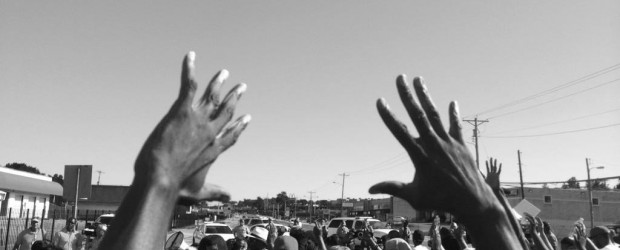
Our speakers Cécile Guédon (Harvard University), Erin Manning (Concordia University) and Ben Anderson (Durham University) will address the paradox of how the (presupposed) ‘immediacy’ of affect can be negotiated in performance praxis or in the broader social sphere. In short, ‘affects’ are often described as those basic, psycho-bodily intensities that emerge from encounters of lived bodies and environments. At a micro-perceptive level, they influence one’s capacity to act or move. While those energetic forces are frequently analyzed as being non-conscious and happening immediately, we will raise the question whether this implies that they are also unmediated. Is there a necessary contradiction between choreographic technique (which can suggest notions of mastery and reproducibility) and affect (so often associated with passivity and immediacy)? What can ‘structures of feeling’ tell us about structures of power and a politics of moving/feeling bodies? Does choreography carry the potential to critically research which energies appear between moving bodies in relation? And can such choreographies intervene to reconfigure affective production for the future?
 
Talks
Cécile Guédon – Articulating Modernity: Choreographing Abstraction
Erin Manning – A Manifesto for Immediation
Ben Anderson – Neoliberal Structures of Feeling
Concluding performance: Alma Söderberg, Nadita (http://www.stuk.be/en/program/nadita)