Mariken Wessels – Taking Off. Henry my Neighbor

By Anne Baptist

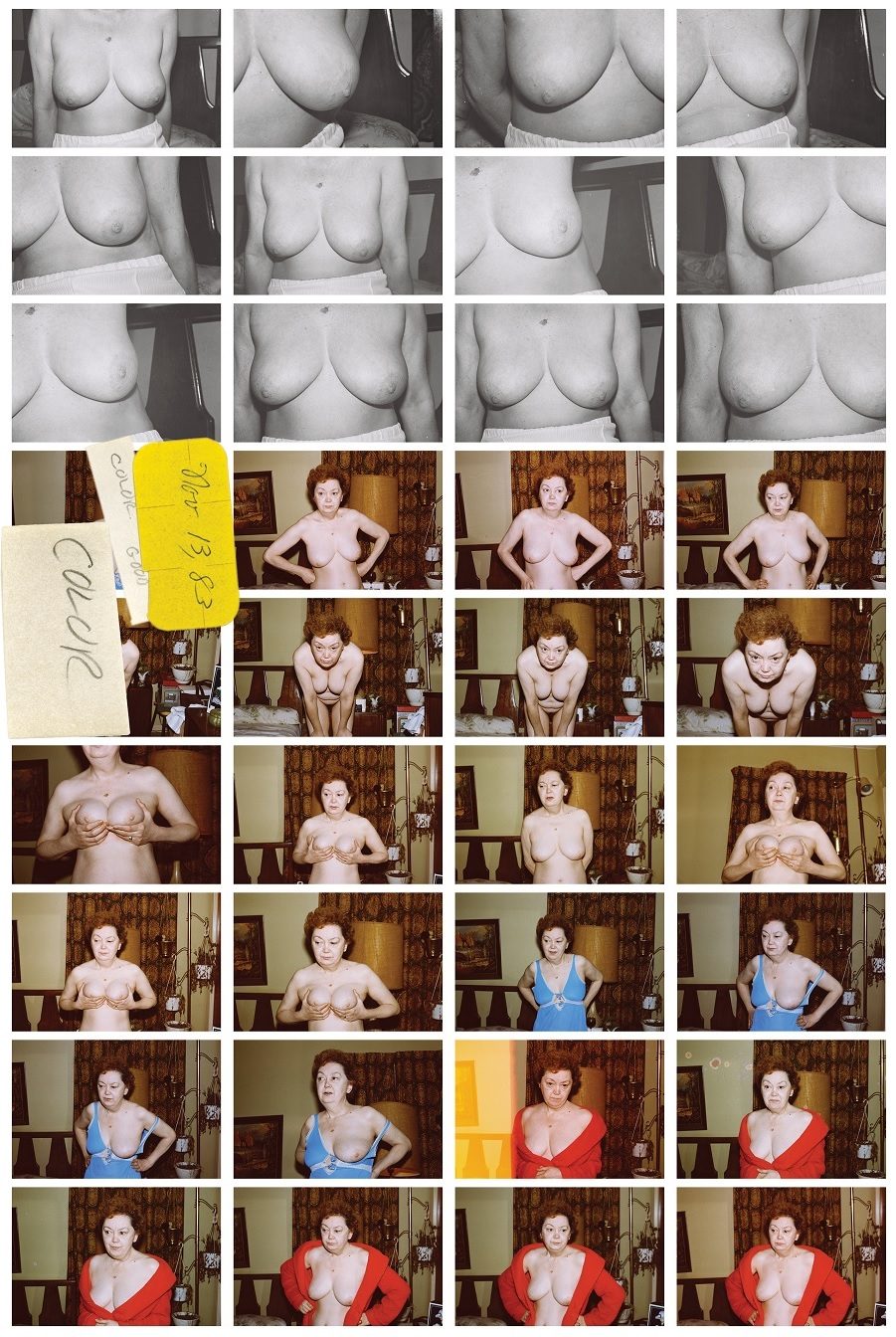
Surrounded by thousands of black-and-white nude pictures, you are instantly captured by an unsettling yet intriguing feeling when walking into Mariken Wessels’ new exhibition at FoMu. Taking off. Henry my neighbor is an exhibition of the works in Wessels’ latest book of the same name. In Taking off she creates an artistic reconstruction of the failing marriage of two people: Henry and Martha.

Wessels (°1961), a Dutch artist, is internationally renowned for her photobooks, but also creates series of photographs, sculptures and installations. She is known for working with found photographic material and recreating the stories behind it. These artistic reconstructions, as she calls them, are based on the untrustworthiness of truth. She recognizes the human restrictions of the concept because truth is only ever someone’s truth. Memories and interpretations are always tainted, failing or fading, limited due to our ever changing personal perspective. This idea is closely related to the nature of photographs. They seem to be the closest thing to a true representation of reality, but the reality they show isn’t necessarily true. By calling her photographic narratives ‘artistic recreations’, Wessels plays into these limits and leaves the spectator guessing and in search of authenticity.

1463955583142

Mariken Wessels (NL), from the series Taking Off. Henry my Neighbor, 2015

In Taking off Wessels constructs a visual biography from a collection of works by an amateur artist named Henry, which was entrusted to her by American friends. The collection consists of more than 5500 pictures, collages and sculptures made in the eighties, that all feature the same subject: his wife, Martha. She seems to have been his only muse and for a long time during their marriage she posed for him, before eventually leaving him, and throwing his work out on the street. The photographs picture her in different stages of undressing, taking on different poses, highlighting different parts of her naked body. She presents her body with a vacant and indifferent gaze, her eyes often averted from the camera. After their split he recovered the photos, cutting them up and reassembling them into collages. These collages mostly contain pieces of similar pictures and body parts, seamed together at joints and creases, thereby assembling a new, hybrid body. Often Martha’s face wasn’t part of these creations and they have an uncanny and vaguely disturbing sexuality about them. Later on the collages in their turn inspired clay sculptures, smooth, pale and seamless versions of these strange bodies.

Seeing the exhibition, that starts chronologically with a space completely plastered with these images and continues into three spaces that respectively encompass pictures of the split, of the sculptures and of the collages, is fascinating to say the least. Although their story is presented as true, Henry and Martha’s hidden motives remain very mysterious and hard to understand. In this alienating presentation of material that was clearly meant not to be seen, Henry seems overcome with an unhealthy, even scary obsession with Martha’s body, void of any love or tenderness. Furthermore, feelings of shame are omnipresent. Her shame, his shame, our shame. But at the same time there are so many unanswered questions. One can only wonder how authentic this representation is and where Wessels’ hand in it is. Do these pictures tell a story of sexual fixation or artistic study? Of objectification or appreciation? Of obsession or inspiration? We are left to wonder, staring closely at these pictures and collages in disturbed amazement.


The exhibition runs in the FoMu Antwerp until  05.06.16
For more info see: http://www.fotomuseum.be/en/exhibitions/mariken-wessels.html

This review was written for the Photography and Visual Culture Class of the Cultural Studies Program

Ukraine, a state in constant transition

By Julie Verheye

Boris Mikhailov’s Ukraine, currently running in FoMu Antwerp, shows a moving portrayal of a state in constant transition. The retrospective covers the unfolding of events in Mikhailov’s homeland by illustrating the developments from Soviet communism to Western capitalism and the recent Maidan protests. Pushing aside the grand narratives of the cold war and the macropolitics of the Soviet Union, Mikhailov visualises the influence on the everyday and, hence, portrays Ukraine in its most intimate setting. The exhibition blurs the boundaries between objectivity and subjectivity, documentary and diary, and recording and performing. Emphasising notions as imposition, alienation and the body, Ukraine stirs emotions with hints of witticism and vulgarity.

1463955581978

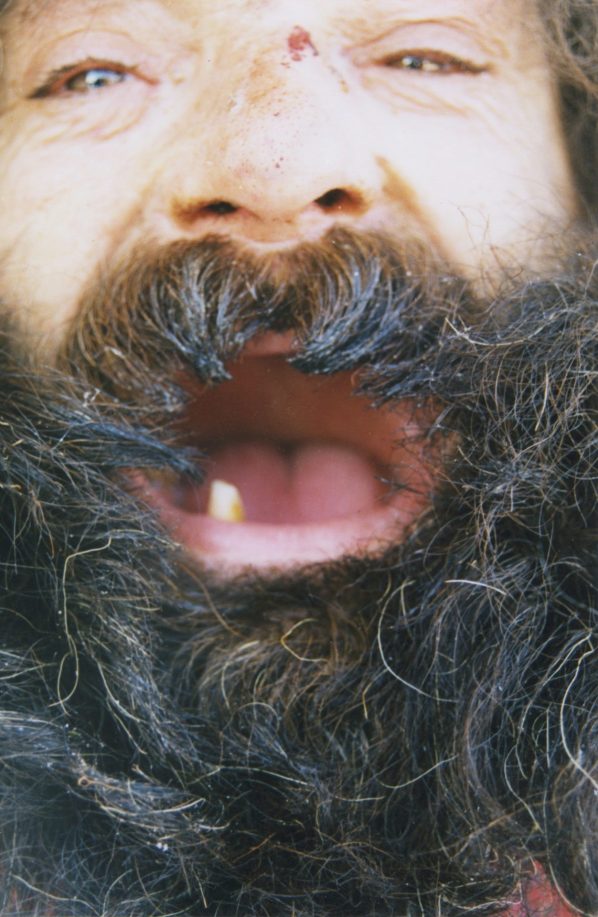
Untitled, from the series Case History, 1997-98 Boris Mikhailov, courtesy CAMERA – Centro Italiano per la Fotografia

Mikhailov openly – yet cunningly – criticises the communist regime. His subtle critique is already present in Superimpositions, which double exposes two colour photographs so as to create a psychedelic dreamland. Mikhailov aesthetically and unmethodologically juxtaposes icons and banalities of Soviet life with deep-seated cultural taboos. The playful overlays allude to the surreal and stand far from the photomontages of Rodchenko’s, El Lissitzky’s and Klutsis’ constructivist photography. The series stunningly counteracts the strict formulated aesthetics and narratives of arts in service of social practice by deconstructing preferred-readings and creating flexible meanings. Mikhailov continues his fight against communism with Black Archive, a series of monochrome photographs contrasting the intimacy of the home with the formality of the streets. Although his critique is barely visible, the series condemns the surveillance culture and numerous restrictions in public life during Soviet times. Mikhailov’s critique of communist society peaks in the colourful series Red Skies and Luriki. The alarming red colours of the former immediately stand out due to the serial representation that alludes to the profusion of communist symbols in day-to-day life. Similarly, Luriki, a set of colourised black and white photographs with a Méliès-like allure, refers to the hypocrisy of communist propaganda which constantly painted a rosy picture in order to beautify reality. During the eighties, a period of political and economic changes caused by Gorbachev’s glasnost and perestroika, Mikhailov’s work gradually lost its colours both literally and figuratively. The sepia tinted photographs of Crimean Snobbism, a visual diary of Mikhailov’s friends during a holiday, and Salt Lake, an objective account of an ecological disaster, are merely a shadow of Mikhailov’s more provocative work of the sixties and seventies.

Other milestones in Mikhailov’s work are the fall of the Soviet Union and the independence of Ukraine in 1991. At Dusk, Tea Coffee Cappuccino and Case History are reflections on the changeover from communism to capitalism and the related impact on the body. At Dusk and Tea Coffee Cappuccino emphasise the disparity between consumer culture on the one hand, and the deteriorating of the social body and urban space on the other. However, both series are easily towered over by Case History, which is probably the apotheosis of the exhibition. The images vulgarly – yet intimately – depict the precarious living conditions of the homeless, a new social class emerging with capitalism. Apart from focussing on the bodily evidence of poverty, Mikhailov also fulfils a performative role as he stages a grotesque drama in paid collaboration with the bomzhes. Appearing in recognisable poses that refer to Christianity, the photographs provoke and could be seen as modern icons. The series raises questions about the traditional relationship between photographer and subject. The exhibition concludes with The Theatre of War, a series depicting the protesting body in moments of inactivity during the recent pro-European Euromaidan revolutions.

In sum, Ukraine shows a moving and intimate portrayal of the social body in transition from communism to capitalism. Sporadically verging on the vernacular, Mikhailov records a visual diary wavering between the objective and the subjective and, hence, reopens some probing questions about photography’s ethical imperative. The exhibition inserts a sense of realism by beautifying ugliness and by rendering visible what lies dormant beneath the surface of society. Simultaneously acting as an objective witness and a participating producer, Mikhailov depicts reality not only with great solemnity but also with a sense of humour. Nevertheless, the exhibition is a roller-coaster of impressions since not all works are equally outstanding: Mikhailov’s early series, along with Case History, rise above the other works, which unfortunately sink fast into oblivion.


The exhibition runs in the FoMu Antwerp until  05.06.16
For more info see: http://www.fotomuseum.be/en/exhibitions/boris-mikhailov.html

This review was written for the Photography and Visual Culture Class of the Cultural Studies Program

Why visit Mons?

By Jan Baetens

Why visit Mons? Why visit a city that is no longer the European capital of culture (2015), a place so small that one may overlook its very existence? A place so near-by and so well connected to Leuven that it seems deprived of all exoticism? A place without railway station, that is without actual building, the existing one having been demolished and the new one eternally under construction, a place with no professional football team (and the basketball team did not very well either this year)?

Many questions, but countless answers as well, after a pleasant and very instructive city trip (we were there for business, not just for entertainment), that helped discover not only the rich cultural infrastructure of the city but also the extremely pleasant atmosphere of daily life in Mons.

In a nutshell, this was the program of the day: sight-seeing on the one hand (yes, the station: a ruin in the making, the main church, a grandiose copy of that of Leuven, the belltower and of course the little monkey at the city hall, the collapsed but rebuilt Arne Quinze installation, the new Manège theater – alas due to a strike it was not possible to recite some poetry at the entrance of the local prison, so famous in European literary history) and great cultural activities on the other hand (the city museum BAM, with a great exhibit on performance art and Bill Viola; the Mundaneum with the astonishing Paul Otlet archives as well as an exciting special exhibition on data visualization, big and small, and the artothèque, which a lack of time prevented us to visit from attic to basement).

In short: why visit Bruges if you can visit Mons?

Save the Date: colloquium Choreographing the Self during Extr’act | 19 & 20 May

Jonasblog

Thu 19 & Fri 20 May14:00-18:00STUK AuditoriumFREE (reservation required through ticket@stuk.be)

For the symposium Choreographing the Self the department Cultural Studies at KU Leuven and arts center STUK have invited several international renown theoretician and artists to think about the role of choreography in the production of the individual and the social. Together they examine how choreography can be understood as a tool to analyze both the aesthetic organization of movement and the socio-political construction of singular and collective identities, in search of different intersections between these ‘small’ and ‘great’ forms of choreography. With conferences by Paula Caspao, Bojana Cvejić, Jason Read and Bojana Bauer.

The definitive timetable will soon appear here.

The symposium Choreographing the self is organized within the framework of the course Contemporary Dance: Theory and Analysis hosted by the department Cultural Studies at KU Leuven in collaboration with arts center STUK. Contemporary Dance: Theory and Analysis is a result of the policy plan culture KU Leuven 2013-2017. The symposium will be the first event of a series co-organized by both institutes aimed at bringing together spectators, artists and theoreticians around dance and choreography.

This symposium takes place during Extr’act – a compact two days with challenging work by a new generation of makers – the evening programmes can be checked here (Thursday May 19) and here (Friday May 20).


do 19 & vr 20 mei14:00-18:00STUK AuditoriumGRATIS (inschrijven verplicht via ticket@stuk.be)

Voor het colloquium Choreographing the Self nodigen het departement Culturele studies van de KU Leuven en kunstencentrum STUK verschillende internationale gerenommeerde theoretici en kunstenaars uit om samen na te denken over de rol van choreografie in de productie van individualiteit en collectiviteit. Samen onderzoeken zij hoe choreografie kan begrepen worden als een instrument om zowel de esthetische organisatie van beweging als de socio-politieke constructie van singuliere en collectieve identiteiten te analyseren en zoeken ze naar de verschillende kruisverbanden tussen deze ‘kleine’ en ‘grote’ vormen van choreografie. Met presentaties van Paula Caspao, Bojana Cvejić, Jason Read and Bojana Bauer.

Het definitieve uurschema is binnenkort hier te zien.

Het colloquium Choreographing the self wordt georganiseerd in het kader van het vak Hedendaagse dans: theorie en analyse, dat wordt georganiseerd aan het departement Culturele Studies van de KU Leuven in samenwerking met kunstencentrum STUK. Hedendaagse dans: theorie en analyse is opgestart vanuit het Beleidsplan cultuur KU Leuven 2013-2017. Het colloquium luidt het startschot in voor een serie van events die zullen worden georganiseerd door beide instituten en die telkens tot doel hebben om toeschouwers, kunstenaars en theoretici samen te brengen rond dans en choreografie.

Dit colloquium vindt plaats tijdens Extr’act – een gebalde tweedaagse met uitdagend werk van een nieuwe generatie makers – het avondprogramma van donderdag 19 mei vind je hier, dat van vrijdag 20 mei hier.

Why “Bad” Literature Matters (and How We Should use It)

By Jan Baetens

Contrary to film or sports, for instance, literature is a part of culture in which there are still heated debates on what is “good” and what is “bad”. One may prefer Messi to Ronaldo, even after the Panama Papers, but nobody will deny that both are great players. One may like Ed Wood and dislike Hitchcock, but the merits of both directors will never be put on the same level. In literature, however, things are less clear. There exists of course a canon, but most readers, even professional readers, agree on the fact that this canon is often horribly boring and not really worth reading. On the other hand, many books that are avidly read will not really be defended by those who read them, as if they were ashamed of enjoying “silly” books or authors.

The situation is schizophrenic, but also complex. It is too easy for instance to frame it in terms of cultural snootiness (on the side of those sophisticated but “camp” readers who are proud of reading bad literature, while never trying to make a case for it as “good” literature) or inferiority (on the side of the many unsophisticated readers who are not always proud of what they actually like to read). Above all, the situation is sad, for it maintains social and ideological barriers that eventually harm both reading and writing.

One of the problems of “bad” reading is not only the persistent hatred that it provokes, not to speak of the psychological damage done to those who cannot love it as they would like, but also the negative effects in the long run on writing and literary culture in general. Just as some forms of “illegal”, that is illegally copied literature (see the recent essay by David S. Roh on this topic and my review on Leonardo[1]) can have tremendously positive effects on the creativity of a given community, “bad” reading should be considered a basic condition of literary invention. However, in order to make this point, one needs examples to demonstrate how this works in practice.

Here is where Robert Walser comes in. An important and even avant-garde Swiss author of the first half of the 20th Century, Walser was fond of “bad” literature, more particularly of cheap French romance novels of the twenties, infamous examples of what is called in French “industrial literature” (the term goes back to the 19th Century but it clearly anticipates Adorno’s distaste of the culture industry). Badly written, badly printed, totally ignored by serious readers, worse than all that one could imagine in all possible senses of the words, these books, actually more brochures than books which were sold in newsstands, not in bookshops, were read by audiences “good” readers have always been happy to mock (one of Walser’s examples is a novel by Sim – pseudonym of Georges Simenon –, Le Semeur de larmes, 1928).


While working as a journalist, Walser happened to review once in a while this kind of “bad” literature, and the way he did so offers an amazing demonstration of what one can actually do with this allegedly inferior literature. For reviewing meant rewriting, not just paraphrasing or summarizing and judging. Walser reinvents completely new stories, which often go totally against the grain of the original works, and this rewriting offers the possibility to deploy a stylistic firework that clearly demonstrates the springboard function of both the reading and the review. Yet what Walser is about is not to “save” the worthless books he is not supposed to read as a serious author, but to demonstrate how literary creativity works and how it can make use of any material whatsoever.

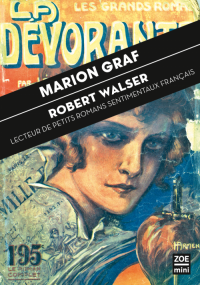
graf_walserSo please read the short essay by Marion Graf on Walser as a romance-reader, and try to do yourself with your bad readings what can be discovered in the examples in the second half of the book, a brief anthology of Walser’s creative reviews. It’s a small and inexpensive book, so you can keep it away from the eyes of those who want you to read Middlemarch or the complete works of Milton.


Marion Graf. Robert Walser. Lecteur de petits romans sentimentaux français. Editions Zoé : Carouge-Genève, 2015.

[1] http://leonardo.info/reviews/apr2016/roh-baetens.php

The Timeless Value of an Artistic Joke out of Exasperation

by Christian Wauters

Until the 5th of June, in ‘De Halle’ in Geel, the city where he spent his youth, runs – as a homage to Jan Hoet (1936-2014) – the impressive exhibition ‘Ungenau’ (“inaccurate” but better translated as “precarious” or “off-beat”). Hoet, remembered as a globally renowned art expert and curator, established for the first time, exactly thirty years ago, his international reputation with the exhibition Chambres d’Amis to which he invited American and European artists to create artworks for homes in Ghent, private residences but open to the public for several weeks. However, not everyone was enthusiastic about this heavily acclaimed innovation, including even one of the participating artists…

CW

Among Flemish examples of so-called Money Art, a young art genre (especially emergent since 1990) that aims at the creation of art objects on the basis of real or symbolic money, Chambres d’Amis (‘Guest Rooms’ – 1986) by the world-famous installation artist Panamarenko (pseudonym of Henri Van Herwegen, b. 1940) presents a remarkable case that cannot be ignored by the art lover focusing on the relationship between art and money. The art object consists of a wicker birdcage and a shoe box on a coconut doormat with the imprint Chambres d’Amis (97 x 105 x 67 cm). The cage is filled with copied money and a pile of (ersatz) banknotes lies on the box. The work that was not even recognized as ‘art’ in its setup, quickly proved to be a playful, mocking and even quite insulting statement or provocation by a humorous but deliberately rebellious artist. It demonstrates (and this could be the ‘hidden’ research question) how an artistic ‘parody’ can become a genuine work of art, for Chambres d’Amis made its way to prestigious art collections and an international auction (Christie’s [London] 28 June 2012), at which it was sold for £ 25.000.

The background of this joke has been extensively documented. Jan Hoet (1936-2014), both hyped or maligned as an ‘art pope’ in artistic circles, organized an unusual exhibition under the auspices of the Museum voor Hedendaagse Kunst (Museum of Contemporary Art) in Ghent (Belgium), from the 21st of June to the 21st of September 1986. It was an art event in which fifty-one residents of Ghent declared themselves willing to provide (part of) their home to an artist for three months. The underlying idea of this idiosyncratic exhibition, which housed contemporary works of art in a social context, was to break the conservative exclusivity of the museum. One of the artists who was to participate in the project, called Chambres d’Amis, was Panamarenko who declared in a television interview (BRT-Flemisch Department, 21 June 1986) that he considered the initiative as ‘heresy’ and as restricting freedom and did not feel like participating. In his own idiom, he stated:

 (…) I was forced to make something for people in the so-called art world, (…) [I]t had to be modern of course, because they had here and there made an earlier purchase. (…) [T]hey wanted a modern version of all that old crap, without the content being different and that annoyed me.[1]

He nevertheless took part in the event:

So I took a birdcage and filled it with [fake] money and I did the same with a shoe box as well [sic] (as everybody always said that I possessed shoe boxes full of cash!). Finally, I added a doormat with the imprint ’Chambres d’Amis’ in big letters and there you have it!

In order not to have to say no, I said no by participating. I presume that many people, being so ostentatiously faced with that money, feel that they have been miffed.

Although the work was exhibited in the hallway (after all, the base was a doormat!) of the De Wilde-Van Peteghem residence at the Olympiadeplein n°.9 in Ghent, the organizers were not pleased with the contribution of an artistic funnyman! In his opening speech of the art event Chambres d’Amis Jan Hoet said: “This is something that we cannot call a true work of art!” But Panamarenko’s provocation did not end there:

The anger [of the curator] became even worse during the opening ceremony, which was broadcast on television. While the lectures were held, Jef Geys [°1934, an internationally renowned Flemich sculptor, photographer and installation artist] and I sat, deliberately uninterested, at a table, eating oysters and talking. That was an idea of Jef Geys, but of course it was staged. They [the organizers] had agreed but nevertheless. While ministers were speaking and everyone was listening, we sat at a table for two, eating oysters and babbling, with a lot of swearing in between and the television people of course broadcasted the silliest excerpts that nobody understood. The oysters have been paid by Jan Hoet but for Jef Geys, the game was over: in Ghent and in the presence of Jan Hoet, he was never to show his face again. But he [Hoet] just did not dare to throw me out (laughs).

With his mockery Panamarenko had pointed out the weakness of ‘modern’ (i.e. 1986-) art-enthusiasm as described in the testimony of art historian Dirk Pültau, editor-in-chief of the Flemish/Belgian art magazine ‘De Witte Raaf’ (The White Raven):

The atmosphere around ‘Chambres d’ Amis’ is indicative for the “ardency” of that time. Jan Hoet was the great defender of contemporary art and present-day art was presented as something that was afflicted and had to be defended. (…) If you look at it afterwards that enthusiasm was really only aimed at presenting contemporary art as a kind of controversial spectacle-commodity. This promotional fire has, in the long-term, made any serious approach to the art of our time impossible. The total acceptance of present-day art comes atz the expense of flattening it and making it more enjoyable. But I must admit that I have followed that apologetic discourse for a long time. I was far too uncritical of the things the museum did. (Gielen, 2004, p. 197).

With a bitter undertone, the above quoted cultural sociologist Pascal Gielen has also noted in his publication ‘Kunst in Netwerken…’(Art in networks…, 2004, p. 197) that ‘Chambres d’ Amis’ paved the way, for Hoet himself, to Documenta IX (Kassel, Germany – 1992):

The concept-note, with which Hoet finally applied for Documenta, covered only five pages. From this you can at least deduce that discursive mediators play a minor role in such decisions. Selection processes often build on previous merits and networks of formal and informal contacts. Moreover, in the art world, ‘babble’ is more central than text.

Furthermore, ‘Chambres d’Amis’ meant the end of the collaboration between Jan Hoet and the television director, executor and scriptwriter Jef Cornelis (b. 1941) who, between 1963 and 1988, made numerous artistic and cultural-historical breakthrough programs for the Flemish  department of the Belgian Broadcasting Corporation, thereby drawing TV attention to Hoet as well. Cornelis dedicated a six-hour broadcast called ‘De langste Dag’ (The Longest Day) to ‘Chambres d’Amis’. It was a satire on a mad contemporary art world, figuring, for example, quarrelling artists (a.o. Panamarenko and Geys) as well as Hoet’s (frequent) outburst of anger. In the year 2000, the director explained his point of view:

I lampooned Hoet in front of the camera; this was not an attack on his person but by reason of the media show in which the art had ended up at that time. A few moments later Hoet became aware of that and it meant the final break. (Gielen, 2004, p. 196).

With this contribution to ‘Chambres d’Amis’, Panamarenko, in his own picaresque way, commented critically on a wide-ranging promotional initiative for contemporary art. As we have seen, history proves that he was not the only one to comment in a critical way on propaganda  for “a modern version of old crap, without the content being different.” In this perspective, the birdcage and shoe box filled with photocopies of bank notes, can be considered as an authentic work of art with a far-reaching, meaningful and even timeless symbolic value.


[1] This text and the two following citations are quoted from an article by Panamarenko, which he mainly edited himself: Indispensable lexicon …” in the Flemish newspaper ‘De Standaard’ (The Standard) of the 21st of April 2005 (my translations).
Conference Photography Performing Humor

The international conference “Photography Performing Humor” will explore the nature and meaning of the relationship between photography, performance and humor within the field of visual arts and visual culture.

Although humor is clearly omnipresent in a wide spectrum of photographic practices — ranging from advertising or art photography to family snapshots with their obligatory ‘smile’ or the classic Tower of Pisa joke — the topic has yet to be fully discovered by researchers. While in recent years photography theory has witnessed the affective turn, its focus remained largely on photographic representations of suffering, trauma and loss.

It is no coincidence then, that one of the central metaphors to think the affective quality of the medium, Barthes’ punctum, relates affect to being wounded. This conference resolutely chooses to elaborate a lighter, humorous side of photography and aims to map different strategies and practices.

PhotographyHumor

Venues

LUCA School of Arts
Paleizenstraat 70, 1030 Brussels

The evening lectures on 13 April (8 pm) take place at:
Vlaams-Nederlands Huis deBuren
Leopoldstraat 6, 1000 Brussels

Dates

13/04 > 14/04/2016

Registration

Attendance to the conference is free but registration is required before the 8th of April 2015.

Register by sending an email to performinghumor@gmail.com


Conference Programme

Wednesday, 13 April 2016

  • 9:00 am Coffee & registration
  • 10:00 am Welcome
    Carl Van Eyndhoven (dean LUCA School of Arts)
  • 10:10 am Opening word
    Mieke Bleyen (KU Leuven)
  • 10:30 am Keynote lecture
    Louis Kaplan (University of Toronto)
    A Morbid Sense of Humor: Reflections on Photography’s Dark Comedy
    Moderator: Hilde Van Gelder
  • 11:30 am Coffee break
  • 11:45 am Heather Diack (University of Miami)
    Playing It Straight: The Alliance of Humor and Photography in Conceptual Art
  • 12:15 pm Sandra Križić Roban (Institute of Art History, Zagreb)
    Elements of Humor in Proto- and Conceptual Photography in Croatia
  • 12:45 pm Johan Pas (Royal Academy of Fine Arts, Antwerp)
    “Défense de photographier.” Parody as a Postmodern Strategy in Some European Artists’ Books, 1960s-70s
    Moderator: Liesbeth Decan
  • 1:15 pm Lunch break
  • 2:30 pm Sian Bonnell (based in Cornwall; Falmouth University, Cornwall)
    Wilful Amateur
  • 3:00 pm Lieven Segers (based in Antwerp; MAD-Faculty, Hogeschool PXL, Hasselt – LUCA School of Arts, Genk)
    8 words on making something good
  • 3:30 pm Thomas Mailaender (based in Paris and Marseille)
    Screening A Very Serious Job
    Moderator: Nicola Setari
  • 4:00 pm Break
  • 8:00 pm Lieven Gevaert Leerstoel Lectures (at deBuren, Leopoldstraat 6, 1000 Brussel)
    Paulien Oltheten (based in Amsterdam)
    Sifting and sorting / centrifugal thoughts
    Hilde D’haeyere (KASK School of Arts, University College Ghent)
    CINEMACINE. Lecture on the Mechanisms of Screen Comedy
    Moderators: Mieke Bleyen & Liesbeth Decan
  • 9:30 pm Reception

Thursday, 14 April 2016

  • 9:30 am Coffee & registration
  • 10:00 am Keynote lecture
    Esther Leslie (Birkbeck University of London)
    Photography and Laughter’s Shattered Articulation
    Moderator: Edwin Carels
  • 11:00 am Coffee break
  • 11:15 am Alexandra Olivia Tait (University College London)
    Düsseldorf’s Commedia dell’Arte: Artistic Self-Staging in polke/richter richter/polke (1966)
  • 11:45 am Ann Kristin Krahn (Braunschweig University of the Arts)
    Adding a Giggle: Lee Friedlander’s Practice of the “Shadow Self-Portrait”
  • 12:15 pm Andrei Venghiac (based in Gothenburg)
    Reflections on the Concept of Play
    Moderator: Volkmar Mühleis
  • 12:45 pm Lunch break
  • 2:00 pm George Emeka Agbo (University of the Western Cape)
    Facebook and Photographic Humourisation of Political Activism in Nigeria
  • 2:30 pm Katarzyna Ruchel-Stockmans (Vrije Universiteit Brussel)
    Uneasy laughter. Photography and Humor in Poland
  • 3:00 pm David Helbich (based in Brussels)
    Being Part of the Problem is the Solution. Sharing and Conceptual Art. On “Belgian Solutions” and “Trying to Look Like a Building”
  • 3:30 pm Kevin Atherton (based in Dublin; National College of Art and Design, Dublin)
    Performing the Performance Documentation
    Moderator: Els Opsomer
  • 4:00 pm Mieke Bleyen (KU Leuven) & Liesbeth Decan (LUCA School of Arts)
    Closing remarks
  • 4:15 pm Reception


The conference ‘Photography Performing Humor’ is organized by LUCA School of Arts in collaboration with KU Leuven, Lieven Gevaert Research Centre for Photography, Lieven Gevaert Leerstoel vzw, and Het Vlaams-Nederlands Huis deBuren.

Generously supported by OPAK Research Fund (LUCA School of Arts) and Lieven Gevaert Leerstoel vzw.

Asian Art: an Online Portal to Asian Art in Belgium

In our master Cultural Studies we keep up with modern advancements and theories in our field, and nothing highlights this more than our course on Online Publishing. This year we asked our students to create their own cultural website in teams up to 5 people. The results were more than satisfactory, and in some cases we were blown away by the design and creativity of our students.
Below you’ll find a short article on how one of these groups went to work to create a beautiful and useful website.


AsianArt

Our journey started with an assignment from the Online Publishing course within the Master of Cultural Studies from the KU Leuven.  Five international students coming from different countries and continents found each other through a common love for Asian art.  The term is broad and encompasses a wide variety of expressions such as painting, sculpture, calligraphy, and dance among others; and different mediums: paper, canvas, bronze, ceramics, etc.  There we were: five heads, one passion, and a world of possibilities. Fortunately, there was also one goal, which helped us to start drawing some lines and define what was to become that Asian art website.

There was the brainstorming moment, in which the sky was the limit, and ideas were generated.  But we had to keep it feasible and realistic, so the main boundaries were defined: a portal that consolidated the different venues related to Asian art in Belgium, in other words, we wanted to aggregate in one location the information about art galleries, museums, institutes, and other institutions in Belgium dealing with our topic.  Then we moved on to the next step: identifying the available sources.  So we selected and collected the relevant information partially manually and partially using features offered in existing tools such as “feed” in Drupal Gardens. Oh! By the way, by that moment we had already decided to use Drupal Gardens instead of a fully-fledged installed version of Drupal. First of all because we agreed that Drupal Gardens offered all (or at least most) of the features we needed, further it would be simpler to split the work over an online tool and avoid having to synchronize/consolidate bits and pieces of work from each of us. The following step was to reflect and organize how we wanted to share what we have collected. We decided to group the items by the main actions in the visitor’s mind, in other words, was the user looking for a place to visit and explore Asian art, or was she/he looking for galleries to buy some artworks, or a place to learn? This helped us keep the structure and navigation simple and shallow, which meant that the information was readily available instead of buried under multiple pages (clicks). Hence, we also added the maps to the end of each page.  Regarding the look and feel, we wanted to keep it clean, artsy, and convey the Zen philosophy. Lastly we also wanted to connect our site to social networks not only as a means of “spreading the word”, but also as a solution to providing a platform in which people could discuss topics and post news in a fairly independent location, i.e.: not within the website itself.

In summary, our main steps were as follows:

  • Define the topic and draw the boundaries
  • Identify the available sources
  • Select and collect the relevant information
  • Reflect and organize how we want to share what we have selected
  • Define the tool we wanted to use
  • Create a website to share our work with other Asian art lovers living in Belgium or visiting the country.

Of course it didn’t always run smoothly from one bullet point to the next, and we had some bumps and frustrations along the road, but we suppose it is part of most endeavours. We are happy that we kept moving and hopefully others will have a chance to visit us at http://asianartbe.drupalgardens.com/ !

Daniela Barroso, Aida Khosa, Margarita Konstantinou, Natalia Qi, Noah Zhao

Hypertextual trauma: Porpentine’s Twine games and the borders of self-narration

By Kahn Faassen
(Student Advanced Master in Literary Studies)

Many interesting narrative experiments have hatched in the margins of the Internet. The paper I wrote for the course Literature and Psychoanalysis in the Advanced Master in Literary Studies gave me the opportunity to take a closer look at a very particular type of textual art that has developed online: Twine games.

Faassen1Twine is a free, user-friendly indie game engine which allows a very broad audience to create, share, and experience interactive stories. Many of these new game developers are not part of the demographic usually working for, or targeted by, the mainstream gaming industry and it shows in the works they create. Lesbian, Gay, Bisexual, or Transgender (LGBT) artists find in Twine a very useful platform to tell the kind of stories they are interested in, and these stories are markedly different from the narratives primarily written by and marketed towards cisgender heterosexual men. Whereas most games of the latter variety are competitive and control-based, and the player’s primary objective is beating them, many Twine games focus on making the most of their medium’s interactive and storytelling potential, and primarily emphasise player affect and experience.

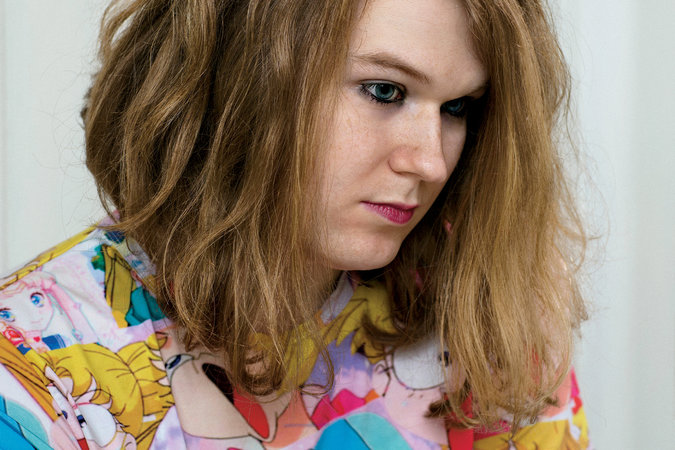
One game developer in particular jumps out for using Twine to tell stories that matter to her: an online artist named Porpentine. As a transgender woman who struggles with the debilitating effects of trauma and disability, her games are for her a way to authentically deal with gender dysphoria, social stigmatisation and depression, and to reach out to other people who are in similar situations. In my paper I looked at her work as a new form of autopathography, an autobiographical illness narrative irreverently straining the limits of literature, using its medium to the fullest extent to create a rapprochement between the game and the writing subject (as a self-narrative, a kind of textual therapy), and between game and gamer (which gives it an interesting political dimension).

In order to create this proximity of lived experiences, Porpentine uses the Twine game mechanics to create a sense of intimacy, intending her games to be what she calls “sensory plugins for the brain”, which give the player an impression of what it is like to live with certain constrains. The way in which the games attempt to make a deeply personal therapeutic struggle with illness and trauma into an interactive experience is a de-pathologising move, and opens up the possibility of a profound subversion of widely accepted ideas concerning embodiment, gender and normalcy by facilitating player identification.

In her games, Porpentine works with and against constraining elements in a variety of ways. Sometimes she actively pushes against them, such as when she is confronted with the perceived limitations of a programme such as Twine. She constantly experiments with the restrictions of digital media, trying to bridge the gap between what is often thought of as a cold, impersonal means of communication and the intimate, personal stories she wants to tell. One of her games, With Those We Love Alive, introduces a particularly interactive element to involve the player, asking them to mark their skin with ‘sigils’, specific symbols which to them personally signify concepts such as ‘severing’, ‘pain’ or ‘shame’, in the course of the story. This turns the game into a physical experience which the player quite literally carries with them even after the game has ended.

Other times, she exploits the particular structure of the Twine engine, which uses clickable hyperlinks to propel the narrative in ways that allow her to curtail the player’s agency. She does this by forcing the player to go through the same repetitive actions, visiting the same places (links) before allowing him or her to progress with the story. As a consequence, the spatial structure of the games starts to feel claustrophobic and even hostile, creating the impression that its protagonists are stuck in a system that is alienating, harmful, or even deadly, but which they nevertheless help perpetuate. This is a clever and very effective way to implicate an immersed player in a system of violence which, implicitly or explicitly, turns against him- or herself.

The confrontation with these kinds of suffocating systems often culminates in an escape and a self-assertion of the queer disabled subject, who never succeeds in heroically vanquishing the system, but whose very existence challenges it. Motifs of abjection (slime, garbage, etc.) abound as the protagonist assumes a new liminal identity, no longer constrained by a discourse that necrotises their bodies and their modes of self-expression. Not being destroyed by structural violence is shown to be a radical act in and of itself.

The choice for a kind of art that focusses on boundaries, restrictions and liminality is evidently not an arbitrary one. Porpentine herself is constrained by the lasting effects trauma and chronic pain have on her art, which results in her deliberate choice for what she calls ‘trash art’. Trash art is an art of conscious failure, a kind of paradigmatic shift which recognises that illness and disability have a profound impact on the artist as well as on the art which they produce. It takes into account that poor and socially marginalised artists are stuck in systems centred around productivity which are heavily informed by a discourse based on the normalisation of a particular type of individuals and the exclusion and pathologisation of others. Trash art is an attempt to no longer be part of a structure that actively works against the artist, a choice made out of the pure necessity to create art in accordance with the body, to work around the restrictions one’s mental or physical health and socio-economic situation imposes upon the artistic process. It is a manifesto for art that can be characterised by interruptions (for medication, rest, etc.), for art that is fragmentary, transitory, unfinished, and often made out of the only materials that are available to a poor and socially marginalised artist: garbage. This new paradigm opens up the possibility for disabled subjects to reject a discourse that has rejected them, which allows them to make art that is no longer immaculate and bloodless, but actually focusses on how self-expression and embodiment intersect.

Porpentine’s games are remarkable not only because of the complex position they occupy at the junction of queer identity and disability, but also because of her use of an unconventional platform such as Twine in order to explore new ways to reach her audience, facilitate player identification, and in doing so challenge the stifling discourse on the subject of pathology and marginalised identities. Despite (or perhaps because of) her attempts to communicate herself authentically and create stories which focus on emotional proximity and empathy, she frequently brushes against the limitations of language, which leads to interesting experiments with metaphor as the games struggle to come to terms with the inherent resistance and opacity of language. There is no doubt that, whether they are seen as authopathographies, queer narratives, or simply novel intermedial experiments, the works created by artists such as Porpentine are rich and rewarding to investigate, but it remains to be seen if the unconventional hypertext stories that are being written in the dark recesses of the Internet will ever get the mainstream attention they deserve.

2/03 at STUK: Public Talk Contemporary Dance #1 – Artistic collaboration: a collaborative talk with Rudi Laermans & Eleanor Bauer

Jonas_post

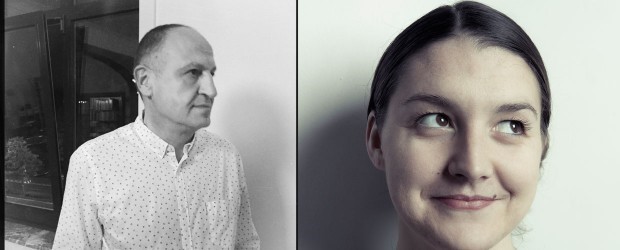
The conversation between Eleanor Bauer and Rudi Laermans will be an experiment in public thought and intellectual exchange on the topic of artistic collaboration and collaborative methods within the field of contemporary dance. Laermans extensively discusses the different modes, the internal dynamics and the implicit political horizon of collaborative practices in the second part of his recent book Moving Together: Theorizing and Making Contemporary Dance. One of the key terms he proposes to conceptualize artistic collaboration from a sociological as well as a political point of view is the notion of ‘commoning’. Bauer has addressed collaboration and commons in group pieces such as Tentative Assembly (the tent piece) (2012) and even more explicitly in the current performing arts practice exchange platform and archive that she co-initiated with Ellen Söderhult and Alice Chauchat called Nobody’s Business. Bauer and Laermans already exchanged views on collaboration’s potential and politics but regard this public collaborative talk as a unique occasion to move on. Both prepare questions for each other inspired by their respective work and previous exchanges, and will invite the audience to collaborate in their collaborative talk on collaborative practices within contemporary dance.

Entrance is free

Rudi Laermans is professor of social theory at the Faculty of Social Sciences of KU Leuven and also a regular guest teacher at P.A.R.T.S., the Brussels based international dance school directed by A.T. De Keersmaeker. His research and publications are situated within the fields of social & cultural theory, cultural & arts policy, and the sociology of the performing arts. He recently published ‘Moving Together: Theorizing and Making Contemporary Dance’, in which he unfolds a theoretical perspective on the work of several Flemish based dance artists such as A.T. De Keersmaeker or Meg Stuart on the one hand and analyzes the co-creation of contemporary dance from a sociological point of view on the other.

Eleanor Bauer is a performer and performance-maker based in Brussels, Belgium. Originally from Santa Fe, New Mexico, she studied dance, choreography, and performance at New York University’s Tisch School of the Arts (BFA, Dance) and P.A.R.T.S. (Performing Arts Research and Training Studios, Brussels). Bauer is an artist in residence at Kaaitheater in Brussels from 2013-2016. She works at the intersections of choreography, dance, writing, music, and performance art. Her pieces range in scale and media towards challenging categories, methods of producing, and ways of thinking performance. Her versatile works such as ELEANOR!, At LargeThe Heather Lang Show by Eleanor Bauer and Vice Versa(BIG GIRLS DO BIG THINGS), A Dance for the Newest Age (the triangle piece), Tentative Assembly (the tent piece)Midday & Eternity (the time piece), and BAUER HOUR have toured internationally to critical acclaim. Along side making her own work, Bauer has performed with Xavier Le Roy, Anne Teresa de Keersmaeker/Rosas, Boris Charmatz, Emily Roysdon, Matthew Barney, Mette Ingvartsen, Trisha Brown, Ictus contemporary music ensemble, The Knife, and others. Bauer also frequently teaches, mentors, and writes about dance and performance. For more information, visit www.goodmove.be.


Source: http://www.stuk.be/en/program/public-talk-contemporary-dance-1-%E2%80%93%C2%A0artistic-collaboration-collaborative-talk