Collective Biography

By Leni Van Goidsenhoven

Five researchers from several universities, working in different departments and on diverse topics, but all with a tremendous interest in Disability Studies, went to a cozy country house in a remote Belgian village. We would stay there for three days to do a ‘collective biography workshop’ under the supervision of the Australian scholar Bronwyn Davies. Prior to this three-day workshop, the group gathered weekly over the past two months for reading sessions. These reading sessions – which focused mainly on new materialism and included the writings of Karen Barad, Jane Bennett and Kelly Fritsch – would prepare us for the workshop. While reading and discussing the texts, it soon became clear that we wanted to work on disability as a practice and on how we could imagine disability differently. Therefore, we chose to start from Michel Foucault’s text on heterotopia, as well as from Kelly Fritsch’s article on Desiring Disability Differently. Nevertheless, whatever the plans and expectations may be, a ‘collective biography’ is not a practice you can fully delineate in advance.

Collective Biography, a post-qualitative research strategy and diffractive methodology developed mainly by Bronwyn Davies (1994; 2001; 2006), basically works with the telling and sharing of stories in which a theoretical concept is put to the fore. Participants in the collective biography workshop each tell a story based on an initial question or topic. It is not relevant if the story or memory is reliable or not, rather it is about creating knowledge about the construction of people and events. This research strategy assumes that knowledge not only emerge out of ‘data’ but out of the intra-action between the data and the researcher (Davies 2006).

P2 P1 P3

As a methodology, collective biography is in the first place inspired by the German scholar Rigga Haug’s memory work. Memory-work contains the writing and subsequent analysis of remembered stories that researchers collectively use to generate their own critique of theory. In the wake of Haug’s memory strategies, Davies uses memories and stories to explore the processes of subjectification (Davies et al 2001). Davies methodology, however, differs from Haug’s memory work in the sense that Haug is concerned in working from the point of view of the individualized subject and is interested in ‘therapeutic outcomes’(Haug et al 1987), whereas Davies is not. Collective Biography works with post structural theory (mainly Foucault and Butler) and against the grain of phenomenology’s liberal-humanist subject. After all, the goal has nothing to do with any therapeutic outcomes, but instead is focused on generating thinking in order to know differently. It is important to understand that collective biography works not as a strict method to be followed; instead it could be interpreted as a set of emergent possibilities. In that sense, one could for instance see that during the last decade the methodology has evolved more and more towards what Davies calls a Deleuzian/Baradian approach.

In the three days we were together we began the workshop by talking about the concepts we might draw on to understand or imagine ‘disability differently’ (in this specific case we started from the concepts: heterotopia, intracorporeal, non-antropocentric multiplicity and animacy). Furthermore, in response to the concepts, each of us told a remembered story and was then questioned by the listeners who sometimes needed more details in order to fully enter the story. The listening, of course, takes us always beyond moralistic judgements:

Emergent listening might begin with what is known, but it is open to creatively evolving into something new. Emergent listening opens up the possibility of new ways of knowing and new ways of being, both for who listen and those who are listened to. (Davies, 2014, p. 21)

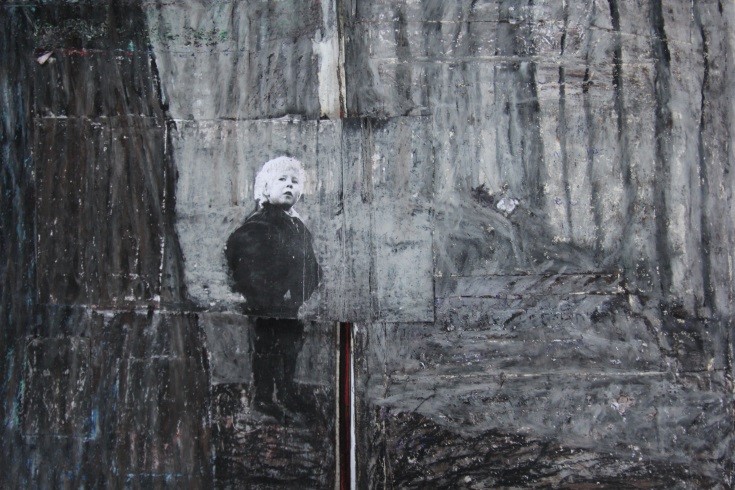
Instead of sharing a memory, one of us chose to show her animation film, De code van Lode – which is still a work in progress.
P4

The film is part of her auto-ethnographic research and tells the story of her brother’s unique and unusual language, as well as the many different interactions of the other family members with the brother. Ultimately, this showing instead of telling unexpectedly opened up new ways for us to work with the concept of animacy, heterotopic imagination and disability.

After the first telling/showing round, the following step was to write all the stories down and again reread them out loud to the group. Thus, it is a process of (re-)telling, (re-)listening and (re-)writing, it is a process of being modified through what one comes to know. At one point the stories – which were mostly about supporting or living in the presence of people with disabilities – were not individual memories anymore, but became collective stories that demonstrate how the concepts from which we started, work.

After circling around our stories as well as around concepts such as heterotopia, intracorporeal, non-antropocentric multiplicity and animacy, we will now write a co-authored article about imagining disability differently and disability as a practice.

‘Nice Work If You Can Get It’

By Heidi Peeters

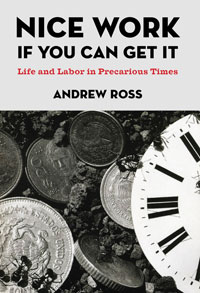
Hipster BarbieOne of Cultural Studies more interesting scholars is Andrew Ross. Besides being an activist, being infamously involved in the Sokal affair (physicist Alan Sokal managed to get a nonsensical article published in the journal with Ross on the editorial board), and being brave enough to ethnographically immerse himself in the life of “Celebration, Florida”, a constructed town by the Disney corporation (as an alternative form of post-Sokal sabbatical reorientation), he also wrote quite a famous book on the conditions of labor in the new neoliberal climate: Nice Work If You Can Get It.

9780814776919_DetailIn this book, Ross focuses, amongst others, on how cultural workers (artists, designers, writers, performers…) have been advertised by policy makers, city developers and the New Economy in general as the motor of a dynamic economic reform. Creativity is considered to be a renewable, sustainable and undertapped source of financial value: everyone has it and no large investments are needed to mine this intellectual gold. The mentality of struggling artists is hailed as the new model in neoliberal entrepreneurship: their ethos of self-discipline, their extreme flexibility, their sacrificial willingness to work long-hours for little pay with little overhead (working at home or in the nearest coffee shop), out of pure passion, the need for aesthetic recognition and the hope of climbing to the level of those rare creative stars in the feast-or-famine, winner-takes all economy. Their precarious, part-time, contractual state-of-insecurity is presented as meritocratic freedom, not in the least because self-promotion and the glorification of one’s lifestyle (on Instagram, blogs and facebook) has become part of the creative worker’s job – leisure is always also work. In this way, the perceived “luminosity” (to borrow Angela McRobbie’s term) of the cultural class is used as a force in the renewal of run-down city neighborhoods. With Richard Florida (The Rise of the Creative Class) as the main theorist of and also the private consultant for attracting this rare breed of creative talent, cities become “hipsterized”: bikepaths are created, industrial warehouses get a cultural makeover, and an image of ethnic and sexual diversity is promoted within cultural city-renewal programs. The eventual result of all this luminosity is gentrification: poorer neighborhoods become fashionable and property value rises.

The problem for Ross is the precarious situation of the creative class. Even though they are presented as carefree, latte-drinking, quinoa-eating hipsters, driving around on their fixed-gear bikes and typing away at their apple netbooks, these precarious members of the creative class will not reap the fruit of their intellectual labor, nor will they benefit from the gentrification they bring about. The appeal of creative workers results in a boost of pop-up concept stores, hip eateries and coffee joints and eventually real-estate development projects, chasing away the original creatives who can no longer afford the rents.

Andrew Ross is of course not against creativity or against a creative economy. He nevertheless wants to warn policymakers not to focus blindly on the creation of jobs and growth and economic gain in the creative industries, but also to be aware of the job security and the work-life balance of these laborers, lest the ones who benefit from the policy are real-estate developers and big corporations. But, to quote Ross:

“So far, however, the kind of development  embraced by policymakers seems guaranteed merely to elevate this traditionally unstable work profile into an inspirational model for youth looking to make an adventure out of their entry into the contingent labor force. If the creative industries become the ones to follow, all kinds of jobs, in short, may well look more and more like musicians’ gigs: nice work if you can get it.”


Andrew Ross, Nice Work If You Can Get It: Life And Labor In Precarious Times, New York: New York University Press, 2009

Moving Together – Book Release

By Jonas Rutgeerts

51dgEA9UbKLOn Friday, October 23 one of Belgian’s leading sociologists and dance critics Rudi Laermans presents his new book Moving Together: Theorizing and Making Contemporary Dance in the Kaaitheater (Brussels). In this book Laermans analyzes contemporary dance through a combination of dance studies and sociology. The book consists of two parts. In the first part Laermans retraces his personal history as a dance theorist through a detailed analysis of different seminal dance works. In the second part he researches the “multi-faceted dynamics of co-creating dance”. Based on personal observations and in-depth interviews with dance artists linked to the Brussels dance scene, Laermans manages to analyze both individual dance works and the social contexts that precede or envelope these dance performances, thus bridging the gap between aesthetics-centred and context-centred tendencies in the study of contemporary dance. Building on years of expertise in both the field of dance-studies and sociology, he is one of the few theoreticians that manages to adopt this symmetrical approach that examines dance both as an aesthetic and social practice.

For the occasion of the presentation of the book, Laermans will enter into discussion with Brussels-based American performance artist and choreographer Eleonor Bauer.

‘Clearly written, meticulously researched and theoretically enriching, Rudi Laermans’ first-hand accounts of key performances by some of the most influential names that have defined contemporary choreography since the mid-1980s make us see how crucial the Flemish dance scene has been for the development of contemporary experimental dance — and therefore, how it has also been a strong influence in those discourses that inform the reception and perception of international dance today. Absolutely essential.’ 

André Lepecki, Associate Professor in Performance Studies, New York University 

No literary studies without cultural studies

By Jan Baetens

Puvoirs_N° 119Recently there has been an impressive amount of publications in French on the cultural as well as the societal value of the humanities (Yves Citton) or, more specifically of literature (Tzvetan Todorov, Antoine Compagnon, Jean-Marie Schaeffer, among others). The new book by William Marx, a world-leading voice in the field of literary studies (see for instance his L’Adieu à la littérature, 2005), does just this and simultaneously brings forth something completely different, and that is one of the many reasons to read it urgently.

In La Haine de la littérature (The Hatred of Literature), Marx is not simply making a plea for the literary text by explaining the numerous benefits it can provide to personal and social development –these arguments pro domo have never convinced those who believe that human societies can do without literary creations and institutions–, he more radically tackles the various critiques that have been addressed since Plato (yes, nothing new under the sun) to all those involved in literature –writers, of course, but also readers, accused of idleness for instance or silly indulgence to as useless, if not dangerous, an activity as spending time with books about nothing.

One of the most surprising passages of the book, which can be found in the section on the alleged lack of social and societal relevance of literary texts, discusses the role of cultural studies in these debates. Marx’s position, which is a vibrant tribute to the British pioneers of the discipline, Richard Hoggart and Raymond Williams, is all the more refreshing since it helps overcome one of the most deeply rooted prejudices against cultural studies. It has often been argued, indeed, that cultural studies has been the gravedigger, first of literary studies, second of literature tout court. The current competition between literary and cultural studies departments or the tricky ‘culturalization’ of the literary curriculum as a last lifeguard against the final disappearance of literary studies, may have become a reality of current academic life, but what Marx clearly demonstrates is how such a perception is due to a blatant betrayal of the ideas of Hoggart and Williams. Both Hoggart and Williams were very much in favor of literature and the inclusion of literary studies in the emerging paradigm of cultural studies, which would be crippled, they argued, by the abandon of the literary imagination as well as the literary canon. Marx also shows how this misreading came about: he rightly considers it the collateral damage of the hold-up on cultural studies by sociology and the social sciences in general. Incapable of making sense of the rebellious exceptionality of the literary text which they could not frame within their abstract generalizations, sociologists such as Bourdieu –but it would be unfair to put the blame just on him, in spite of the huge responsibility his way of thinking has had on the statistic streamlining and hence erasure of the literary text qua text– accelerated the move away from close reading and literary scholarship. It is now time to repair the damage and to start reading again. And cultural studies has to speak up for the key role it has always wanted to give to literature.


William Marx, La Haine de la littérature. Paris: Minuit, 2015. http://www.leseditionsdeminuit.fr/f/index.php?sp=liv&livre_id=3179

Bojana Kunst’s ‘Artist At Work: Proximity of Art and Capitalism’

By Jonas Rutgeerts

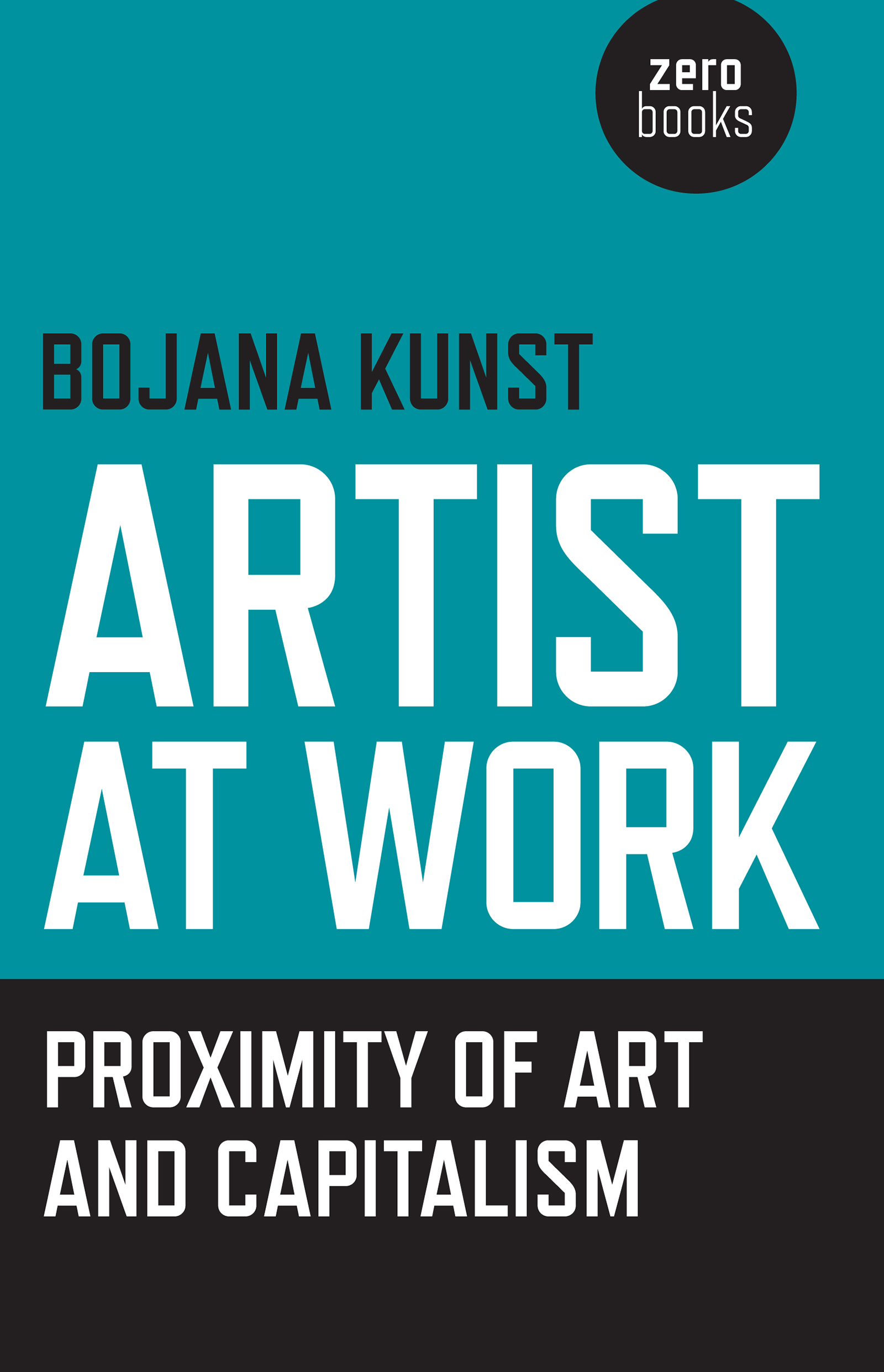
bojana-kunst-artist-at-workBook presentation of Bojana Kunst’s ‘Artist At Work: Proximity of Art and Capitalism’. 1/10 in De Vooruit, Gent.

When Belgian philosopher Dieter Lesage was invited to write an introductory text for the catalogue of German artist Ina Wudtke Lesage slightly changed the proposal. Rather than describing Wudtke’s artistic “products”, his “Portrait of the Artist as a Worker” describes what the artist does when she works:

“You are an artist and that means: you don’t do it for the money. That is what some people think. It is a great excuse not to pay you for all the things you do. So what happens is that you, as an artist, put money into projects that others will show in their museum, in their Kunsthalle, in their exhibition space, in their gallery. So you are an investor. You give loans nobody will repay you. You take financial risks. You speculate on yourself as an artistic asset. You are a trader. You cannot put all your money into one kind of artistic stock. So you diversify your activities. You manage the risks you take. You would say it differently. I know. You say you suffer from a gentle schizophrenia. You have multiple personalities. You are a photographer, but also a DJ. You have a magazine, you are a publisher, but you also organize parties. You take photos of party people. You throw a party when you present a magazine, you make magazines with photographs of party people, you throw a party and you are the DJ. You do interviews with people you meet, you do interviews with people you would like to meet, you tell the people you meet about your magazine. You buy records on flea markets, you distribute flyers announcing parties in the bar where you have a coffee after visiting the flea market, you make videos recording how you destroy the records you bought on the flea market, you liberate your country from its bad music, you show the video in a gallery and you are a DJ at the vernissage.”

In her new book Artist at work art historian and Bojana Kunst takes up exactly this question of “how do artists work?”. What should we consider as artistic work? Is everything the artist does part of the artistic ‘practice’? Where is the work? Is it in the gallery? In the theatre? In the rehearsal space?…

In her thought-provoking book Kunst addresses all these questions through a more extensive analysis of contemporary “postfordist” or “immaterial” labour. Mapping the evolution in the organisation of labour, Kunst shows how the modernist claim that ‘the work of art and the work of life should be inseparable’ has established itself in the very hearth of capitalist society. However, rather than becoming cynical or pessimistic Kunst searches for way to reclaim ‘work’ and to emancipate artistic work from its neoliberal counterpart.

In this time where every ‘creative worker’ is juggling several projects and manages several “projective temporalities”, Kunst analysis of the way artist works provides an insightful analyses on how artist work and looks for pathways to “rebel against the project and demand the temporality of work as duration”.

Eula Biss’ Immunity: A question of relation

By Laura Katherine Smith

BissWhile doing research for the then upcoming international conference hosted by the KU Leuven: Immunity and Modernity: Picturing Threat and Protection (May 2015), I picked up the book On Immunity: An Inoculation (2014). I thought that Eula Biss’ book might offer a straight forward, medical or law-based analysis that would help me to pin down or to grasp an answer to the question: just what is immunity? Biss’ book did not provide such a ready-made definition of immunity but rather, and to my benefit as a reader, documented a journey of discovery that outlines and embraces the complexity of this concept. Eula Biss, author of On Immunity: An Inoculation, is a senior lecturer in the Department of English at Northwestern University.

The book opens with an image of the myth of Achilles, “whose mother tried to make him immortal” (3). Through such stories of myth and fate, Biss shares her earliest memories with the reader; encounters with what she would later come to recognize as related to the question of immunity. These often cautionary tales were passed from parents to child. The stories, including Grimm’s Fairy Tales, remained in latent consciousness as Biss returned to explore the limits and possibilities of immunity as an adult. The author notes, “I do not remember the brutality for which those tales are famous as vividly as I remember their magic. (…) But it did not escape my notice, as a child, that the parents in those tales have a maddening habit of getting tricked into making bad gambles with their children’s lives” (4). The author’s struggle for clarity with regards to this concept is coloured by her own experience as the daughter of a doctor, as a nonfiction writer and as a mother. The book’s dedication reads: “to other mothers, with gratitude to mine”.

In addition to what Sarah Manguso defines as Biss’ ‘self-documentation’, the reader feels herself well informed by the obvious paramount research that has gone into Biss’ investigation of immunity (Manguso defines this extensive research practice as Biss’ ‘world-documentation’). The collected fragments for this project are drawn from medical journals and articles, nonfiction and fiction books, newspaper clippings, world events, politics, history, poetry, science and myth in an exhaustive effort to come to terms with this concept. Biss’ methodology creates an historical tapestry; stories and voices of Christopher Columbus, Karl Marx, George Orwell, John Keats, Søren Kierkegaard, and Rainer Maria Rilke are woven amidst various scholars, including Susan Sontag and Donna Haraway, as well as historians of immunology and other scientists. Data from the American Medical Association, the Centre for Disease Control and Prevention, and the World Health Organization entwine with these stories and voices. References to Alice in Wonderland and, in particular, Bram Stoker’s Dracula, reinforce this tapestry. Biss takes the reader back to the first vaccinations in the eighteenth century that were performed by farmers and involved transferring the pus of infected cows (cowpox) into humans – the author notes that this experiment was successful in the protection against smallpox. Themes and topics of vaccination, fearfulness, paranoia, germ theory, herd immunity, banking immunity, and governmental and pharmaceutical corruption fill out the context upon which we imagine our own and each other’s immunity.

To describe Biss’ book as ‘straight forward’ would be, on the one hand, to highlight the ease with which this book is read – the reader can immediately relate to its reminiscences of personal familial experience concerning, for example, childhood illness, debates about vaccination, and the confusion of frenzied consumerism – its trends and paralysing choices when it comes to ‘knowing what is best for our children’. However, overall, and to her credit, Biss takes the reader on an anything but ‘straight forward’ journey. With the author as guide, the reader discovers that this concept bends, twists, and metamorphoses as metaphor and imagination grip and drive perception and experience.

This book identifies that immunity turns around the central question of self and other. As a new, and she admits ‘fearful’ mother, Biss tries, through the collection and analysis of information, to find the best strategies of protection for her newborn son. Through this investigation, however, the blurring of lines – between imagined and physical self and other, individual and community – becomes evident and Biss posits that humans are not and cannot be immune to life since we are bound to the very elements that we perceive as threatening. We are ‘always already’ both threatened and dangerous it turns out although continuously, “we imagine our bodies as isolated homesteads that we tend either well or badly” (21). George Lakoff and Mark Johnson’s book, Metaphors We Live By (1980), is directly put to use here as Biss demonstrates that metaphor shapes the way we perceive ourselves and the world.

Rather than pinning down a static answer to ‘what is immunity?’, I have instead obtained, through Biss’ book, a much richer understanding of the nature of immunity. Rather than a definition of immunity that closes a conversation, Biss’ book creates fertile links that spark further thought – a meditation on the concept without beginning or end. A metamorphic image of immunity, gleaned from Biss’s book, proved a solid foundation for my further research – not despite but because of its malleability in confronting the question: just what is immunity? The image of immunity that Biss paints is one of relation, a continual negotiation, breakdown, and/or redefinition across and between self-other. Biss’ complex constellation, wherein all of life is implicated in the consideration of immunity, inevitably demonstrates that with protection comes vulnerability and vice versa.

Highly recommended reading for research and/or general interest.

Blogging the Narrative of Culture, Media and the Arts

By Anneleen Masschelein

Tom Gauld

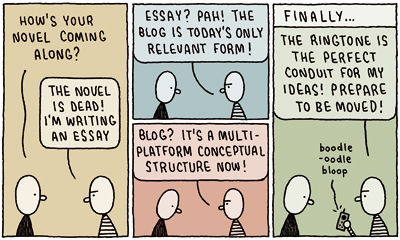
Image courtesy of Tom Gauld.

The blog “Cultural Studies Leuven, Blogging Since 1425”, hosted by the staff of the Institute for Cultural Studies in Leuven, aims to share interesting publications and events, and give insight into our research and the best work of our students. The research of ICS Leuven can be placed on three, interrelated axes: ‘cultural theory and concepts’, ‘applied narrative’ and ‘media, art and technology’. Interdisciplinarity is of course crucial to the concept of Cultural Studies and we enjoy collaborating with colleagues from other disciplines, departments and institutions. However, these three strands, we believe, do summarize our shared project and can help make our identity as a group visible. Last but certainly not least, these three thematic focus points are not purely research-oriented but they all have practical ramifications in various events that will be organized in the coming year.

Cultural theory and concepts encompasses research on important cultural theorists and ideas that belong to the canon of cultural studies, ranging from the theorists associated with the Birmingham Centre of Contemporary Culture Studies, like Stuart Hall or Angela McRobbie, to important thinkers about culture now (Meghan Morris, Andrew Ross, Lauren Berlant, Pierre Bourdieu and Gisèle Sapiro, …) and in the past (Walter Benjamin, Jean Baudrillard, Theodor Adorno …). We also focus on certain concepts that are topical in cultural studies today: precarity, postfeminism, vernacular, identity, creative industries, amateur/professional, immunity, biopolitics and social choreography… Apart from traditional research, it is our aim to invite some of these theorists to Leuven and interview them for our blog. We will signal interesting events and there will be screenings of documentaries (or other public performances like plays or blogs…) related to theorists, theories and concepts.

Applied Narrative concerns all kinds of storytelling that are a bit outside or beside the focus of traditional narratology, i.e., the analysis of literature and film. More particularly, we study serial storytelling in quality television series, the culture of handbooks or How-To-Books for various literary genres, graphic novels and photonovels and photo narratives, illness narratives, and storytelling and new media. But also the question of dance and notation, archives and narrative and semiotic structures in culture can be seen as part of this focus. We not only study all these types of narrative, but we are also actively involved with different organizations that host events on new forms of storytelling – the Are You Series festival at Bozar or Passa Porta, a Brussels-based literary organization – and many of us enjoy working and experimenting with new narrative forms.

Media, Art and Performance is a label that groups together all work on the intersection between art, culture and technology on the one hand: the representation and social construction of technology, but also new cultural and artistic forms that stretch the limits of technologies. On the other hand, it also has to do with our mediatized society in which the distinctions between real and fiction, between authentic and fake, between live and staged have become highly complex and often problematic. This is perhaps most clear in the domain of performance in the broadest sense of the term – ranging from “art” to performing and staging the self and biopolitics – that holds up a mirror to society and ourselves and shows how the human body is always already mediatized and permeated by technology and by politics. Many of the concrete projects that staff members are involved with can be placed under this aegis. There are the collaborations of ICS with FabLab Leuven: Ex Vitro, an artist in residence program that will result in an artistic walk in the “science quarter” of Leuven, a Hackathon where hackers will remix photographic heritage, and a city quest using augmented reality that we elaborate with the city archives of Leuven. The new course on the theory and analysis of contemporary dance in collaboration with STUK will bring together various choreographers and dramaturgs in public debates. And there are several events coming up, such as an exhibition on interwar typography around the “Arts et métiers graphiques” magazine in October (University Library Leuven, opening Oct. 21st),  and a conference on ‘Photography Performing Humor’ in November (LUCA School of Arts Brussels, November 24th-25th).

As pointed out above, the three focus points intersect in interesting ways. Moreover, we are all cultural and intellectual omnivores who are basically interested in everything. So while we will try to consistently highlight our three research tracks in the blogposts, we also keep an eye open for everything interesting, especially when it comes from our students, who, in the course of their time with us, constantly feed us with new impulses and ideas.

Paul Otlet’s Mundaneum, or How to create the internet before the digital age

Otlet's post

By Jan Baetens

On August 23rd, Google celebrated the 147th birthday of Paul Otlet, one of the visionary minds whose thinking has proven crucial in the birth of the Internet. Otlet did not invent the Internet himself. Inventions are always the result of a social and collective “desire” – and I am reusing here the key word of the seminal book by Geoffrey Batchen, Burning With Desire (MIT, 1997), on the dream of photography before the technique was actually developed and eventually commercialized (or given away for free: nothing new under the sun).

Otlet’s dream to  foster world peace and understanding between nations through information and communication could only take a pre-digital form when he established his Mundaneum, a searchable index cards system on which he worked during the first decades of the 20th Century (in this context, he also introduced many important technical innovations in the field of information storage and retrieval, for instance in the UDC system or, more prosaically, the ideal size and form of the index card and library furniture).

As demonstrated by Markus Krajewski in his World Projects (Minnesota UP, 2014), the craving for global information systems was already a major feature of Western culture around 1900, and Otlet was just one of the many revolutionary thinkers eager to supersede the divide of languages, media, currencies, disciplines, and national frontiers. Institutionally speaking, most of these thinkers were not very successful. They worked in the margins of the established knowledge production centers, often with little political and ideological support from the decision-makers.

If the case of Paul Otlet is so fascinating, it is not only because of his truly visionary thinking, but also because of the possibility we have now to rediscover his intellectual and material heritage in all its complexity. The City of Mons, European Capital of Culture in 2015, hosts the essential pieces of what is left of the Mundaneum –the heart of the “ideal city” of culture, research and information Otlet wanted to build from scratch with the help of Le Corbusier. It is hosted by a wonderful museum that combines an impressive reconstruction of Otlet’s working space with thematic organizations on knowledge and media communication. And Paul Otlet’s major scientific publication, his Treatise on Documentation, has just been republished in a well-designed facsimile edition. It is an amazing document, not only for those working on the history of science, as well as an excellent preparation for a city trip to Mons (don’t miss Mons 2015, you will regret it!).


Mundaneum: http://www.mundaneum.org/en

Paul Otlet, Le livre sur le livre. Traité de documentation (with prefaces by Benoît Peeters, Sylvie Fayet-Scribe and Alex Wright). Brussels : Les Impressions Nouvelles, 2015. (http://www.lesimpressionsnouvelles.com/catalogue/le-livre-sur-le-livre/)

Intellectual Property Rights: good or bad for Creativity in the Digital World?

By Fred Truyen

VanEyck2

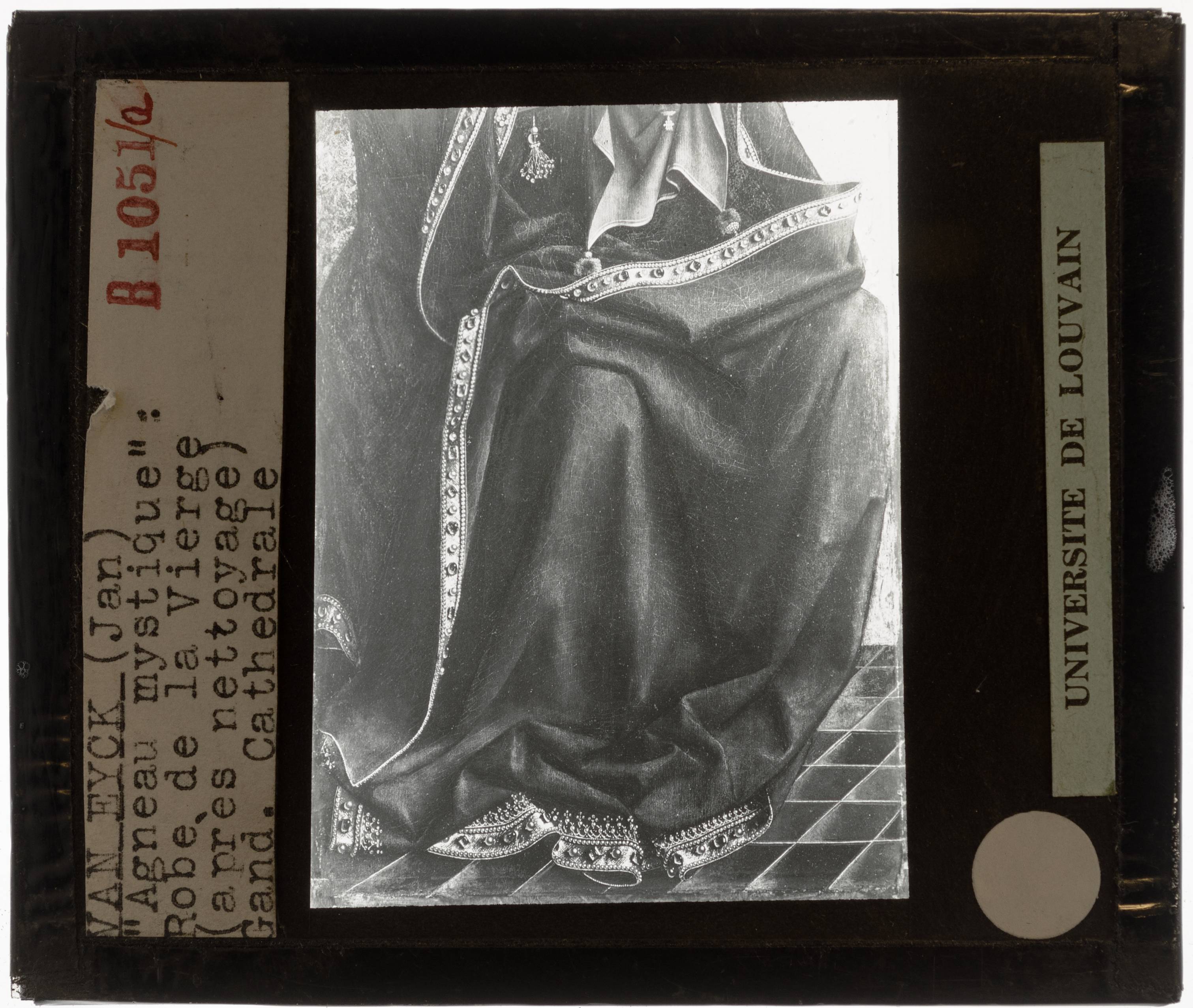
Jan van Eyck. Hubert van Eyck. Lam Gods Open: Our Lady Mary, detail: Dress Collection Glass slides KU Leuven Saint Baafs Cathedral, Ghent Public Domain Marked

I was writing a contribution for a book for the RICHES project, which deals with challenges of heritage in the digital environment. I chose to offer some reflections on our experience with Intellectual Property Rights (IPR) in the EuropeanaPhotography project (see also the nice final report!). While this project was about early photography, and we spent golden moments just sifting through brilliant collections of early photographs, (we never had a meeting without actually looking at photos) – IPR imposed itself as an unwanted burden; a horribly complex but unavoidable issue when you’re dealing with photography. From a task attributed to a subcontractor it quickly became a pivotal aspect of the project. And an interesting one, I must confess.

What was the situation? We were, with about 15 partners, of which several hold prominent archives of photographic heritage, both public and private, hired to digitize, and then contribute about 450.000 high quality images of early photography to Europeana. The digitization, though technically challenging, went smoothly. But the upload to Europeana encountered a glitch, when it appeared that the images had to pass through what is called the “Rights Labelling Campaign“, which tries to identify, for each object uploaded to Europeana, the copyright status.

For an individual user of Europeana, this is not so relevant, but once you want to make professional and/or commercial use of what is on Europeana, it becomes totally different. Because while Europeana gives you free access to about 30 million objects of European Cultural Heritage, copyrights tend to block any re-use other than personal re-use. So even a teacher who would want to make a website for their students cannot simply copy these images, without checking the copyright. Having clear copyright labels that allow you to search for reusable content is thus a necessity, both for humans and computer applications: developers can easily filter out content that they can reuse in their apps.

At first the content providers for EuropeanaPhotography were not pleased by this initiative, to say the least. Private photo agencies, whose business model is completely IPR oriented, fearing their older work, when labelled Public Domain, would be reused without them receiving any revenue. Similarly, public archives, who feared misuse of heritage photos (e.g. as backgrounds in video games or commercials), were not at ease. You can read about these findings in our IPR Guidebook.

Eventually, we had some very good experiences with publishing under an open license, e.g. with the beautiful Lithuanian Art Museum collection (see also a nice blogpost about this), the Gencat collection and the KU Leuven collection.

On the one hand, certainly in the digital realm, IPR is essential so that those who produce and create valuable works can earn a living from it. Without copyright protection (and the similar patent, design, software and database protections) authors, programmers, developers, publishers and others in the creative industries wouldn’t be able to sustain their work. But with massive sharing of information on the internet in the smartphone age, IPR doesn’t seem very much up to the task. And it’s very complicated too. If you want to learn more about its intricacies, there are the absolutely excellent and very readable guidelines developed by the Europeana Fashion project. In particular, two deficiencies in the current regulations are holding up creative reuse.

First of all, most European national legislations do not have a real “Fair Use” provision such as US Copyright Law §107. These limit the copyrights in such a way that educatonal reuse is warranted. Instead, in Europe, there are “fair dealings” with the rights holder representatives (often collecting societies) that many in the educational world would rather label as “unfair dealings“. In Belgium, e.g. through Reprobel, universities and libraries contribute for their use of copyrighted work in an educational context.

Second, libraries and archives are hampered when trying to put digitzed heritage online by still unfinished legal work on Orphan Works, a work of which the author is unknown, which is the case for many very interesting family photographs in archives (which are often the most appealing images for an archive to publish). In many European countries there is still no translation of the EC Orphan Works directive in national laws, so there is still a lot of risk involved that right holder representatives come up with claims.

Public Domain Mark

What can help, and how can you help? Well, first of all, if you contribute stuff to the web and do want to share, use Creative Commons rights statements to clearly indicate that your work can be reused, remixed, redistributed to the benefit of all, and why not to your own benefit in the long run. And don’t be too shy: “commercial reuse” isn’t always “commercial” as in “commercials” or advertising. It could be some smart kid makes a nifty application with your work, which brings joy to all! He/She needs to pay his bills for pizza and sweets, and their internet connection too!

But, more generally, copyrights should be embedded in a broader discussion, involving moral and cultural rights. One of those rights is the right to culture! A very convincing proposal has been worked out in the RICHES project policy brief, a must read for anyone interested in Cultural Policy and Creative Industries. Real access to culture means also appropriation by stakeholder communities and the possibility for co-creation.

And what if you yourself, in a sudden moment of creative fervor, decide to reuse content and make something new and share it with others? Well, you can easily search for reusable content online using the following resources:

Enjoy!