A Reprint as well as a Novelty: The Castle 2.0

By Jan Baetens

Deprez1

Cover of the first edition

Le Château (“The Castle”) is a two hundred pages mute graphic novel by the Belgian artist Olivier Deprez. First published in 2002, this reinterpretation in expressionist black and white woodcuts of Kafka’s famous novel was immediately recognized as a masterpiece of modern graphic storytelling and had rapidly become a cult album. The longtime out of print status of the book dramatically increased its almost mythical standing, while slowly moving the work from the field of literature to that of visual arts (actually, the only way to access the material was to visit the regular exhibits of Deprez’s work, in Belgium as well as abroad).


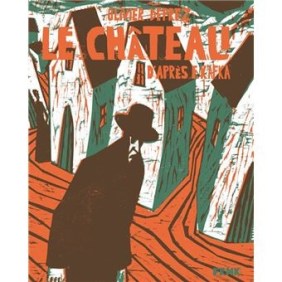
The new edition of the book, superbly printed and including some minor edits and a strongly revised cover and flyleaf design, will finally enable a larger audience to discover and appreciate this milestone of the modern graphic novel, radically different from the prototypical features of this kind of narrative.
Deprez2

Cover of the new edition

At first sight, one may even have the impression that The Castle rejects most of the elements that distinguish the graphic novel from mainstream comics: no autobiographical voice or plot, no blurring of boundaries between fiction and nonfiction, no attempt to present a narrative that ties in with the daily life and the ordinary concerns of today’s reader. Instead, the book appropriates a very old technique (woodcuts, here directly inspired by the pioneering early 20th Century work by Frans Masereel, the founding father of the wordless graphic novel), and is not afraid of proposing a personal yet faithful adaptation of a literary classic (Kafka’s unfinished novel was only published in 1926, two years after the death of the author).

Yet form and content of Deprez’s work are stunning. The novel’s plot, an endless and open series of waiting and missed encounters, is both cleverly respected and completely reinterpreted in a new way of visual telling. Key in this regard are two elements: first the tension between figuration and abstraction, which appear as two sides of the same coin; second the multiple plays with rhythm, as determined by the fundamental “beat” of the page layout, which generally offers a combination of two large horizontal panels (the notion of “gutter”, the worn-out stereotype of comics analysis which always repeats the importance of the “gap” between panels, is reworked according to the more fundamental logic of montage, the basic unit being the page and the double spread, not the sequentially arranged individual units).

The reading of Deprez’s Kafka book can now finally take a new start. In combination with a series of upcoming exhibits (among them a retrospective at the Wittockiana in Brussels), this new edition will represent a major and lasting contribution to the field of graphic storytelling in print.


Oliver Deprez, Le Château. D’après F. Kafka. Brussels : FRMK

ISBN : 9782390220138
Around the world in 80.000 slides: the Carl Simon collection

By Sofie Taes – PHOTOCONSORTIUM / KU Leuven – CS Digital

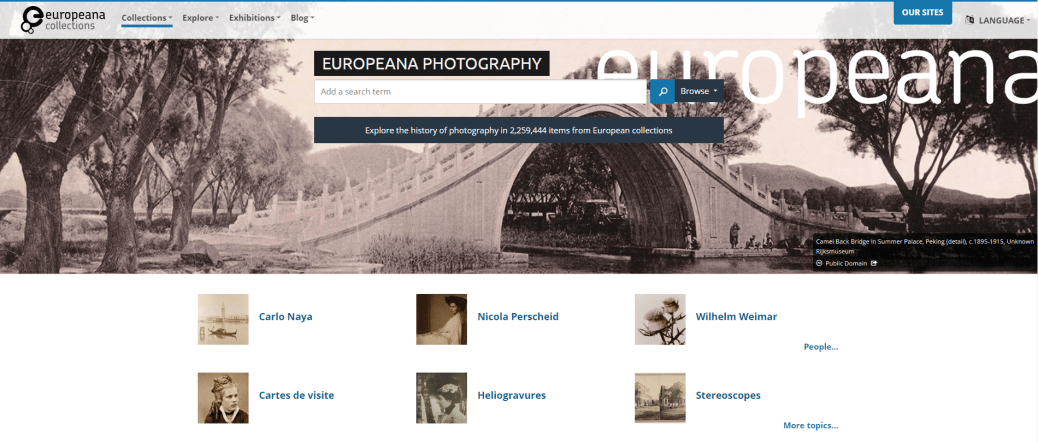
Over the past two years, CS Digital has been partnering up with Europeana – Europe’s most trusted source of digital cultural heritage objects – to promote photographic heritage via the ‘Thematic Collection’ on photography. This subset of photographic records only includes high-quality images, often with a license permitting (free) re-use. Also characteristic to the Thematic Collection are the editorial features that allow for a (re)discovery of masterful photographers, outstanding oeuvres, interesting techniques and previously undisclosed collections.

Working mostly on content selection, curation and online publications, we have been only too happy to embark upon the rollercoaster that is the dive into +2 million early photographs. Because our quest for amazing images, baffling stories and must-see collections has brought on our way a veritable treasure trove of photographic gems and unforgettable characters.

CS1

Europeana Photography Thematic Collection – Homepage

Carl Simon definitely ranges among the latter. Simon (1873-1952) first worked as a procurator at the German photo company Liesegang in Düsseldorf and founded his own photography service company in 1907. He constructed cameras, lent slide projectors and began to collect hand-colored glass slides on a wide array of topics (historical, scientific, geographical, literary, etc).

CS2

A visit to the zoo: the bears Carl Simon United Archives/Archiv Carl Simon. In Copyright

Presenting slide shows with narration and live music eventually became the core of his activities. Simon wanted to show the world to as many people as possible – especially those who didn’t have the means to go and explore themselves –  and put on about 300 shows all across Germany.

By 1945, his collection comprised no less than 80.000 images. After Simon’s demise in 1952, this substantial archive was inherited by his son Karl-Heinz Simon (1920-2002). Karl-Heinz continued to use the material in slide shows, but to the public at large, the collection remained unknown and unseen.

In 2011 – about 6 decades later – the life work of Carl Simon was finally rediscovered in an old storage room in Unterbilk, Düsseldorf (Germany). A year later, United Archives – a photo agency based in Cologne – acquired this unique legacy.

The Carl Simon collection is a most intriguing private archive. Next to 2 original glass slide projectors, 15 lenses and scripts used by Simon in his public presentations, United Archives was able to add c. 23.000 glass slides, arranged in 200 wooden boxes, to its collection.

The range of topics covered by Simon is astonishing: from “Earthquakes and volcanic activity”, “Japan” and “Tibet”, “Faces of Sweden”, “Folk songs” and “Fairy tales”, to “Underwater life”, “A Visit to the Zoo”, “The lives and miracles of the Saints” and “The Dangers of Alcohol”.

Visually, the slides range from child-like drawings to intricate illustrations, photographic images, maps and diagrams. In this image, taken from the ‘Alcoholism’ series, Simon compares the composition of cognac and absinthe in an early example of ‘data visualization’. In a more illustrative style, the ‘metamorphosis’ from healthy young gentleman into inebriated pensioner is depicted here. The worst outcome to be expected, is not left out of the picture show: this etching-style slide shows exactly how a life wasted to alcohol might end…

The compact ‘Tunisia’-series is a beautiful example of a travel report in pictures, with the carefully chosen and applied colors emphasizing the exotic features of the chosen sights. One of the absolute highlights is the ‘Titanic’-story, using a wide range of pictorial styles and touching upon the key points in the narrative, as well as on some intriguing details (ship construction, committee hearing of the ship’s company director, …). In the diptych below, a view of the luxurious dining hall (left) is flanked by a drawing of the wreck at the bottom of the sea.

As a whole, this collection testifies to a media-practice that has transformed significantly over the past few decades. Pitches and presentations often still consist of a well-paced succession of spoken text and visuals (powerpoint, Prezi, ….) yet mostly get reduced to short sequences with an aim to inform or to demonstrate only. Simon’s objective could be best summarized as ‘Bildung’: he wanted to share his finds, his experiences and his stories in a thorough yet engaging manner – an early example of “infotainment” – so as to implant new knowledge with spectators, furthering their level of culture and intellectually empowering them. The written scenarios and the slide projectors add a tactility to his efforts that definitely has a ‘vintage’ feel about it, at the same time underlining his dedication and commitment to the cause.

Thanks to the digitization of this archive, Simon’s mission has now taken on a new, global dimension. Still, our relationship with these glass slides has changed as well: Simon’s archive is no Wikipedia, which we might turn to in search for objective information about a certain person, country or phenomenon. Yet it does provide extremely valuable insights in social conventions and traditions, ethical and aesthetical ideals of the time. So make sure to join us in revisiting Simon’s slides in the Europeana Thematic Collection: we promise it’ll be worth your while.

French Cartoon Art in the 1960s and 1970s

By Jan Baetens

Michallat1

Wendy Michallat

French Cartoon Art in the 1960s and 1970s

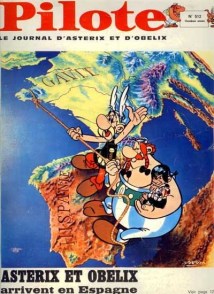
Pilote hebdomadaire and the Teenager Bande Dessinée

http://upers.kuleuven.be/en/books/authors/wendy-michallat


Launched in 1959 by René Goscinny and Jean-Michel Charlier, partially in reaction to the unfair labor conditions offered by the then leading comics magazines, Pilote is considered today the publication that made the bridge between traditional children and adolescent comics magazines such as Tintin or Spirou and adult comic journals such as Fluide Glacial and Métal Hurlant (which will even develop a US sister publication[1]). As the publication that translated and creatively appropriated some material of Kurtzman’s MAD magazine, Pilote also played a vital role in the transatlantic dialogue between US nonmainstream, if not underground production, and the new European comic artists.

Michallat2Although there exist quite some studies on the journal, the study by Wendy Michallat is the very first one to rethink its history in a broader perspective, not just that of comics culture, but that of culture at large. And the result is absolutely breath-taking. First of all because Michallat gives a very detailed yet nuanced and well written overview of the various periods of the magazine, whose history is one of nearly permanent crisis and eternal attempts to relaunch new formats and formulas in a publication niche that was much less profitable than it was often thought. Second, and most importantly, because the author succeeds in doing what other studies fail to do, namely explaining the systematic changes in the magazine’s policy.Michallat3

This explanation is not an a posteriori enumeration of hits and misses, but a scrupulous examination of the various contextual aspects that influence the zigzag transformations of the journal. As such, Michallat’s study is a model for all those who would like to write the history of a mass media form. More particularly, it takes into account issues such as:

  • The need to come up with a concept that is ‘in sync’ with social and political expectations (in this case the obsession with “education” in postwar France, which helped turn away from the pure entertainment of comics and introduce a more text-oriented magazine).
  • The competition with similar titles, which cannot be reduced to a matter of style and content, but has a lot to do with distribution networks and good or bad relationships with backing groups in society.
  • The legal constraints that burden the necessity to always change even a winning formula, in this case, the (in-)famous law of 16 July 1949 on Publications for Youth, censoring all publications depicting crime, violence and moral debauchery (initially a measure of protectionism, for the law helped ban all American import, it rapidly became a dangerous arm in the hands of all those eager to police this type of publications).
  • The necessity to find a place in the existing mediascape, for instance via new forms of collaborations with newspapers and radio stations (at that moment, just after the invention of the transistor, the dominating medium in youth culture).
  • The obligation to adapt to a rapidly changing cultural environment, for instance by taking into account that the comics medium during the sixties gradually became an important vector of the counterculture.
  • The challenges raised by the internal changes of the magazine format itself, torn between different and always unstable logics, as revealed for instance by the emergence of the comics album as the new hegemonic format.[2]
  • The labor conditions within a collective enterprise such as a comics magazine, which has to find a balance between the creative freedom offered to its collaborators and the basic obligation to make money (we shouldn’t forget that May 68 did not start in May 68, but had been prepared by a decade of growing unease with a mainstream culture that was no longer capable of keeping its great promises of the postwar period).

The great achievement of Michallat is that she shows the complex interaction between these (and many other) dimensions, which prove often mutually incompatible. She does so in a way that retells the whole story as if we were in the driver’s seat, facing problems as well as opportunities and having to take decisions whose consequences remain unsure. This approach gives the reader the impression that she is making history herself, including when it comes down to find an answer to failures and dead ends (even if the magazine will last till 1989, its life as a weekly ends in the early seventies, which is also the moment in which its influence in the field is reduced to almost nothing).


[1] Nicolas Labarre, Heavy Metal, l’autre Métal Hurlant. Bordeaux: Bordeaux UP, 2017, see : https://www.noosfere.org/icarus/livres/niourf.asp?numlivre=2146594729).

[2] On this dramatic change, see the exhibition curated by the GREBD research group of the University of Lausanne: https://wp.unil.ch/grebd/evenements/expositions-du-grebd/

Traversals: The Use of Preservation for Early Electronic Writing

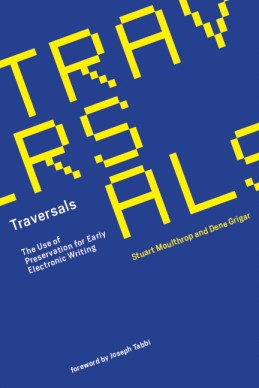
A reading suggestion for the summer: Traversals: The Use of Preservation for Early Electronic Writing by Stuart Moulthrop and Dene Grigar and with foreword by Joseph Tabbi, described as “An exercise in reclaiming electronic literary works on inaccessible platforms, examining four works as both artifacts and operations.”

Many pioneering works of electronic literature are now largely inaccessible because of changes in hardware, software, and platforms. The virtual disappearance of these works—created on floppy disks, in Apple’s defunct HyperCard, and on other early systems and platforms—not only puts important electronic literary work out of reach but also signals the fragility of most works of culture in the digital age. In response, Dene Grigar and Stuart Moulthrop have been working to document and preserve electronic literature, work that has culminated in the Pathfinders project and its series of “Traversals”—video and audio recordings of demonstrations performed on historically appropriate platforms, with participation and commentary by the authors of the works.

If you are still unconvinced, you should first read Jan Baetens’ review of the book. Quoting directly from the review:

The very classical, perhaps eternal, topic of the author speculating on, day-dreaming or boasting of the afterlife of her or his works, is something that the successive new media revolutions of the last decades are forcing us, as readers as well as writers, to reconsider in radical ways […] True, the loss of literary and other works is far from a new phenomenon (most works are almost immediately forgotten; many works are destroyed, by accident or on purpose; still others get simply lost), but the issue of their technical accessibility is becoming one of the major problems of our contemporary, electronic culture. […] If one decides that just moving ahead in order not to miss the next new thing and that just forgetting about the past is what matters, then technical obsolescence is not a problem. But if one believes instead that “we must struggle never to forget” (p. 237, last words of the text), then the situation becomes quite different (it should be reminded here that in cultural semiotics, as illustrated by the School of Tartu of Yuri Lotman, culture is defined as “non-hereditary memory”). The keyword of this book’s subtitle is therefore twofold: it is about preservation, but even more about the use of preservation, a way of saying that it should be read as a double warning: first, against the illusion of the very possibility of such an enterprise (nothing can be “really” preserved –– what is being preserved is always only a certain form or version of it); second, against the confusion between material conservation (which is a necessary step in the larger process but nothing more) and preservation in the broader sense of the word (which refers to the need of making meaning of the object of preservation, here and now but also in the future).

You can access the full review here.

Traversals


Traversals: The Use of Preservation for Early Electronic Writing

by Stuart Moulthrop and Dene Grigar; foreword by Joseph Tabbi

The MIT Press, Cambridge, MA, 2017
296 pp., illus 30 b/w. $45.00
ISBN: 9780262035972

Adaptation studies after the fidelity issue

By Jan Baetens

For many decades, scholars of adaptation studies have been quarreling on the flaws and merits of the so-called fidelity issue, that is the (biased) idea that the novel is always better than the film and that the value of a movie thus depends on its more or less faithful recreation of the original, whatever all these terms (recreation, faithful, original) may mean.

Current research has a more relaxed take on these problems, what does not mean of course that fidelity is no longer an interesting field of research. Simone Murray has done excellent work in the economic reframing of fidelity: the decision to select a work for adaptation and to rework it in a way that acknowledges the form and content of the adapted work is less determined by aesthetic than by financial issues (cf. The Adaptation Industry, 2012). Jean-Louis Jeannelle has foregrounded the necessity of making a genetic analysis of the adaptation process, making room for trial and error, if not for failures, censorship, and other types of obstacles (cf. Cinémalraux, 2014). Jean Cléder and Laurent Jullier, whose book Analyser une adaptation (2017) was reviewed here a couple of weeks ago, strongly advocate for the creative practice of adaptation as interpretation.

Adaptation

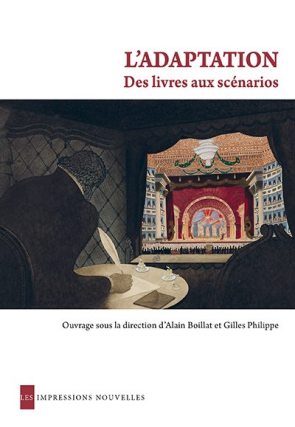
In this broader context, L’Adaptation. Des films aux scenarios (Les Impressions Nouvelles, 2018), a collection of essays edited by Alain Boillat and Gilles Philippe, respectively professor of cinema studies and linguistics at the University of Lausanne, can be seen as both an admirable synthesis of the abovementioned tendencies and a groundbreaking study that helps rethink the very process of adaptation.

On the one hand, one finds here many elements that were highlighted by Murray, Jeannelle, and Cléder and Jullier: a strong focus on the industrial aspects of cinema, a sharp awareness of the inevitable difficulties and dead ends of the adaptive process, and the healthy reminder that adaptations do not have to save the original but give it a new life –on screen and elsewhere. On the other hand, their work on the archive of a famous, although today not always much appreciated director, Claude Autant-Lara, a typical representative of the “French Quality” school of the 1940s and 50s, allows them to correct a certain number of historical errors and misunderstandings as well as to propose a different methodological and theoretical framework for the study of filmic adaptations. As an example of the former, I am thinking of their new reading of François Truffaut’s debunking of Autant-Lara and “French Quality” in his 1954 article “A Certain Tendency of French Cinema”. Their historical reconstruction clearly demonstrates how critically and ethically unfair Truffaut’s attack actually was, and how urgent it is to abandon the caricature of “French Quality” that the young Turks of the New Wave have managed to establish as an eternal truth. As an example of the latter, it is key to emphasize the work that this book is doing on the redefinition of the very process of adaptation. Instead of being a single process of changing words into images, adaptation is a multilayered and temporally very complex procedure that involves a great number of intermediary agents such as, for instance, the person that transforms the book into a filmable idea, the person that further transforms this idea into a shooting script, the person that writes and edits the dialogues –not to mention the many feedback and interaction processes between them that determine the making of a movie.

All the essays in this book, written by some of the best film scholars in French today, share these same convictions. Hence the exemplary cohesion of the book, whose use-value is increased by the exceptional stylistic and conceptual fluency of all the articles and the elegant layout. Currently the best that is being said and written on cinema in French, this book should be translated in English with no further delay.

In a Search of an Oasis

How do we respond to the current ecological issues and how much of environmental consciousness is getting to us? How can we, collectively or individually, improve the natural environment within the city of Leuven? What are the most pollution-free sites in Leuven and how to visit them?

In a Search of an Oasis” is a project created by Cultural Studies Master students Eline Dewaele, Amber Florizoone, Lucie Korbelová and Josef Terlaeken as part of the course ‘Cultural Policy’.

The Faculty of Art’s Erasmus Building is surrounded a by a “literary garden”. Amid the shrubs, trees and occasional flowers, surrounded by a sea of concrete and brick, you’ll find short poems celebrating the beauty of nature. However, the poems paint an idyllic, romanticized, and nowadays old-fashioned understanding of the relationship between human beings and nature.

Hence, we set up to create a counterweight to the “Erasmus Literary Garden” and communicate a less romantic view of nature.

In Search of an Oasis” focuses on the current ecological concerns of the city of Leuven. We have investigated various types of pollution and consequently created an ecological walk in Leuven, displaying the least and the most polluted places in order to find a little “Oasis” within the city of concrete. Moreover, next to an ecological walk that you can physically follow, our booklet contains pages on eco-poetry. This is a kind of poetry that raises awareness of the connection between nature and culture, thus shifting the boundaries between them.

By moving away, physically and metaphorically, from the romanticized idea of nature, we invite everyone to participate in the promotion and facilitation of the ecological philosophy and practice within the city of Leuven.

In search of an oasis

All shades of Brussels. Why So Serious?! – A photo exhibition

Why so serious posterWhat comes to your mind when you hear Brussels? Politics, terrorism, rain? Or Magritte, beer and waffles? We are 5 Cultural Studies Students from KU Leuven who decided to shift the stereotypes about the “heart of Europe” and show the fun side of Brussels. The photo exhibition “WHY SO SERIOUS?!” will be held in the city center from 7th MAY till 24th MAY 2018.
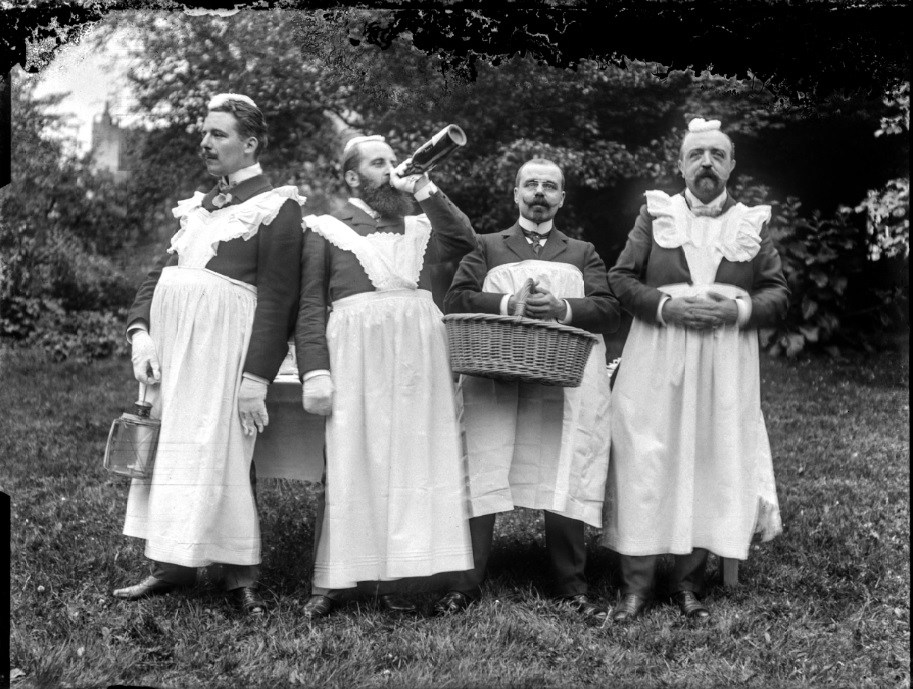
Make laugh, not war

Serious faces on the news, worrying reports from the borders and difficult agreements during the EU summits: the media space makes life in Brussels quite sad. But Belgium and its capital are more than grey skies and grey jackets: the joy of creativity and the unique sense of humor never abandoned this place. Whilst designing the exhibition, we all fell in love with the idea of promoting a positive visual image of Brussels.

How to start?

When the initial idea was born, the next step was to dig deeper. And what’s better to dig deeper than jumping into the past: How did the ‘Bruxellois’ have fun 30, 50, 70 years ago? In our quest for the vintage ‘Bruxellois’, we bumped into an immense photo archive – shout-out to EUROPEANA, apparently the place to be when it comes to images. We found photographs that made us laugh: cows in the streets on a leash like they were dogs; well-dressed, seemingly serious men making fun of themselves by jumping over the friend’s back in an elegant suit… No need to say why we wanted to display these pictures.

Why so serious

© KIK-IRPA, Brussel

Competition and the prize

While vintage photographs are a great way to have a look into the past, we realized that  there is much more going on right now in Brussels. We began wondering how we could capture (and display) the fun and humorous side of today’s Brussels, and the answer suddenly presented itself to us: a photo competition. Fun, surreal and completely crazy photos from Brussels’ streets and houses are welcome – anyone can participate. What do you get? To exhibit your picture right in front of the Central Station in the touristic downtown of Brussels. We already received plenty of the most amazing, weird submissions and had lots of fun arguing whether the portable toilet in the middle of the road is more hilarious than the boy carrying a huge zebra on his back. All in all, we are close to the final selection and look forward to seeing your smiles at KU Leuven Campus Brussels very soon!

We willl open the expo with a VERNISSAGE night on the 7th May from 19:00-21:00 where drinks and snack will increase your visual joy of the exhibition.

Do come, have fun and please, don’t forget to reserve your place for the vernissage here: https://www.whysoseriousbxl.com/events/opening-night/form

Riana Musschoot, Margaux Bertier, Elizaveta Dmitrieva,

Mira Caroen and An-sofie Tratsaert


Why So Serious?!

https://www.whysoseriousbxl.com/

FB: https://www.facebook.com/whysoserious.bxl/

Instagram: https://www.instagram.com/whysoserious.bxl/


Address

KU Leuven Campus Brussels

Rue Montagne aux Herbes Potagères 26, 1000 Bruxelles


Dates & Hours

7-24 May

7:00 – 19:00 Monday-Thursday

7:00 – 18:00 Friday

Closed during weekends and public holidays

“Analyser une adaptation. Du texte à l’écran”

By Jan Baetens

9782081395954

Jean Cléder & Laurent Jullier

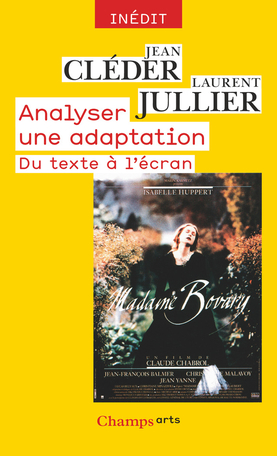
Analyser une adaptation. Du texte à l’écran

Paris : Flammarion, 2017 (« Champs Arts »), 410 p.

ISBN : 9782081395954 (15 euros)


For many years, adaptation studies have been the core business of film and literature studies. The often sterile debates address issues of fidelity as well as the progressive opening of adaptation studies to other media than just film and literature. Co-authored by two leading French film scholars with an impressive pedigree, Jean Cléder and Laurent Jullier, this important book helps reframe both issues, while breaking new ground in this vital field of research.

On the one hand, Cléder and Jullier propose to study adaptations as interpretations, that is, as new works that offer a certain point of view and a new perspective on the adapted work. A clever and nuanced answer to the many problems raised by fidelity discussions, since it avoids direct comparison of source and target, while at the same time keeping a creative relationship between both. On the other hand, Analyser une adaptation demonstrates the usefulness of sticking to close-reading and meticulous exploration of the verbal and the audiovisual, whose medium-specific features should not be discarded in favor of a more generalizing, for instance historical or cultural examination (which does not mean that the historical and cultural context of the analysis is neglected in this book).

The importance of this publication exceeds, however, these global and more institutional considerations, for Analyser une adaptation, which I hope will soon be translated in English, is really the book for which all film scholars, theoreticians as well as teachers, have been anxiously waiting (in that regard, I would like to compare the possible impact of this book to that of Jacques Aumont’s 1990 The Image, a game-changer in the field of visual studies). I would like to foreground here four qualities, each of them already remarkable in itself. First of all, this book demonstrates the possibility of making a technical, even microscopic analysis of adaptation, and it does so with the help of many, excellently chosen examples. The analysis of the “distance” between character and camera, an often -overlooked feature, is a significant renewal of the well-known but not always correctly understood close-up/medium shot/long shot approach. Second, the book succeeds in encouraging its readers to start loving this kind of technical analysis, sometimes considered boring or shallowly mechanic. Cléder and Jullier show very convincingly that extreme close-reading matters and that it discloses key aspects of film adaptations. Third, this book also offers a two-way approach of film and literature, paying as much attention to the verbal adaption of images as to the audiovisual adaptation of texts, thus creating (finally!) a more encompassing reading of word and image in the field of film studies. Fourth (but certainly not last), Analyser une adaptation is a work that proves helpful to both scholars and students. The former will find in it an invitation to rethink many of their concepts and perhaps attitudes. The latter are offered a hands-on approach of adaptation that will prove supportive in more than just the classes on cinema.


Arty as Experience

By Jan Baetens

Updike.jpg

John Updike

Always Looking. Essays on Art

New York: Alfred A. Knopf, 2012

This is not a new book and many readers may find it pathetically old-fashioned. Yet this collection of writings on art with a capital A by an author often discarded as typically WASP is doing what so much modern art criticism seems no longer “capable and willing” of doing, as we are asked by the air hostess when boarding the plane and being offered an exit seat: to make critical judgments, taking into account one’s personal, subjective, individual point of view, but always in a kind and gentle way, written in an elegant and jargon free language, and addressing the reader as a partner in a polite and cheerful conversation.

Updike is never on the lookout for the new or the surprising. The selection of the art shows he discusses may even seem horribly conformist and conservative, unpleasantly biased toward the Western canon, and dramatically reluctant to revise canonical values and classifications. With some slight American exceptions, Updike’s taste –even in the hypothesis that he is doing nothing else than accepting well-paid commissions– almost naturally brings him to the masterpieces of Western painting (things become suddenly American when sculpture is involved, and this sculpture is always bigger than life as in the case of Oldenburg and Serra). And his writing is that of the mild and smiling guide, who hints at what is to be seen and discusses what others –mostly the authors of the catalogue, which is as important a part of a big budget exhibit as the works themselves– have to say on it. It reads marvelously, a real feel good experience for those who do not want to read romance novels.

img769

Yet Updike is also a very sharp and ruthless judge, who is not afraid of saying things nobody else would say. As an outsider –after all, he did not have to make his living as an art critic– he is not only repeating what the artistic community so noisily repeats, he also dares to show the emperor’s new clothes. His remarks on Serra are exemplary in this regard. While underscoring the strength of some of his sculptures but quoting some sophisticated babble of the specialists, Updike concludes “All this steel devoted to scrambling our habitual perceptions? Wouldn’t the funhouse or Ferris wheel at the country fair do just as well?” (p. 192).

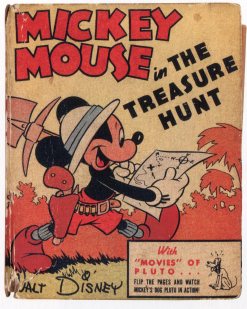
This remark ties in with the preface of the book, in which Updike, who first wanted to become a cartoonist, shows the modest, if not “silly” books that made him an artist: the Mickey Mouse “Big Little Books” of the 1940s serious readers would no longer allow their children to read. That a high-brow and apparently conservative writer such as Updike opens a book like this with praise of what is anything but “the best of the best” is a kind of manifesto –no fists raised of course, since this is Updike, but a lesson on the lasting effects of a real artistic experience (to quote John Dewey, that forgotten founding father of cultural studies).

img770

A universal Belgian

By Jan Baetens

In these days of globalization, including global culture, it might be useful to recall the old humanist ideal of “universality”, that of the uomo universale (and please do not read the term “uomo” in gender-biased terms) who develops his faculties in as many fields as possible and who manages to do so thanks to the general (that is: nonspecialized) education s/he receives and eventually implements in his or her life as scholar, artist, scientist, but also citizen. Today, this ideal has come under pressure, but many examples of great men and women remain to demonstrate how challenging and necessary this ideal of universality remains in today’s society.

img768Simon Leys (pseudonym of Pierre Ryckmans, 1935-2014) is a great example of this humanist ideal. As a law and art history student in Leuven and the representative of a students’ magazine, he was offered the possibility to go to China for one month, an experience that dramatically changed his life. He started to learn Chinese and, after his graduation, left for Taiwan where he defended a PhD on Chinese painting before moving to Hong Kong and eventually Canberra and Sydney, Australia, where he became a professor of Chinese culture. Ryckmans had to take a pseudonym when publishing the book that made him world-famous, The Chairman’s New Clothes: Mao and the Cultural Revolution (1971), the first critical account of the Chinese Cultural Revolution.

It would be unfair, however, to reduce Leys’ work to his political writings. The anthology just released in the Espace Nord series, which had already reissued his best-known novel, The Death of Napoleon, gives an excellent overview of his exceptional diversity. It gathers essays on his three main passions: China (Leys is considered one the best scholars on Chinese culture and painting; he has also translated Confucius in French as well as in English); the sea (in this book one finds for instance an amazing personal testimony of his journey on an old-fashioned sail fishing vessel and thought-provoking comparisons of literary and nonliterary authors fascinated by the sea), and of course literature (a field in which Leys has worked as critic, translator, and novelist).

What strikes most in all these texts is the quality of writing as well as thinking –and it is of course the convergence of these qualities that make Simon Leys such a “universal” author. Leys’ prose is as fluent and crisp as it is jargon-free and permanently open to broader questions, while the discussion of more general issues is systematically supported by literary and cultural examples and insights. Read, for instance, the essay on his experiences as translator, which are also a great example of how to live with, and thanks to, the other (if not in service of him or her). Or take the essay on the issue of heritage in Chinese culture, which departs from a paradox, at least for us Westerners: China is simultaneously the country that succeeds in keeping its traditions alive and that systematically destroys the material traces of its past (all those interested in heritage policy should read this text in order to understand the problematic character of our Western definition of “authenticity”, which we have ridiculously fetishized).

Oh, you don’t read French? It’s never too late to learn it (as Leys himself understood very well after his first trip to China). In the meantime, you can have a preview by reading these texts in English (and Leys is smart and universal enough to repeat that the original is not always better than its translation).


Simon Leys, La Chine, la mer, la littérature. Essais critiques (Brussels : Espace Nord, 2018)

ISBN : 978-2-87568-250-5 ; 378p., 9,50 euros