By Jan Baetens
Axel’s Castle, an essay by Edmund Wilson on the living literature of its time (the book was published in 1931 and never out of print) is a thrilling read. The subject has everything we can imagine to bore us today: we know, or think we know, what the good modern writing of the first decades of the 20th Century was; the literary essay is no longer a genre with great sex-appeal; the authors under scrutiny are literary monuments that frighten us (Yeats, Valéry, Eliot, Proust, Joyce, and Stein) and what to think of a book that aims to construct a canon, something of which we are now afraid?


Nevertheless, everybody should read this book.
First, is better to address issues of canon formation in an open and direct way, rather than thinking that one can get rid of canons by ignoring them. This applies to literature as well as any other art: without the much criticized institution of the canon, that ultimate example of symbolic power, the power issues and stakes in critical debates remain as fierce as always, and the way they are discussed becomes even more violent and arbitrary. Hence the necessity to shift from emotional to rational criteria, which is always inspiring: if this or that is good, it is not because I like this or that, but for this or that reason.
Second, because it helps us understand that the making of a canon is not the result of the taste of those in power and the subsequent refusal of all the rest. A canon is always multilayered, it may start from the present but look always over its shoulder (each canon results of a struggle of the past, whose traces remain) as well as ahead (the choice of this work or author rather than that one is always risky business and those who try to build canons are perfectly aware of that). In this case, the history of modernist literature is projected onto the age-old dichotomy between romantic and naturalistic tendencies: Modernism appears when Realism has run out of steam, but it does not come back as a farcical return, dixit Marx, of what had been superseded by Realism, namely Romanticism.
Third, because a canon is never a dead object. It is always in the making, and each use, abuse, appropriation, re-appropriation, expansion or continuation involves a passionate debate on the what and the why: what do we want to keep for the future, and why precisely this item or author? This essential stance forces the canon-maker (and later the gunner who will use the canon outside the cultural arsenal, in real life) to make sharp distinctions between failure and achievement, not between authors and works, but within them. Wilson is outstanding in this respect: Ulysses is a masterpiece, but the Lotos-Eaters chapter suffers from serious flaws, while other chapters can quietly be skipped. Stein revolutionizes language, but please reader: do stop after reading five pages. We like Yates, but what a hodgepodge of silly Celtic abracadabra in much of his works, etc.
What Wilson is doing is no longer accepted today. We have become suspicious of canons and even more to canon-making. At least that is what we proudly but stupidly believe. Reading Wilson’s criticism in action, a practice that combines what we are no longer capable of practicing simultaneously, namely creative writing, theory and criticism, should be a great lesson for us.

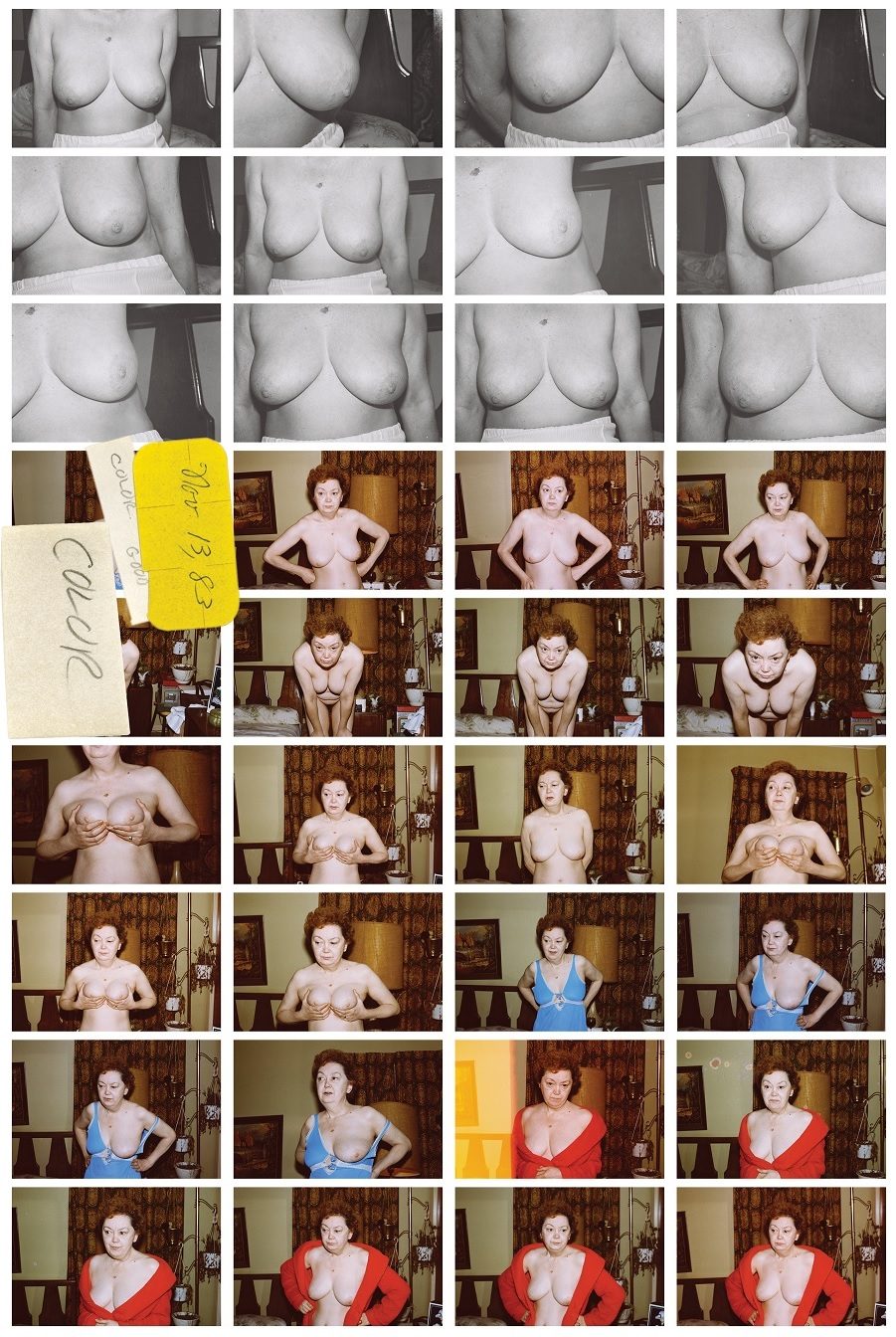
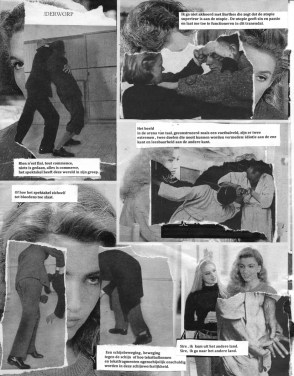 All this to say that I was cruelly disappointed by two recent “new” works, which both claim a certain form of novelty, if not avant-garde aura, but which rapidly collapse in light of the longer history of their art: first “Roman”, a parodic collage (mindlessly labeled “graphic poem” by the journal that devotes a special issue to the newest kid on the graphic novel block) by Luc Fierens (a Flemish artist enthusiastically embraced by the in-crowd as a representative of the post-neo-avant-garde); second Carpet Sweeper Tales, an equally parodic photo-cum-captions collage by Julie Doucet (best known for the feminist punk comics she published in the 1990s).
 and much harder and harsher forms– of parody in the pale and dull remakes by Fierens and Doucet that prove disappointing. No mention here of the Situationnist détournements, those for instance by Marcel Mariën who already in the 60s critically appropriated the aesthetics and ideology of the photonovel. No mention either of Barbara Kruger’s later attacks on consumer society through the combination of photographs and overlaid stereotypical statements. And one could go back to Surrealist Max Ernst (whose collage picture novels are now being reissued) or the political art of John Heartfield –the list is almost endless (in the comics field, why not remember Art Spiegelman’s early collages or the many constrained works produced by the Oubapo group and their many sympathizers).


 Schlanger’s newest book, Trop dire ou trop peu. Essai sur la densité littéraire (Paris, Hermann, 2016) addresses a question that no one who takes writing seriously can ever avoid: Where do I stop? How can I be sure that I have said enough (for to say more would be a bore to the reader)? And how do I know that I have to say something more (for if I don’t my reader will discard my text as opaque or incomprehensible). Very simple questions, but real questions, which can never be fully answered.
 Cultural Studies Leuven