By Sofie Taes – PHOTOCONSORTIUM / KU Leuven – CS Digital
Over the past two years, CS Digital has been partnering up with Europeana – Europe’s most trusted source of digital cultural heritage objects – to promote photographic heritage via the ‘Thematic Collection’ on photography. This subset of photographic records only includes high-quality images, often with a license permitting (free) re-use. Also characteristic to the Thematic Collection are the editorial features that allow for a (re)discovery of masterful photographers, outstanding oeuvres, interesting techniques and previously undisclosed collections.
Working mostly on content selection, curation and online publications, we have been only too happy to embark upon the rollercoaster that is the dive into +2 million early photographs. Because our quest for amazing images, baffling stories and must-see collections has brought on our way a veritable treasure trove of photographic gems and unforgettable characters.
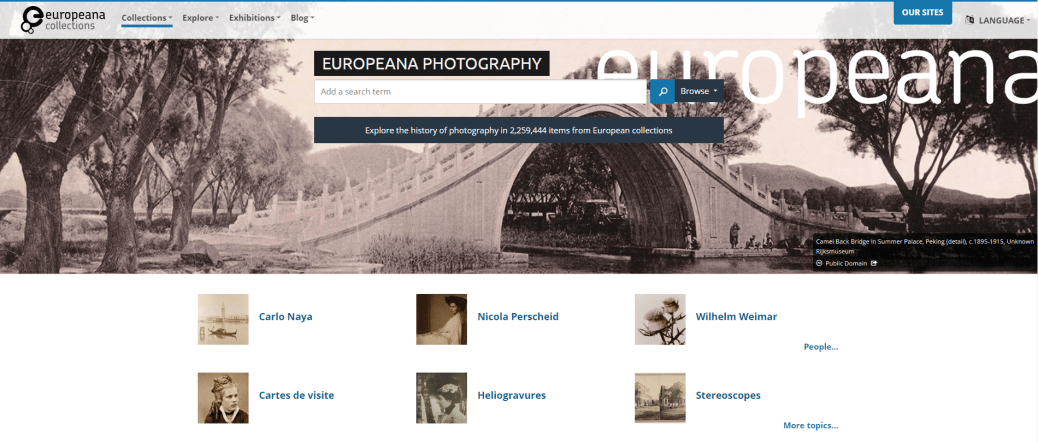
Europeana Photography Thematic Collection – Homepage
Carl Simon definitely ranges among the latter. Simon (1873-1952) first worked as a procurator at the German photo company Liesegang in Düsseldorf and founded his own photography service company in 1907. He constructed cameras, lent slide projectors and began to collect hand-colored glass slides on a wide array of topics (historical, scientific, geographical, literary, etc).

A visit to the zoo: the bears Carl Simon United Archives/Archiv Carl Simon. In Copyright
Presenting slide shows with narration and live music eventually became the core of his activities. Simon wanted to show the world to as many people as possible – especially those who didn’t have the means to go and explore themselves – and put on about 300 shows all across Germany.
By 1945, his collection comprised no less than 80.000 images. After Simon’s demise in 1952, this substantial archive was inherited by his son Karl-Heinz Simon (1920-2002). Karl-Heinz continued to use the material in slide shows, but to the public at large, the collection remained unknown and unseen.
In 2011 – about 6 decades later – the life work of Carl Simon was finally rediscovered in an old storage room in Unterbilk, Düsseldorf (Germany). A year later, United Archives – a photo agency based in Cologne – acquired this unique legacy.
The Carl Simon collection is a most intriguing private archive. Next to 2 original glass slide projectors, 15 lenses and scripts used by Simon in his public presentations, United Archives was able to add c. 23.000 glass slides, arranged in 200 wooden boxes, to its collection.
The range of topics covered by Simon is astonishing: from “Earthquakes and volcanic activity”, “Japan” and “Tibet”, “Faces of Sweden”, “Folk songs” and “Fairy tales”, to “Underwater life”, “A Visit to the Zoo”, “The lives and miracles of the Saints” and “The Dangers of Alcohol”.
Visually, the slides range from child-like drawings to intricate illustrations, photographic images, maps and diagrams. In this image, taken from the ‘Alcoholism’ series, Simon compares the composition of cognac and absinthe in an early example of ‘data visualization’. In a more illustrative style, the ‘metamorphosis’ from healthy young gentleman into inebriated pensioner is depicted here. The worst outcome to be expected, is not left out of the picture show: this etching-style slide shows exactly how a life wasted to alcohol might end…
The compact ‘Tunisia’-series is a beautiful example of a travel report in pictures, with the carefully chosen and applied colors emphasizing the exotic features of the chosen sights. One of the absolute highlights is the ‘Titanic’-story, using a wide range of pictorial styles and touching upon the key points in the narrative, as well as on some intriguing details (ship construction, committee hearing of the ship’s company director, …). In the diptych below, a view of the luxurious dining hall (left) is flanked by a drawing of the wreck at the bottom of the sea.


As a whole, this collection testifies to a media-practice that has transformed significantly over the past few decades. Pitches and presentations often still consist of a well-paced succession of spoken text and visuals (powerpoint, Prezi, ….) yet mostly get reduced to short sequences with an aim to inform or to demonstrate only. Simon’s objective could be best summarized as ‘Bildung’: he wanted to share his finds, his experiences and his stories in a thorough yet engaging manner – an early example of “infotainment” – so as to implant new knowledge with spectators, furthering their level of culture and intellectually empowering them. The written scenarios and the slide projectors add a tactility to his efforts that definitely has a ‘vintage’ feel about it, at the same time underlining his dedication and commitment to the cause.
Thanks to the digitization of this archive, Simon’s mission has now taken on a new, global dimension. Still, our relationship with these glass slides has changed as well: Simon’s archive is no Wikipedia, which we might turn to in search for objective information about a certain person, country or phenomenon. Yet it does provide extremely valuable insights in social conventions and traditions, ethical and aesthetical ideals of the time. So make sure to join us in revisiting Simon’s slides in the Europeana Thematic Collection: we promise it’ll be worth your while.

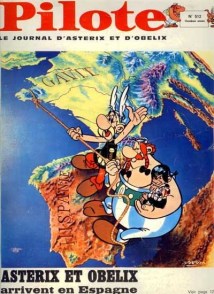 Although there exist quite some studies on the journal, the study by Wendy Michallat is the very first one to rethink its history in a broader perspective, not just that of comics culture, but that of culture at large. And the result is absolutely breath-taking. First of all because Michallat gives a very detailed yet nuanced and well written overview of the various periods of the magazine, whose history is one of nearly permanent crisis and eternal attempts to relaunch new formats and formulas in a publication niche that was much less profitable than it was often thought. Second, and most importantly, because the author succeeds in doing what other studies fail to do, namely explaining the systematic changes in the magazine’s policy.



 What comes to your mind when you hear Brussels? Politics, terrorism, rain? Or Magritte, beer and waffles? We are 5 Cultural Studies Students from KU Leuven who decided to shift the stereotypes about the “heart of Europe” and show the fun side of Brussels. The photo exhibition “


 Simon Leys (pseudonym of Pierre Ryckmans, 1935-2014) is a great example of this humanist ideal. As a law and art history student in Leuven and the representative of a students’ magazine, he was offered the possibility to go to China for one month, an experience that dramatically changed his life. He started to learn Chinese and, after his graduation, left for Taiwan where he defended a PhD on Chinese painting before moving to Hong Kong and eventually Canberra and Sydney, Australia, where he became a professor of Chinese culture. Ryckmans had to take a pseudonym when publishing the book that made him world-famous, The Chairman’s New Clothes: Mao and the Cultural Revolution (1971), the first critical account of the Chinese Cultural Revolution.
 Cultural Studies Leuven