Europeana Photography: vintage photography revisited

By Fred Truyen

In May, we launched the Europeana Thematic channel on Photography – “Europeana Photography”. Cultural Studies Leuven was responsible for the curation – being a member of Photoconsortium, the expert hub on photography for Europeana. The channel opens up the richness of photographic heritage in Europeana by telling stories from a point of view that combines a sense for history with a deep understanding of the materiality and the photographic techniques, and how these interact with the way photographers used the medium to produce their magic. Photography is and will always be this raw, “in your face” medium, that directly imprints in the brain a compelling, unescapable “image”. Even though photographs have lied and deceived in so many ways, it is hard to resist their immediacy and supposed “realism”. Photographs have actually shaped our views on “facts”, events, news items and perceptions of conflicts throughout history since their invention in 1839. In Europeana Photography, curator Sofie Taes brings you an insight in the development of this medium and art through the centuries, by telling stories in the form of virtual exhibitions, such as “The Pleasure of Plenty” – in fact a series devised in different seasons as you might expect in the Netflix age -, galleries and so-called “browse entry points” or predefined queries, like the one on “cartes de visite”. Of course, if you are not afraid to browse through thousands and thousands – we can safely say more than 2.3 million images – just use the search box!

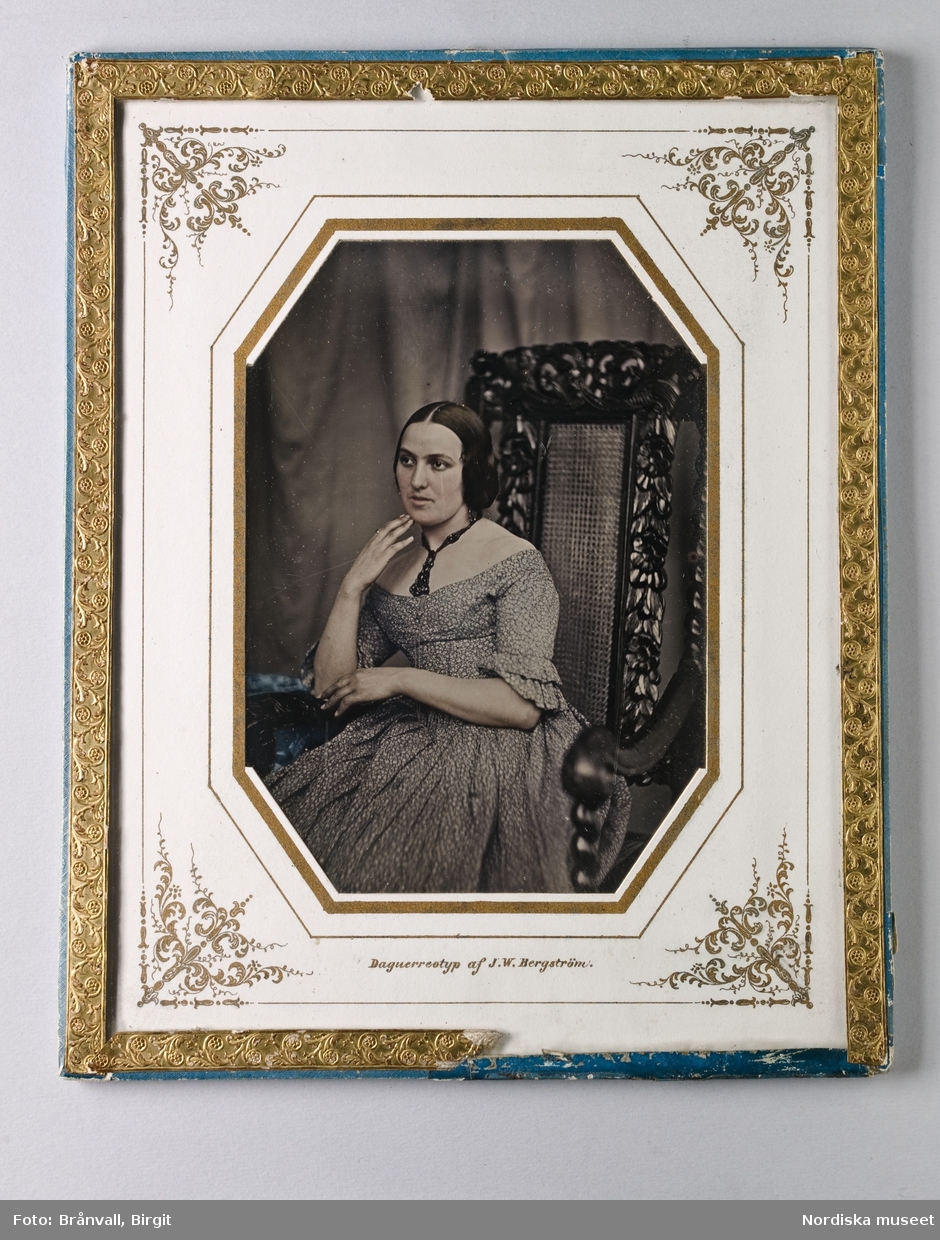
But for this blog post, let’s discuss some old photo techniques and how they define the character of the photograph. Let’s go from the oldest to newer ones. It is still very difficult to do justice to a Daguerreotype, as it is the result of a process that gives amazingly sharp images, with a typical silver brilliance. As it required a sealed glass encasing, Daguerreotypes in their frame are nice, precious objects. However, there is almost no shadow to be seen – Daguerreotypes are only sensitive to ultraviolet light. It has a rather dull, even tonality. This gives the images a kind of clinical, lifeless feeling. The object has a charming “metal” gloss, mostly improved through a gilding process. Often they were coloured in, as the example shown. A Daguerreotype (named after its inventor Louis Daguerre) is normally a mirrored image, although it was possible to reverse this by using prisms. It is very shiny and appears only when viewed from a certain angle.
What a contrast with the process developed by Louis Daguerre’s rival John Talbot, the calotype, which is a two-phased process with a calotype paper negative used to make salt print positives, by direct contact, exposed in the sun. The Daguerreotype produces a unique object, by contrast the calotype/salt print process allows for multiple copies to be made. What a warmth the sun gives to this all, and the paper negatives bring high contrasts and shadows, but also some blurriness and a soft feel. While the Daguerreotype quickly became the photography of science, the calotype won over the hearts and minds of the general public, offering dreamy impressions rather than naked facts.

My favourite photographic process is without any doubt the wet collodion process, commonly called wet plate photography. Collodion is a brownish, viscous fluid, to be poured on a hard support – can be a glass or metal plate –  that contains silver halides which can be sensitized when put in a bath of silver nitrate. That’s why it is “wet” when you take the photo – the whole process taking on average about 15 minutes for one shot. This procedure superseded the older techniques from about 1854 onwards. While it combines the sharpness of the Daguerreotype with a certain ease of use, it is the absolute king of contrast, producing a deep silver black and a richness in shadows.
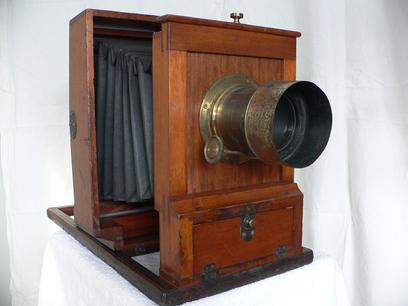
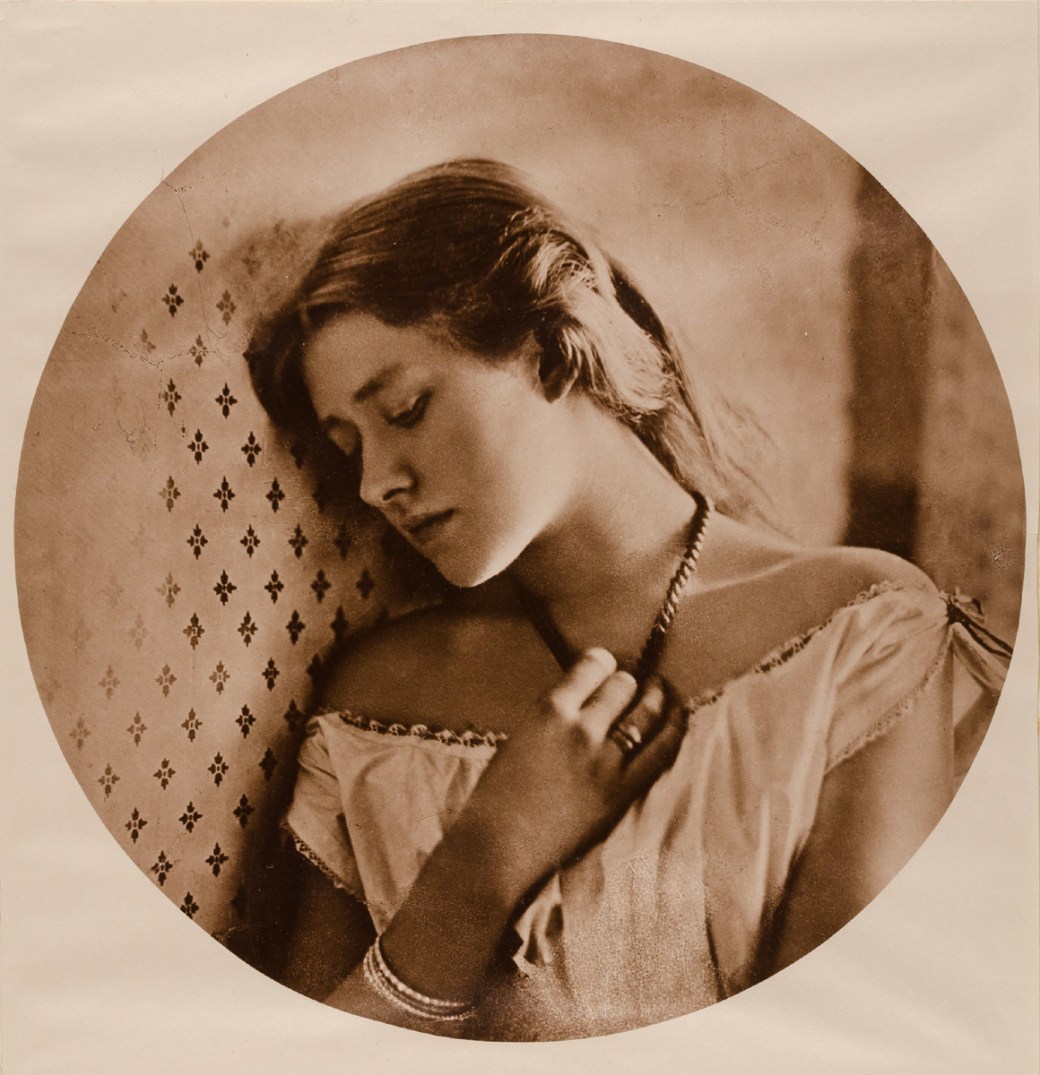
Combine this with the properties of the big cameras used to make these photos – glass or metal plates sized 5×5 up to 14×14 inch and higher – and the big lens with an abhorrent large opening and the resulting very narrow depth of field, you get extremely forceful portraits, as Julia Margaret Cameron showed with such prowess, thereby defining portrait photography as an art in its own right! While the contrast is high, the dynamic range is rather limited, about half of that of digital photography, which in its turn is also not really a champion. A wet collodion photo is brutal: it reveals every detail in a face, due to its sensitivity for ultraviolet light, of which the short waves can perfectly map the slightest irregularities on the skin. A wet collodion photo on glass is called an ambrotype, when it is on a metal sheet it is often called a ferrotype or a tintype. The reproduction below however is a paper print.
Wet plate photography is increasingly popular with current portrait and landscape photographers as it is a relatively safe procedure and adds an astonishing level of detail and quality that are difficult to match by digital cameras.  This is not only the case for professional photography, but also for artistic photography where photographers such as Sally Mann have made decisive contributions to revive the genre.

The subsequent silver gelatine process would become the standard monochrome process in the later nineteenth and twentieth century, until the advent of course of digital photography. This easy to use, safe and scalable process would establish analogue photography. It is super clean and has all the good properties, but to me – and to many vintage enthusiasts rediscovering early photography – it cannot compete with the raw force of the wet collodion based ambrotypes or tintypes, let alone with the poetry of the salt prints. But then again its ease of use – dry plates or celluloid film – and higher sensitivity – resulting in shorter exposure times – boosted the creative development of photography, opening it up to sports, action, movement, depth of field etc., where older photographic techniques were essentially constrained to rather static portraits and landscapes.
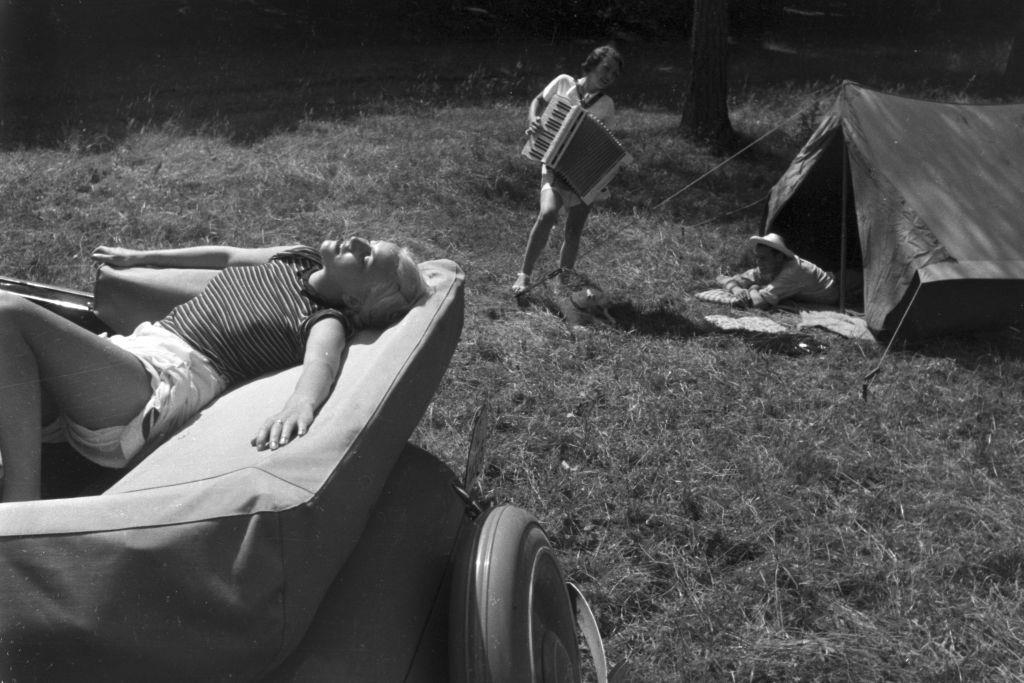
A cyanotype is a specific process producing, as the word says, a “blue” image. There is a nice gallery of those on the channel. As this was an easy process, it was often used to quickly make prints to verify photos before making the actual commercial print. It was also used for the so-called “blue-prints” of designs and drawings. In fact the process was discovered by Sir John Herschell, one of the founding fathers of photography.
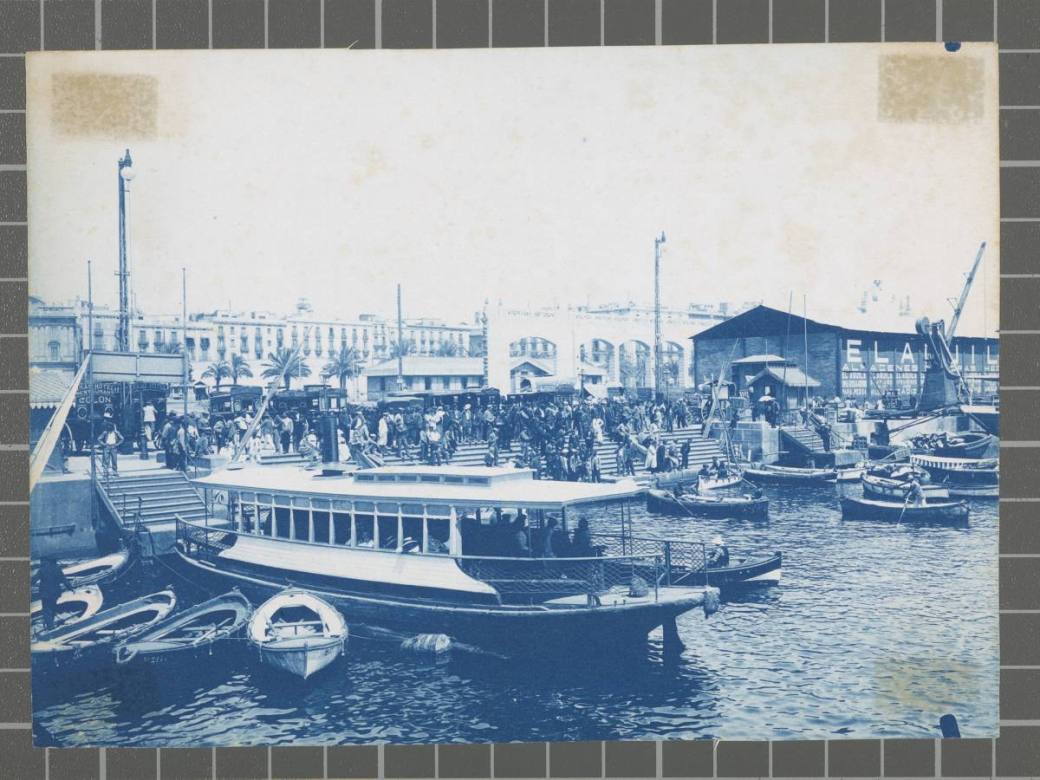
A last technique to mention is an early colour technique, developed by the brothers Lumière. It is the autochrome. In fact, this is a kind of diapositive. Onto the glass plate a layer of coloured starch grains – red, green, blue – is attached, which filters the incoming light. This layer stays with the photograph, which is then shown by backlighting. You get a kind of pointillist effect, and the colours produced have a special warmth that you usually do not find in current, more blueish and colder colour techniques.
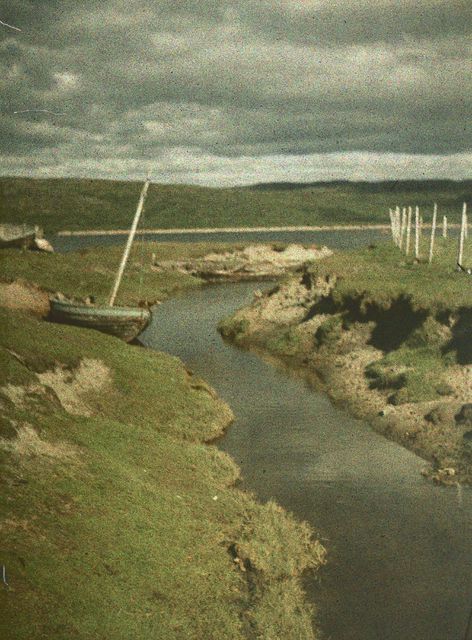
Is the growing popularity of vintage photography yet another pointless surge of nostalgia in a world of digital banality and immediacy? A kind of allergic reaction to the emptiness of the selfie? Or is the photograph indeed something else than just the light information captured, but a magic that occurs in the chemistry of the material object that is the vintage print or plate ? This is for you to decide, but hopefully only after spending some hours on Europeana Photography!

Seminar: “The 3 Ecologies Institute – Anarchiving an Alter-University”

On Thursday, the 18th of May, we have the privilege of welcoming professors Erin Manning (Concordia University) and Brian Massumi (University of Montreal) for a doctoral seminar at the KU Leuven, entitled The 3 Ecologies Institute: Anarchiving an Alter-University. This encounter will take place between 10 a.m. – 12 p.m., at Hoger Instituut voor Wijsbegeerte – Room HIW 01.20 (Kardinaal Mercierplein 2 – 3000 Leuven). Registration is not required, though brief notice of your attendance to arne.vanraes@kuleuven.be would be appreciated.
Poster4Erin Manning and Brian Massumi will discuss their development of ‘The 3 Ecologies Institute’ at SenseLab (www.senselab.ca), a laboratory for thought in motion that explores the active relations between art, philosophy and politics through the matrix of the sensing body in movement.
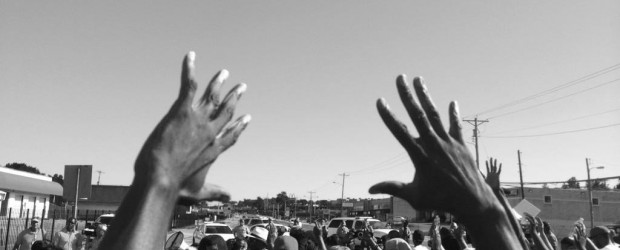
 
The 3 Ecologies Institute is an experiment in thinking/making, formulated as a speculative proposition for an alter-university. Working with Félix Guattari’s concept of the three ecologies – the conceptual, environmental and social – Manning and Massumi move us to collectively invent what else learning can mean, beyond the model of the neoliberal university.
 
As university education has become increasingly focused on the demands of the job market, its earlier mission as a realm for creative exploration and flexibility of thinking has eroded – a development that has harmed the humanities and social sciences. The 3E Institute aims to provide a dedicated place for creative exploration and free inquiry as values in themselves. It encourages experimental thinking and creative making and supplements a transversal, transdisciplinary milieu to the split between theory and practice that often underlies pedagogical methods and educational institutions. The Institute will further approach its efforts toward collective experimentation, improvisation and reinvention by exploring the possibility of an alter-economy (new forms of ‘commons’, cooperative networking, skill-sharing and crypto-economies), including neurodiverse ways of knowing and the co-habitation of social diversities, and fostering ecological sustainability (including, but not limited to, the environmental).
 
Brian Massumi and Erin Manning will explore this potential through the concept of the anarchive: not the documentation of known past activities, but an ‘anarchic’ research-creation event of collective experience in the making. They look forward to the opportunity of sharing this work and discussing what else learning and living can be in these neoliberal times.
 
Further reading,:
 
Speakers
Erin Manning holds a University Research Chair in Relational Art and Philosophy in the Faculty of Fine Arts at Concordia University (Montreal) and is the founder and co-director of SenseLab. Her activities are situated across art-making, philosophy and activism. Through process philosophy, her writing researches the relations between movement, art, neurodiverse ways of knowing and the political. Her artworks explore conditions of emergent collectivity and more-than human ecologies. Manning’s current art projects are focused around the concept of minor gestures in relation to colour and movement, and the synesthesia of colour-smell. Her publications include Politics of Touch: Sense, Movement, Sovereignty (Minnesota UP, 2007), Relationscapes: Movement, Art, Philosophy (MIT Press, 2009), Always More Than One: Individuation’s Dance (Duke UP, 2012), The Minor Gesture (Duke UP, 2016) and, with Brian Massumi, Thought in The Act: Passages in the Ecology of Perception (Minnesota UP, 2014).
 
Brian Massumi is professor of communication at the University of Montreal and co-director of SenseLab. He works on the philosophy of experience, art and media theory and political philosophy. His research participates in the collective exploration of new ways of bringing philosophical and artistic practices into collaborative interaction. Massumi has translated work by Deleuze and Guattari, Lyotard and Attali into English. He is well-known as a foundational figure of the ‘Affective Turn’ in the humanities and social sciences. His publications include Parables for the Virtual: Movement, Affect, Sensation (Duke UP, 2002), Semblance and Event: Activist Philosophy and the Occurrent Arts (MIT Press, 2011), What Animals Teach Us about Politics (Duke UP, 2014), Politics of Affect (Polity, 2015) and Ontopower: War, Powers, and the State of Perception (Duke UP, 2015).

Symposium “Mediating Immediacy: Choreographing Affect”

On Wednesday May 17th 2017, there will be a symposium entitled Mediating Immediacy: Choreographing Affect, which is being organized in the framework of the KU Leuven Cultural Studies course Theory of Contemporary Dance, in partnership with STUK. The symposium is free, welcomes all and will take place at STUK – Soetezaal (Naamsestraat 96 – 3000 Leuven), between 14:00 – 18:00.

A description for the event and details about the program and speakers can be found at:
Contact: Arne Vanraes – arne.vanraes@kuleuven.be


com_foto_dans_symposium_17

Photo credit: Twitter @trymainelee

Mediating Immediacy: Choreographing Affect
Our speakers Cécile Guédon (Harvard University), Erin Manning (Concordia University) and Ben Anderson (Durham University) will address the paradox of how the (presupposed) ‘immediacy’ of affect can be negotiated in performance praxis or in the broader social sphere. In short, ‘affects’ are often described as those basic, psycho-bodily intensities that emerge from encounters of lived bodies and environments. At a micro-perceptive level, they influence one’s capacity to act or move. While those energetic forces are frequently analyzed as being non-conscious and happening immediately, we will raise the question whether this implies that they are also unmediated. Is there a necessary contradiction between choreographic technique (which can suggest notions of mastery and reproducibility) and affect (so often associated with passivity and immediacy)? What can ‘structures of feeling’ tell us about structures of power and a politics of moving/feeling bodies? Does choreography carry the potential to critically research which energies appear between moving bodies in relation? And can such choreographies intervene to reconfigure affective production for the future?
 
Talks
Cécile Guédon – Articulating Modernity: Choreographing Abstraction
Erin Manning – A Manifesto for Immediation
Ben Anderson – Neoliberal Structures of Feeling
Concluding performance: Alma Söderberg, Nadita (http://www.stuk.be/en/program/nadita)

Panorama 1080 – Students. Sint-Jans-Molenbeek. ‘Delta’. Urban art

Panorama 1080, a collective composed of four KU Leuven master students Marjoleine Delva, Maria Vasquez, Yesim Bektas and Michelle Hernandez, is organizing a children’s exhibition in Brussels (Sint-Jans-Molenbeek). With MIMA’s current exhibition A Friendly Takeover, Panorama 1080 is juxtaposing some of the most current topics in Brussels in an effort to shed light on the issues of intercultural interactions amongst children finding their identity in Brussels and flexing their voice through street art. You are invited to partake in the youth’s exhibition on Friday 28 April 2017 from 14h00-18h00 at ‘The Malterie’, Henegouwenkaai 41/43, Sint-Jans-Molenbeek.

Panorama 1080 is a cultural and arts educative project for children of Sint-Jans-Molenbeek with a twofold objective. On the one hand it’s an art educative project for school aged children that aims to give them a unique artistic experience. It’s a project for kids, by kids. It aims to stimulate their creativity by giving them the opportunity to create their own artwork in the format of a workshop, which contributes to their general identity formation. Specifically, Panorama 1080 aims to give these children a total experience into the urban art world. In order to do this, Panorama 1080 will work in conjunction with MIMA’s exhibition by Boris Tellegen aka ‘Delta’.

panorama2

‘A Friendly Takeover’ by Boris Tellegen at the MIMA

The program will expose local children to street art on exhibition at MIMA, guide them to generate their own artistic style, and give them tools to explore self and expression through street art style graffiti. Through a series of three encounters, pupils in 6th grade at Vier Winden Basisschool will first learn about Tellegen’s art, what it represents, and ways to interpret it. In a guided workshop, pupils will then create their own version of street art graffiti on cardboard with provided materials. In that way they can develop the skill of making art themselves and the process that goes with it. Finally, they will exhibit their art for their families, school, and neighborhood to share their world views with their community.

Secondly, Panorama 1080 has a broader purpose to include others in the project: parents, the neighborhood, people from outside Brussels by concluding the project with a public exhibition. In that way the broader purpose is to encourage out a more positive image of the community of Sint-Jans-Molenbeek. Panorama 1080 is eager to break down stereotypes around this district as a poor or even dangerous ghetto. As a melting pot of customs, cultures, languages, and peoples, Sint-Jans-Molenbeek is a unique forum to explore the concept of individuals and societies. Or as said with the words of the Brussels writer and political philosopher Bleri Lleshi: “Brussels is a city without an owner. This city is a collection of people from all corners of the world. There are so many differences here. In cultures, traditions, languages, religions, norms and values. We can hardly do anything else than start from those differences. What connects people from Brussels aren’t just resemblances, like everywhere else in the world, but also differences. That’s exactly the reason why Brussels, the most diverse city in the world, is the lab of the future.” (Bleri Lleshi, Inaya: Brief aan mijn kind, 125). It’s this uniqueness of Sint-Jans-Molenbeek and Brussels in general that Panorama 1080 wants to express in a creative way.

The children’s art will be exhibited on Friday 28 April 2017 from 14h00-18h00 at ‘The Malterie’, Henegouwenkaai 41/43, Sint-Jans-Molenbeek.

The exhibition will be in Dutch. Participation is free and open to all. For more information, please visit: https://www.facebook.com/events/111328862699865/

panorama

Cultural Studies and Digital Humanities

By Fred Truyen

2024907_photography_ProvidedCHO_Generalitat_de_Catalunya__Arxiu_Nacional_de_Catalunya_ANC_1_994_N_664

Final d’oracio de la V sèrie Caps d’estudi | Artigues i Carbonell, Joan – Generalitat De Catalunya. Arxiu Nacional De Catalunya

Digital Humanities is an area of study involving the use of computers and computational methods in the various disciplines of the humanities. It is also a critical analysis of the impact of technology on culture. Certainly in regards to the latter the field of Digital Humanities is often close to Cultural Studies, of which it borrows key concepts such as ‘intersectionality’ or ‘remediation’.

But also in the first range of activities, pertaining to the use of computational methods in the humanities, there are many ways in which Cultural Studies is affected by the developments in Digital Humanities. One such field is the digitization of Cultural Heritage, a domain we have been very actively involved in here in Leuven.

In the project EuropeanaPhotography, we contributed over 450.000 images of early photography to Europeana, a project involving 14 partners from different European Countries. For Leuven, there were two different tasks: on the one hand the Digital Lab digitized over 20.000 images from our art historic pedagogical collection – with art historians at the University Library providing the descriptive metadata; on the other hand we coordinated the overall project and curated the exhibition “All Our Yesterdays”. The photographs offer both professional as well as amateur photography from 1839 to 1939. Digitizing early photographs brings to life the many reflections in classic texts from authors such as Walter Benjamin, Susan Sontag and Roland Barthes, which are part of the canon of Cultural Studies. It also reveals that digitization is not making merely a copy but actually amounts to what should be called ‘re-photography’.

screenshot2.png

As a sequel to this project we just finished – successfully, it got an excellent rating by the reviewers! – Europeana Space, a project with a very different aim, which brings us even closer to Digital Humanities activities: the creative re-use of cultural heritage content. So, a venture from re-photography to re-use.14808513761496536

It involved, for a number of cultural practices such as Photography, Publishing, TV, Games, Dance and Museum exhibitions, a cycle entailing: development of a pilot demonstrator and re-use tools; organising a hackathon with students, GLAM professionals and developers to exploit these tools; and going with the winning teams through a business modelling workshop and monetizing event. The photography pilot we ran features applications that bring old photography to life in new ways, such as augmented reality overlays, touristic guides or interactive viewers such as MuPop. That a student of Cultural Studies who teamed up with a computer scientist actually was one of the winners of the photo hackathon convinced us even more that a fruitful marriage of Cultural studies and Digital Humanities could yield new venues in our research.

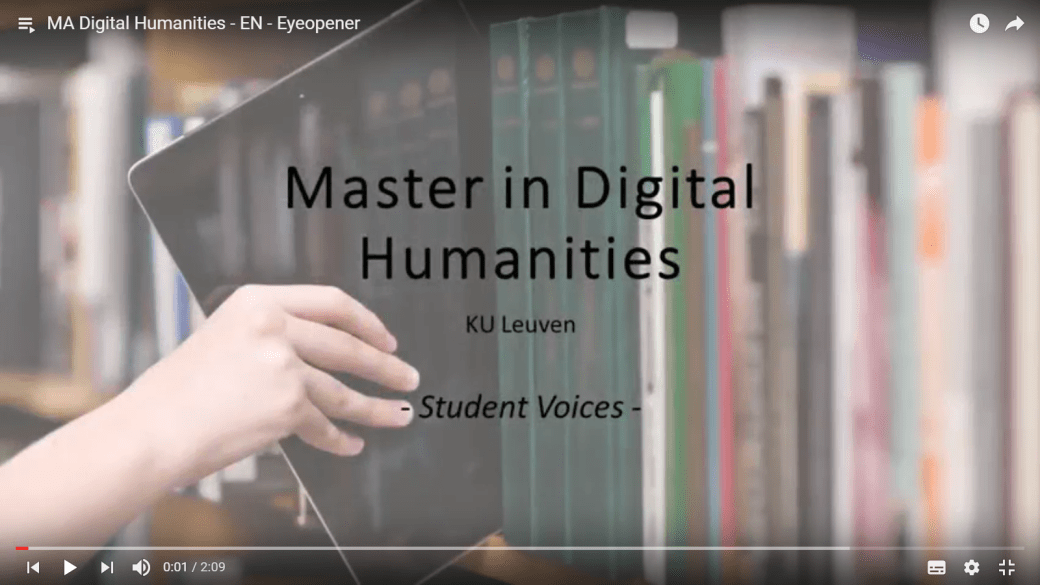
As Digital Humanities always implies a practical component of actually applying digital techniques, the Europeana Space MOOC hosted by KU Leuven offers amateurs and professionals alike the opportunity to try it out – you can have a look at our “tell your own photo storydscf5752 developed in collaboration with LIBIS, our natural partner in Digital Humanities! Offering these digital humanities experiences in higher education doesn’t stop with this MOOC however. Cultural Studies Leuven is also contributing to the KU Leuven MA in Digital Humanities programme, a Master-after-master degree targeting holders of a Master’s degree in the humanities, who want to take this next step in applying computational techniques by actually getting a serious in-depth training in programming. Cultural Studies contributes its Online Publishing course to this Master programme, which has, besides an introductory course in the field of Digital Humanities, a course on programming in Python (Scripting Languages) and a course on Information Structures and Implications. Now that this programme is in its second year and we already have successful graduates – some of whom are now pursuing Phd’s here and at universities abroad – we can say that it actually reaches its goal to offer students with a solid humanities background, such as the MA students of Cultural Studies, the necessary training and background to program their own solutions and applications. It allows for novel ways of doing humanities research, with an experimental touch. Have a look at what of some of the former students of the MA have to say!

MA DH 2.png

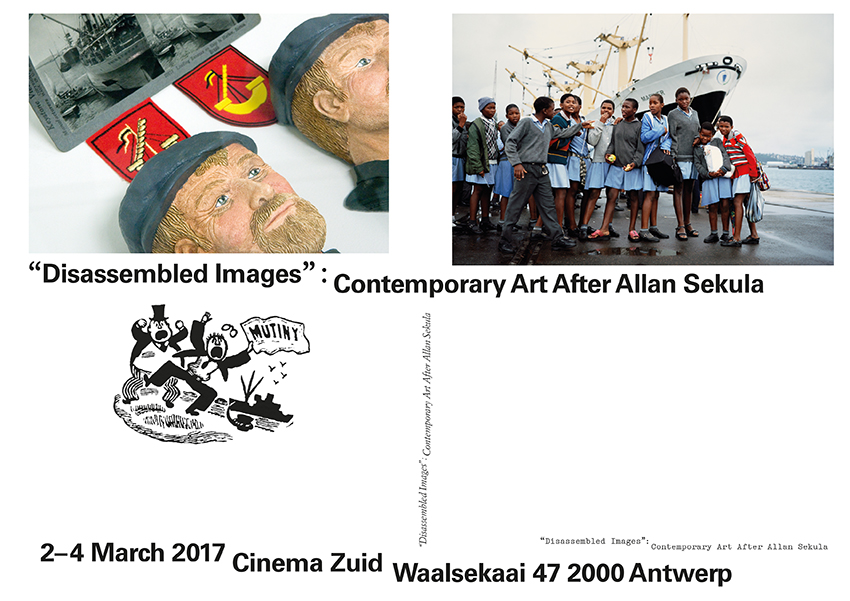
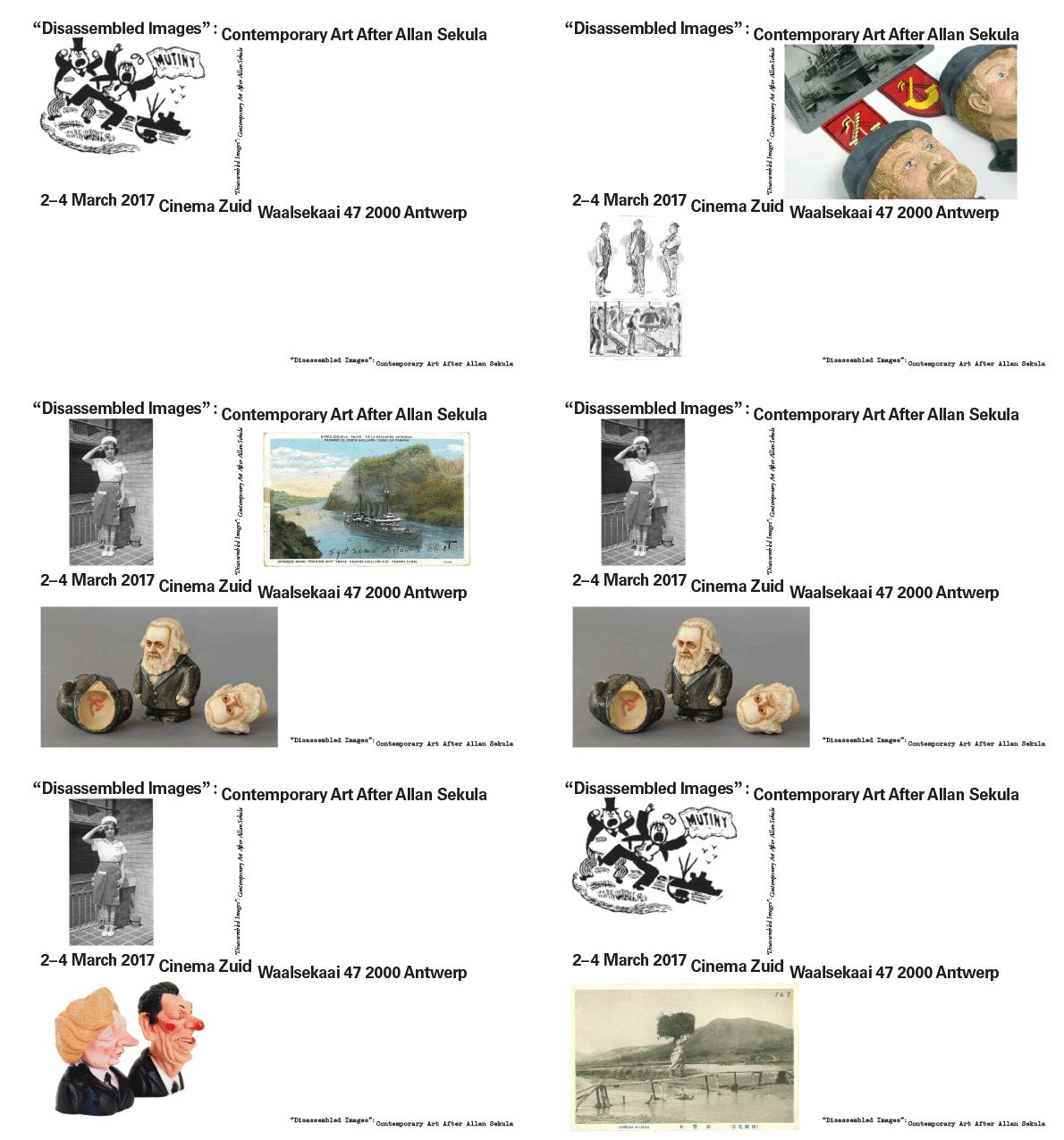
“Disassembled Images”: Contemporary Art After Allan Sekula

The Lieven Gevaert Research Centre for Photography, Art and Visual Culture (KU Leuven – Université catholique de Louvain) and M HKA – Museum van Hedendaagse Kunst Antwerpen kindly invite you to their scientific conference.

disassembled_images

This international conference takes the US artist, theoretician, critic, teacher and poet Allan Sekula’s Ship of Fools/ The Dockers’ Museum (2010-2013) as its point of departure. At the very end of his life Sekula produced this unfinished, multifaceted and variably installable work of art, which contains ca. 1250 objects. Focusing on dock workers and seafarers, Sekula’s Ship of Fools/ The Dockers’ Museum paid tribute to all the joined, past efforts of human labor now irretrievably lost in history – a struggle he identified as “Sisyphean.” In doing so, Sekula wished to provide a message of hope: his last work contributes to imagining possible forms of solidarity in a globalized economy confronted evermore with its own limitations. The conference’s participants will discuss both Sekula’s oeuvre and works by other contemporary artists whose approach dialogues with his seminal legacy.

The conference is organized around three thematic sections:

  • Collecting Folly
  • Maritime Failures and Imaginaries
  • Critical Realism in Dialogue

Each forms a separate session that opens up to contemporary art engaging with Sekula’s influential method of making artwork as “disassembled plays” – a term he connected to the work of Bertolt Brecht, and which served to indicate that he demands a substantial productive and temporal input from the spectators who are experiencing his works.

The keynote speakers of this conference will be W.J.T. Mitchell (University of Chicago) and Marco Poloni (artist, Berlin).

The conference will be held in English. Participation is free and open to all, but prior registration is mandatory. For more information, the conference schedule, and the registration form, please visit:

http://lievengevaertcentre.be/highlight/disassembled-images-contemporary-art-after-allan-sekula

To download the leaflet, please click here.

disassembled_images

Interview with Dr. Bridget Conor

By Ilham Essalih

Dr. Bridget Conor is Senior Lecturer at King’s College London, in the Culture, Media and Creative Industries Department. She was recently at KU Leuven, and we were very happy to be able to interview her on this occasion.

conor3

I would like to thank you for being with us at KU Leuven today. I hope you are enjoying Belgium so far. I’d like to also thank you for accepting to do this interview. Before I get into more specific questions, could you tell us which issues you are working on at the moment?
You’re welcome, Belgium is wonderful!
In my department of Culture, Media and Creative Industries, there are a few of us who have been working on these issues around what we call Cultural Labour, or experiences of work in the cultural industries. My interest is mainly in working lives in film and television productions and screenwriting specifically. I’m also interested in why people choose to work in these professions, how they get into the industry, what their experiences are once they get in, and I guess, what we call precarious work, precarious lives. I’m also interested in what kinds of rewards people get from working in these industries, beyond simply money or fame. The other issue that I have become interested in is inequalities in the cultural industries, because to my mind, and some of my colleagues would agree, these industries should be egalitarian, and should be open to all, and that’s what creativity is, creativity is free, abundant and we all have it; but the industries are, if we look at them, often so unequal in terms of every type of inequality we might find. So I’m interested in these kinds of discrepancy between the dreams of what a creative life could be and what the reality is in terms of who actually gets to do that work.

In the introduction of Gender and Creative Labour you develop the problem of gender inequality in the Cultural and Creative Industries, and you also mention discrimination on grounds of race, disability, place etc. You mention that Black, Asian and Minority Ethnic communities are under-represented in these industries, and that this problem is only getting worse. What about individuals who are at the intersection of these identities? By this I mean, for instance, women of colour or disabled women? Have you yourself worked on this subject? Do you think this is a relevant issue?
The short answer is: yes. I think intersectionality is really crucial if we talk about these issues. Because in a way, if we talk about inequality, intersectionality is still something relatively new in the field of Cultural Labour. I think we have to be really cautious about separating out one kind of inequality. Of course I think we need to, for practical reasons, but I think what’s difficult is; how do we develop methods that take into account intersectionality, because intersectionality of course is complex. For particular persons who try to get into these industries, you know there’s a huge complexity of identity that they bring onto the table, but I think the evidence we do have, although it is quite limited, that if you are a woman, and then you are also a woman of colour or you are also living with disability, it can be even more difficult for you to not only get into the industry, but then maintain and build a sustainable career. I think that’s really tricky, because those who might be making policy to change these things have to understand what intersectionality is as well. It’s something I have certainly thought about and my other colleagues have also done a lot of research that takes this into account, I think I just hope that more people will be interested in these issues and will do more of those intersectional studies.

When we discuss the problem of work discrimination against women, you often get the reaction that it is normal for companies not to hire women because of the risk of pregnancy and having to pay maternity leave, and that this is not misogyny, but rather the pragmatic need of a company to make profit and that, although regrettable, this is the rational reality. What do you respond to that as a woman, specifically in the context of the film industry?
Well, I think you’re absolutely right. If we as researchers talk to those who make policies and we kind of say, look, there are these problems and the statistics clearly show us that we’re nowhere near fifty-fifty equality when it comes to gender when it comes to directing film, or making art, and I think often the first response to that, is, exactly as you say, that it’s just “natural”, because yes, women, often at some point in their careers and their natural life cycle want children and we as companies and organisations have to be pragmatic and we have to take that into account and what becomes difficult, is that that’s absolutely true and fair on one level, but I think the problem is, women and motherhood very quickly become conflated. Women are often seen by a production company as potentially problematic because of the fact that they may one day possibly have children. So I think that this potentiality always becomes a certainty. The other thing that I find curious about this, is that it’s always women who are associated with childbirth and childrearing, whereas we could talk about it in terms of parenting, I mean men are also parents, and men who work in the cultural industry often have children but that’s never seen to be a problem for them, and of course, women have the biological capacity to bear children so we have to take that into account, but I still think that very quickly, this becomes a kind of natural reasoning and a natural problem. It is just often used as the one and only nice argument of why we don’t need to change this, and maybe change things could just be to have better childcare in organisations or in corporations, but again, we don’t really see that happening, at least not at the moment.

Do you think womanhood and motherhood should be two completely separate things?
It’s tricky, but potentially, yes, I think we need to try not to see these things as always inextricably linked, because otherwise we very quickly find ourselves in a kind of biological determinism. Maybe we need to try to overturn some of those assumptions. At least it would be fun to try.

You also mention gender segregation in the film industry, where you typically find women working in the hair, make-up and fashion departments, and men are predominantly present in sound and light engineering. Why do you think this segregation exists? Is it because men and women automatically put barriers to themselves? Do you think there is actual discrimination in accessing these jobs? Or is this simply a matter of comfort zone?
Oh, boy! Could it be all of the above?! I think it’s a very tricky combination of all of those things, I think, yes, the evidence shows that there is both horizontal and vertical segregation. I guess when I think about these issues, it’s very important to look at the history of these industries. When I looked back at the really early time when screenwriting as a profession kind of appeared in the early twentieth century, you actually initially had lots of women writing for film, as many as men. It was pretty close to fifty-fifty equality. But as these industries became more and more financialised, and therefore more business-orientated, they very quickly got new kinds of advertising and the kind of hype around new industries and they suddenly became really quite gendered in terminology and image, you quickly began to see that all the ads for camera’s and camera equipment were about the strength and power of those tools and technologies, which then were just assumed to be masculine traits, and women very quickly became associated with other kinds of jobs that are sex-typed ‘feminine’. So from very early on you get professionalisation and you get these stereotypes and myths of the profession, and then you start seeing women fall out of the industry and fall into those types of jobs that are considered feminine. History can be a helpful way to show us that it is not necessarily natural. Maybe we are brought up in certain ways, and then we assume that make-up and costume are things women are necessarily interested and good in. I suppose there’s individual and subjective dimensions of this, but I suppose we really need to think about those in the context of the history of these jobs and I guess when we start to shake things up, when we start seeing women directing films, then we really start seeing a change and we see that this gender segregation is not just common sense, it can be changed. We just need to try.

Do you think that a certain academic elite has the right to tell women that they shouldn’t restrict themselves to certain jobs and that they should aspire to ‘more’ when maybe they just feel comfortable doing what they do? Are certain women entitled to think that they know better than others because they are more educated?
It is just really, really hard, and you’re right, there is this image that academics and researchers are locked away in their ivory tower and they are disconnected from real people’s lives, and I can really see why. But the reaction that “you don’t know me, or my life or my choices”, is legitimate, who are we to pronounce that? I’m still learning myself and I think that in an ideal world I would like to do the kind of research that is qualitative and really takes into account people’s lived experience. Academics shouldn’t just theorise ‘over there’ and there’s probably more work to do in figuring out how we can try to do more collaborative research that works with people in communities and that address issues that are important to them. We can only try and aspire to this.

Thank you so much for this interview!
You’re welcome, thank you.

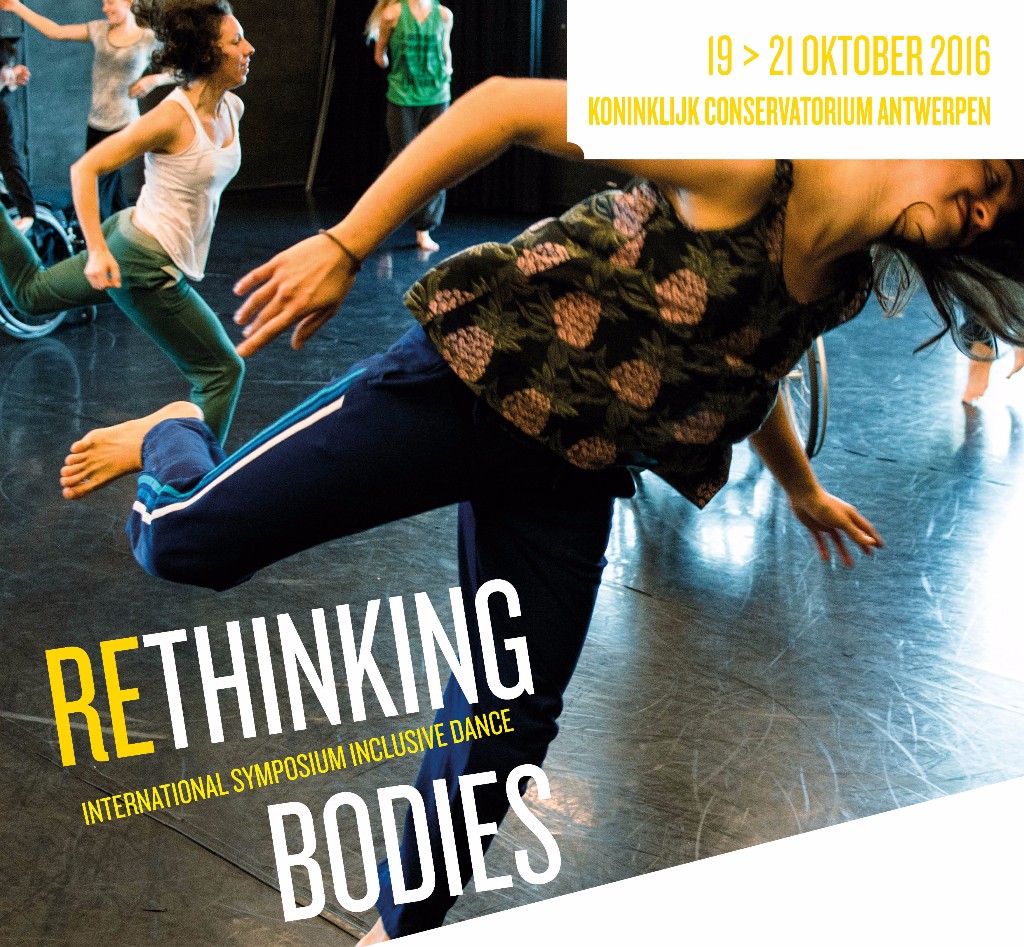
International Symposium Inclusive Dance: Re-thinking bodies

da8a47b3-5a82-424a-b93c-7629caf0de99

International Symposium Inclusive Dance: Re-thinking bodies 19/20/21 October 2016

The contemporary dance department of the Royal Conservatoire Antwerp/AP University College is organizing for the third time an International symposium on Inclusive Dance practices.

Experts, choreographers and performers within the field of inclusive dance practices, education and performing arts will collaborate with students in dance of the Royal Conservatoire Antwerp and the Faculty of Arts & Humanities from Plymouth University. Dancers with different disabilities will join the student dance groups during an intensive program of 3 days: a program with workshops, lectures, debates and performances open for public.

The research project ‘LAB incl.’, initiated by cultural studies student Iris Bouche, stands for ‘LAB Inclusion Dance Platform’. Its aim is to create an inclusive and experimental learning environment that can be used for fundamental artistic research into dance as a means of communication and for the essence of creativity as the ability to solve problems.

By initiating research projects, inviting international practitioners and participating in European exchange programs, the dance department inspires a new, more open-minded generation of dancers and clears the way for the progression of inclusive dance practices in Flanders. Within the context of a University College, artistic and academic research reinforce each other and support the development of inclusive performing arts.

For more information on the Symposium, please visit the following website: https://www.ap.be/koninklijk-conservatorium/evenement/rethinking-bodies-symposium-2016/4654

Facebook page: https://www.facebook.com/International-Symposium-Inclusive-DanceRe-thinking-Bodies-192021-okt-413366288825769/

“Europeana Space: Creative with Digital Heritage” – Enroll now!

Screenshot

Online courses – MOOCs: Massive Open Online Courses – have become a popular means to access information freely, explore new subjects, update one’s knowledge, and learn something new.

In the past months, Cultural Studies Professor Fred Truyen has been organizing the online course Europeana Space: Creative with Digital Heritage. The mission of this MOOC is to show how people can become creative with Europeana and digital cultural content, to demonstrate what Europeana can bring to the learning community, and to bring about the essential concept that cultural content is not just to contemplate, but to live and engage with. This is an extremely topical subject since the online availability of digital cultural heritage keeps growing; it is therefore more and more necessary that users, from passive readers, learn to find, understand, reuse and remix the online resource in an active and creative fashion.

The course feeds into the experiences of the Europeana Space (E-Space) Pilots and brings you the results of their research, analyses and test cases. The educational idea behind the E-Space MOOC is to lower barriers to the access and reuse of cultural heritage content on Europeana and similar sources, providing tutorials and trial versions of applications and tools alongside with reading materials and useful tips and best practices gathered during the course of the project.


Pick one of these inspiring modules, or just take them all!

Photography: In this module you will learn how to create your own stories with vintage photographs online, using Europeana and other open content, and remixing it with personal narratives and images.

Open and Hybrid Publishing: In this task-based module you will learn how to put together an online book by studying aspects of Photomediations: An Open Book as a case study. Materials included in this session range from online articles on photography and other arts, some visual material, to guidance notes about the use and reuse of CC-licensed material, Open Access and Open and Hybrid Publishing model. The most exciting part of this module is a freewheeling and playful challenge exercise which involves students reusing and remixing pre-existing material from Photomediations: An Open Book in order to create their own resource.

TV: Europeana Space developed a series of multiscreen applications for TV, focusing on reuse scenarios of cultural heritage. You will learn different ways in which archive footage can be re-used online, which formats exist, and which technology and coding languages can be utilized to make video available in a TV setting.

Dance: The E-Space Dance Pilot MOOC offers a series of activities for learners at different stages, ranging from undergraduates to PGR students, to showcase and encourage uptake of the dance pilot tools. The activities will enable learners to build personal dance collections on selected themes and discover how an online annotation tool can support the creation and analysis of dance.

Museums: This module will help you designing web-based and mobile services tailor made not only for the visitors but also for museums and memorials staff, especially for those who are in charge of  designing educational paths, by sharing lessons learned and best practices.

IP for the Cultural Entrepreneur: This module will guide you through the process of managing intellectual property rights from an initial idea through to a start-up business. You will learn how to develop a clear strategy when it comes to intellectual property rights associated with digital cultural content and its commercial re-use. You will be introduced to E-Space tools and case studies which will demonstrate how to clear copyright, source open re-usable content, carry out IP audits and risk assessments, and how to approach licensing and the IPR associated with hackathons, business modelling and incubation.

Creative Marketing: The aim of this module is to stimulate creative ideas on communicating cultural contents with the use of new media and to show how a greater audience can be reached by combining the power of social media and storytelling and how audiences can be better engaged.


Whether you are a student or teacher with an interest in cultural heritage, a GLAM professional, a developer or a cultural heritage amateur, this MOOC is for you. Every module is in fact organized on three levels in order to satisfy the needs of all the learners:

  • Students or teachers? Or just a culture fan? The information provided here concerns digital cultural heritage in a broad sense; different kinds of content are presented and it is explained how to easily reuse them. No technical skills or understanding of the underlying mechanisms of the cultural sector are needed for this level of information.
  • GLAM professionals (galleries, libraries, archives and museums). The information provided here presuppose a professional knowledge of the sector. The aim is to help GLAM professional discovering and understanding useful tools – such as those on the E-Space platform and Europeana Labs – that can be used to enhance, remix, rethink, play with collections in new and fascinating ways.
  • Nothing of the above: you are a serious developer! This is the most technical part of each module and it is intended as a way for developers to discover the tools they can work with (e.g. the multiscreen toolkit, the Europeana APIs, …)


The Europeana Space MOOC Creative with Digital Heritage is planned to take place during the first semester of 2016/2017 academic year and will begin the 10th of October 2016. The enrollment has opened this month on the KU Leuven channel of the edX platform.

Digital cultural heritage is online and ready to be creatively reused: enroll now and start learning!

Fred Truyen and Clarissa Colangelo

Mariken Wessels – Taking Off. Henry my Neighbor

By Anne Baptist

Surrounded by thousands of black-and-white nude pictures, you are instantly captured by an unsettling yet intriguing feeling when walking into Mariken Wessels’ new exhibition at FoMu. Taking off. Henry my neighbor is an exhibition of the works in Wessels’ latest book of the same name. In Taking off she creates an artistic reconstruction of the failing marriage of two people: Henry and Martha.

Wessels (°1961), a Dutch artist, is internationally renowned for her photobooks, but also creates series of photographs, sculptures and installations. She is known for working with found photographic material and recreating the stories behind it. These artistic reconstructions, as she calls them, are based on the untrustworthiness of truth. She recognizes the human restrictions of the concept because truth is only ever someone’s truth. Memories and interpretations are always tainted, failing or fading, limited due to our ever changing personal perspective. This idea is closely related to the nature of photographs. They seem to be the closest thing to a true representation of reality, but the reality they show isn’t necessarily true. By calling her photographic narratives ‘artistic recreations’, Wessels plays into these limits and leaves the spectator guessing and in search of authenticity.

1463955583142

Mariken Wessels (NL), from the series Taking Off. Henry my Neighbor, 2015

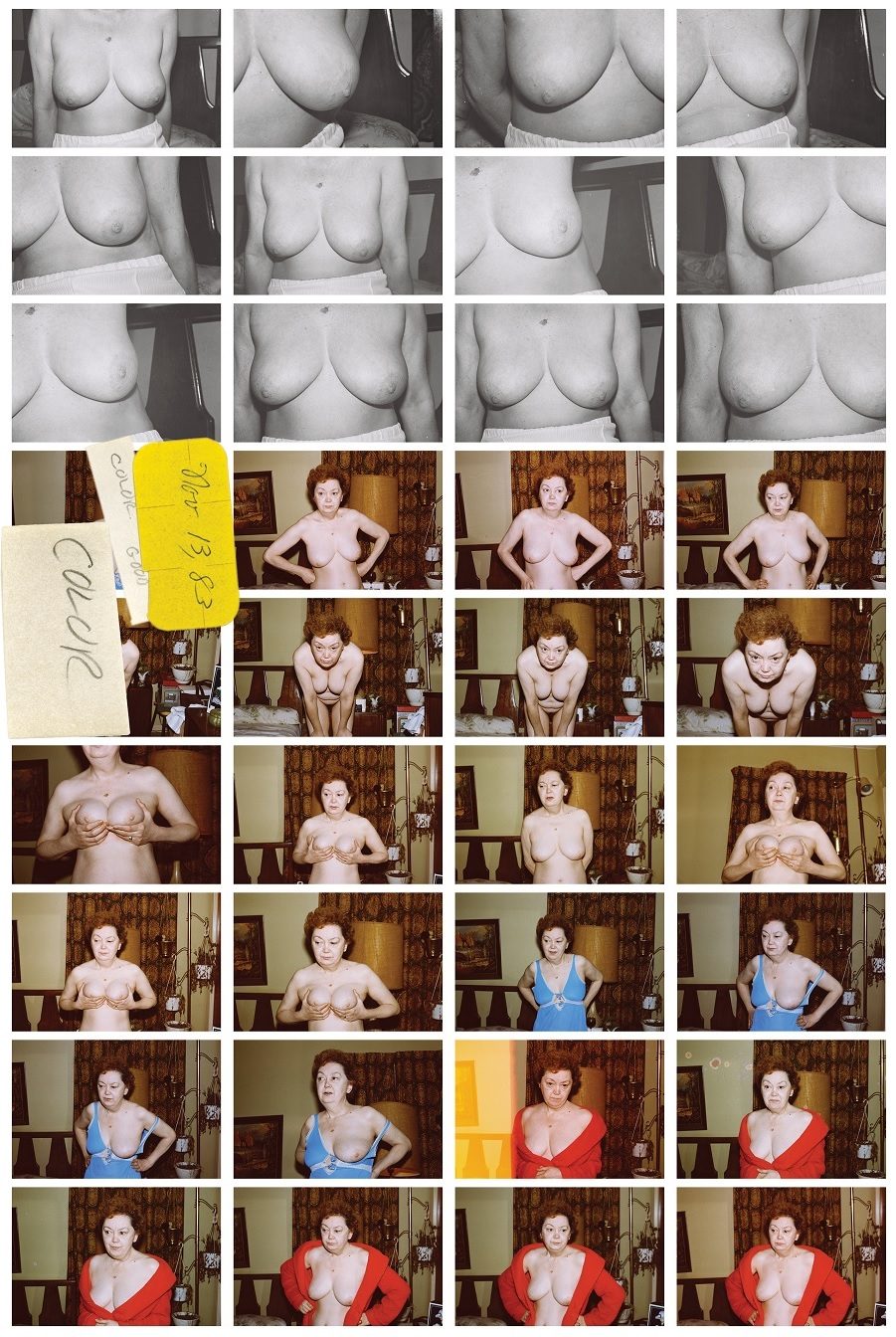
In Taking off Wessels constructs a visual biography from a collection of works by an amateur artist named Henry, which was entrusted to her by American friends. The collection consists of more than 5500 pictures, collages and sculptures made in the eighties, that all feature the same subject: his wife, Martha. She seems to have been his only muse and for a long time during their marriage she posed for him, before eventually leaving him, and throwing his work out on the street. The photographs picture her in different stages of undressing, taking on different poses, highlighting different parts of her naked body. She presents her body with a vacant and indifferent gaze, her eyes often averted from the camera. After their split he recovered the photos, cutting them up and reassembling them into collages. These collages mostly contain pieces of similar pictures and body parts, seamed together at joints and creases, thereby assembling a new, hybrid body. Often Martha’s face wasn’t part of these creations and they have an uncanny and vaguely disturbing sexuality about them. Later on the collages in their turn inspired clay sculptures, smooth, pale and seamless versions of these strange bodies.

Seeing the exhibition, that starts chronologically with a space completely plastered with these images and continues into three spaces that respectively encompass pictures of the split, of the sculptures and of the collages, is fascinating to say the least. Although their story is presented as true, Henry and Martha’s hidden motives remain very mysterious and hard to understand. In this alienating presentation of material that was clearly meant not to be seen, Henry seems overcome with an unhealthy, even scary obsession with Martha’s body, void of any love or tenderness. Furthermore, feelings of shame are omnipresent. Her shame, his shame, our shame. But at the same time there are so many unanswered questions. One can only wonder how authentic this representation is and where Wessels’ hand in it is. Do these pictures tell a story of sexual fixation or artistic study? Of objectification or appreciation? Of obsession or inspiration? We are left to wonder, staring closely at these pictures and collages in disturbed amazement.


The exhibition runs in the FoMu Antwerp until  05.06.16
For more info see: http://www.fotomuseum.be/en/exhibitions/mariken-wessels.html

This review was written for the Photography and Visual Culture Class of the Cultural Studies Program