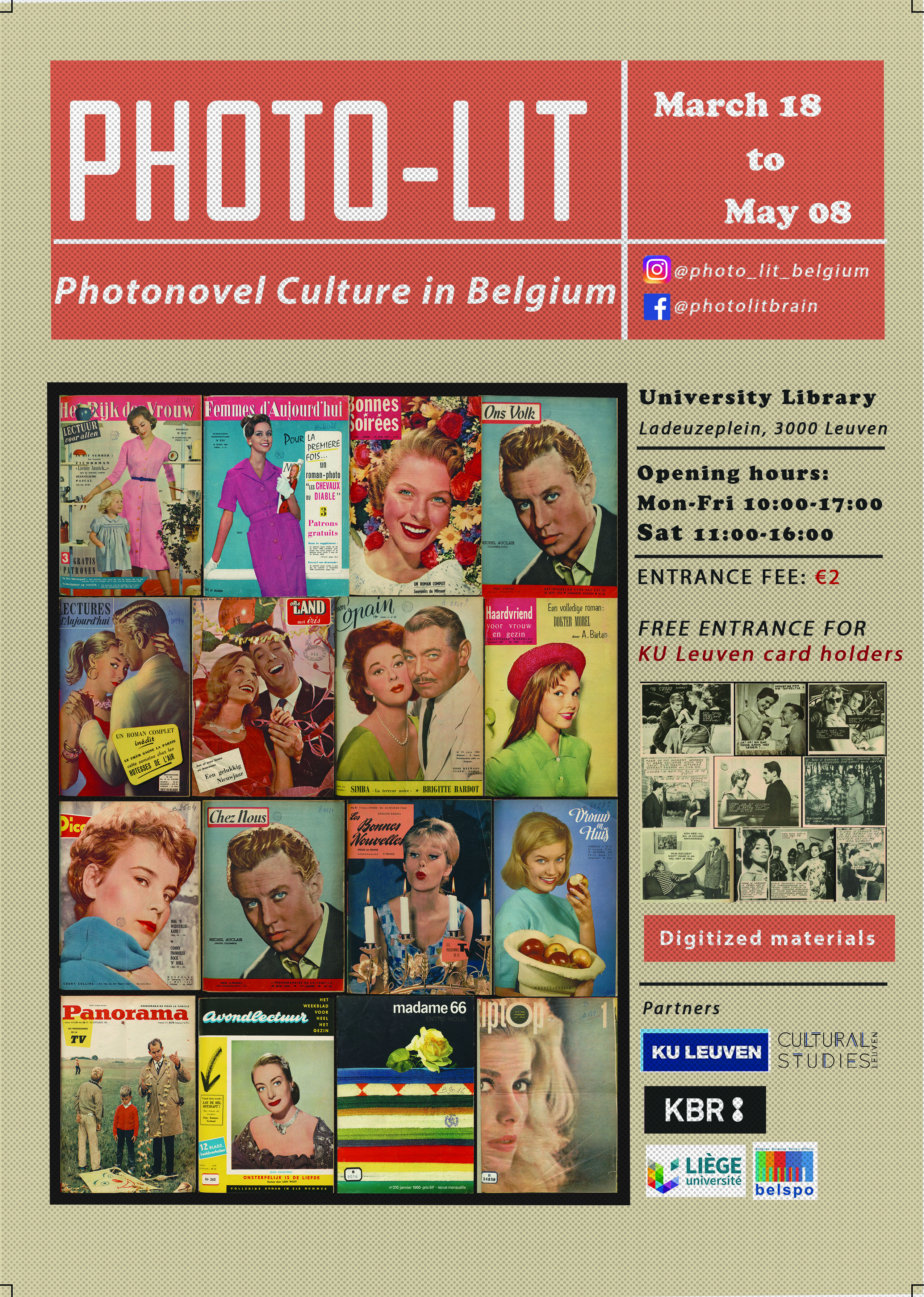
A piece of good news in these strange times: in two weeks’ time the exhibition “Photo-Lit: Photonovel Culture in Belgium” opens its doors at the University Library of Leuven!
The exhibition is the closing event of the four-year-long Photo-Lit project. It revolves around the Belgian photonovel, showcasing the results of our research and disclosing the immense corpus of photonovels that have been published in Belgium from the 1950s. Where were these photonovels published? When? Who created them? How were they made? Who were the readers of photonovels? The exhibition tackles these and more questions, bringing visitors back in time to the beginnings of the photonovel, recounting its origins and evolution, uncovering its most famous and prolific creators in Belgium, and diving into its making of with storyboards and behind-the-scenes photos. Past and present are linked together through a photonovel reenactment especially created for the exhibition that uses modern technologies, defies the difficulties posed by the pandemic, and remixes and modernizes themes and poses of the past.
The collection showcased is partly physical, consisting of magazines, photonovels, photographs and preparatory material that has never before been exhibited; partly digitized, with the aim of acquainting visitors with the masterfully digitized collection of photonovels resulting from the efforts of the KBR within the project.
The exhibition is curated by Clarissa Colangelo under supervision of project coordinator Jan Baetens. It is organized in collaboration with a group of students following the MA Cultural Studies at the KU Leuven, and the University Library of Leuven. Divided in groups, the students took care of scenography (Elise Peeters, Felien Vandermotten, Stephanie Silva Chaparro, Xinyi Jiang, and Xiuyi Huang), policy and publicity (Iza Moreno Reyes, Lisa Alexandra Albornoz Muñoz, and Liujun Shang), and reenactment (Jenske Verhamme, Jiaqui Li, and Lia Herbots).
The exhibition will be kicked off by a Facebook Live on March 18th at 19h. Be sure to check out our Facebook page and Facebook event for more info and the streaming link.
From March 19th, the exhibition will be open Monday to Friday from 10h to 17h, and Saturday from 11h to 16h.
By: Frederik Truyen, KU Leuven CS Digital, Roberta Pireddu, KU Leuven CS Digital, Ilaria Bartolini, Dept. of Computer Science and Engineering (DISI), University of Bologna, Anne Marit Waade, Aarhus University, Cathrin Helen Bengesser, Aarhus University
As it is mentioned on the project’s website: “DETECt is a large collaborative initiative that involves scholars, teachers, students, professionals of the creative industries, and the general public in investigating how practices of transnational production, distribution, and consumption in the field of popular culture have facilitated the appearance of engaging representations of Europe’s cultural identity.”
The project researches the popular genre of crime novels and TV series, and in particular, tries to find out what explains the successful circulation of e.g. the European Noir.
Not only does the project bring together top experts in Europe on this very genre, but it also, from its inception, stated some very specific ambitions towards the role of digital approaches, methodologies and tools for the research as well as the dissemination activities.
There is little need to convince even the most hardcore humanities scholar of the necessity of going digital in these COVID times, unfortunately. But it is important to stress that it also offers key advantages from a research and teaching point of view, regardless of this direct urgency. In this short blog, we want to discuss how the DETECt project involved Digital Humanities in its data management and source gathering, methodology and analysis, teaching, public interaction and dissemination.
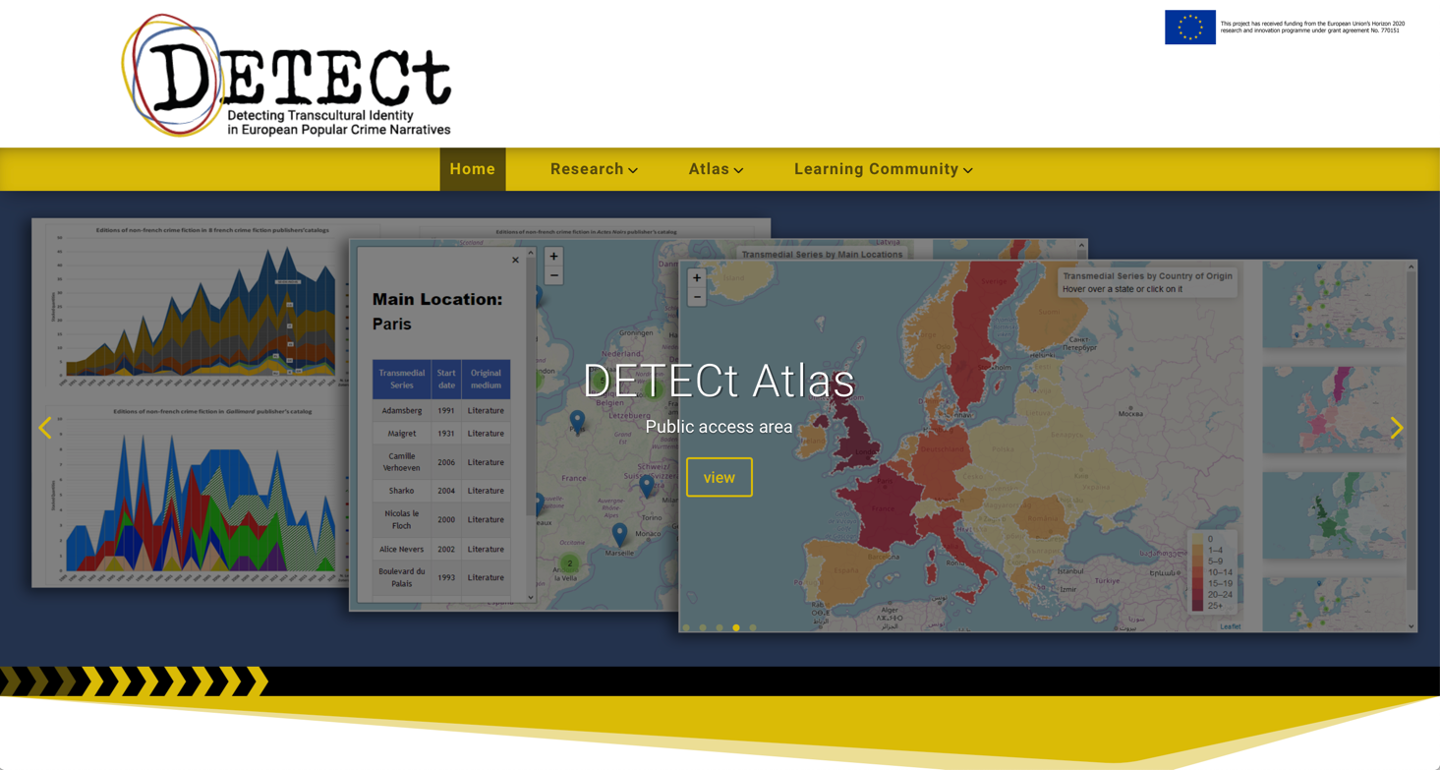
The developed portal contains access to the research data, the repository, an atlas, a web app, and access to the Moodle and MOOC learning environments (see details below).
Data management and source gathering
To share documents for collaboration, UNIBO decided to develop a specific document repository for the project, instead of using the usual tools offered by big brand ICT platforms. This approach allowed for a better integration in the web portal and the possibility of specific indexing. As a bonus, this allowed us to comply with EU GDPR regulations without having to make contracts with outside parties about data storage. To structure the research data and repository an ontology was developed to map the different relevant aspects and their interconnections.
But probably the most innovative part of it all is that the University of Bologna (UNIBO) developed an underlying repository and indexing system to assist in the gathering of sources. This was an important part of the evidence-based approach of this research: we wanted to do research into crime novel and TV series creation, distribution and reception based on a large repository of data. These activities in the “Infrastructures” part of the project support the research done in the specific work packages on creative industries, creative audiences, and transcultural representations.
Data was gathered according to legal use conditions from a diversity of open sources and merged into consolidated tables by means of tools such as OpenRefine. A workshop was organized for the project partners to share expertise on these digital humanities tools.
Methodology and analysis
The availability of a portal based on a proper internal database in a web environment allowed us to easily integrate data from a variety of sources, and describe them with relevant research metadata. It allows for the implementation of algorithmic Human-machine analysis as a tool to study creative industries, creative audiences and European transcultural identity. The DETECt researchers involved have a longstanding pedigree in data-informed approaches.
On top of this database, data visualizations were developed, first off-line with tools such as Gephi and Tableau, and then specifically programmed onto our core database infrastructure for live online consultation. This means researchers can now find on our portal integrated visualizations build directly on the database, in mashups with maps. This allows for a refined analysis e.g. of trends in distribution and circulation.
As a result, a collaborative analytical atlas of European transcultural identity is available on the portal.
Teaching and Learning
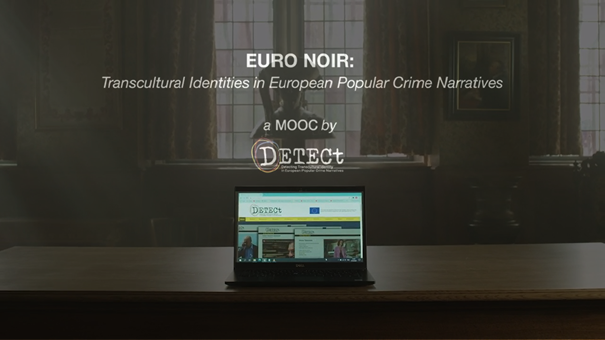
From the earliest conception of the project, it was decided to include a MOOC. KU Leuven is a member of the world-leading edX consortium, and has a wide range of MOOCs on offer. The Cultural Studies KU Leuven DETECt team also had ample experience with MOOCs, having been instrumental in the development of an institutional MOOC strategy. Our latest MOOC, “Creating a Digital Cultural Heritage Community”, attracted over 2000 learners. KU Leuven has several recording studios and a large support team including ICt support, pedagogical expertise, scenario writers and video artists. The university support service LIMEL also offers training of staff members into MOOC development. The MOOC will target a mixed audience of both professionals and a wider audience, as there is a very strong general public interest in crime novels and TV series.
To prepare for the MOOC, a workflow was designed by UNIBO and KU Leuven, for which a Moodle instance, integrated with the DETECt platform, would be used as a temporary online tryout and content development platform. It also allowed for test student interactions. The materials gathered according to project standards for the Moodle constitute the pool of resources from which the MOOC is built, on the internal Edge server of KU Leuven, before it is published on the KULeuvenX edX platform. This way, we have a managed production process to which all involved partners could contribute. Of course, the MOOC will not only provide recorded lectures and study materials but will tap on the potential of the portal and database for interactive student activities.
Public interaction and dissemination: Web App
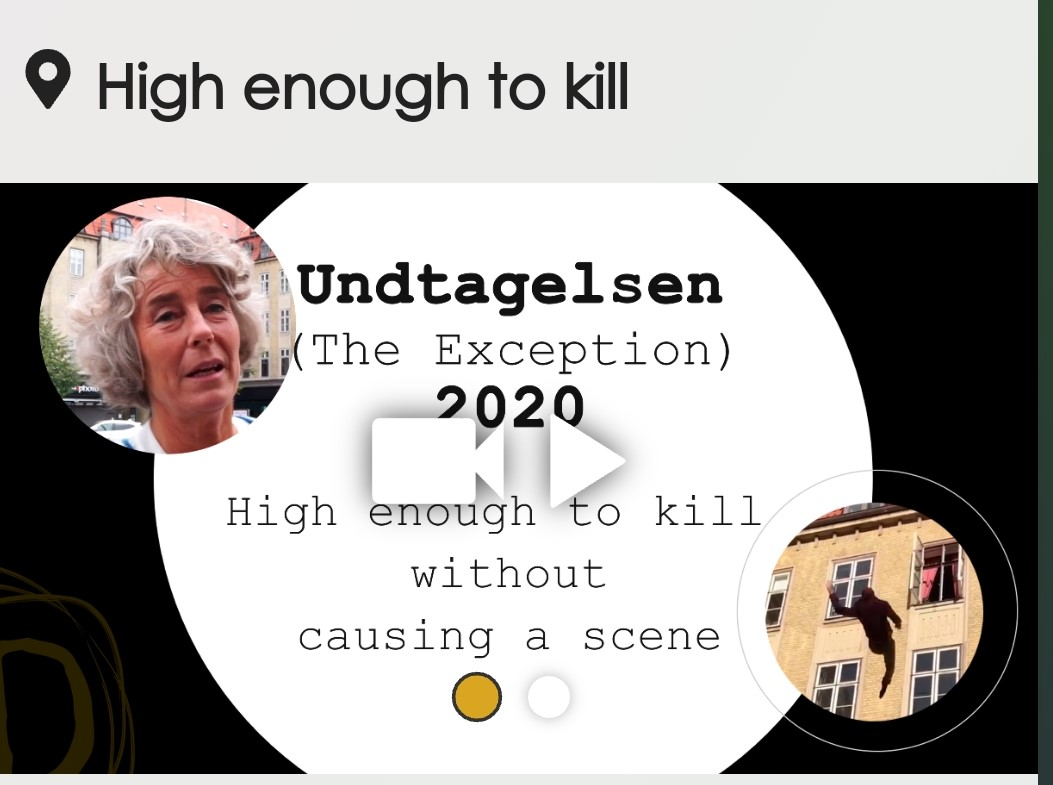
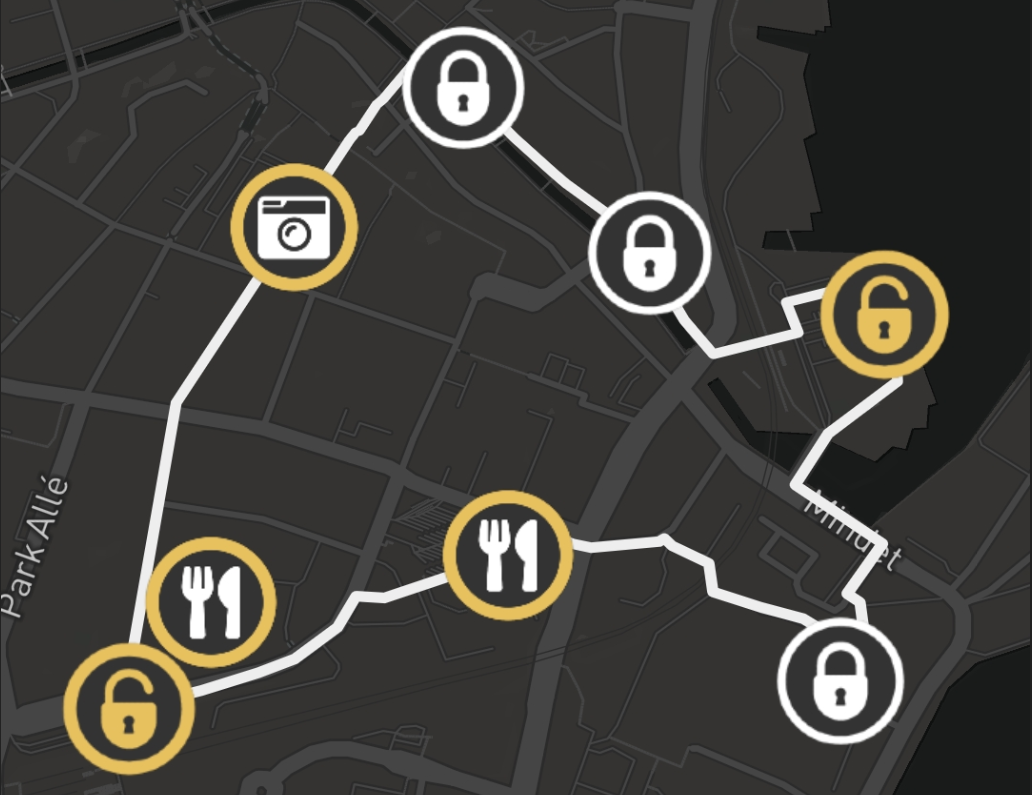
A Web App has been developed by the University of Aarhus, VisitAarhus and the start-up Motes, giving a guided tour to the “crime scenery” of Aarhus. The DETECtAarhus web-app (www.detectaarhus.eu) is a locative screen tourism experience, which consists of three walking tours through the city. Through GPS navigation It leads people to sites where contemporary films and TV series such as Dicte or Undtagelsen/The Exception were filmed, places which have inspired literary authors and it lets them discover the city’s silent film history. The app navigates the users to a total of 22 different spots where they can unlock audio, video, text and images or get recommendations for cafés and restaurants in Denmark’s second biggest city.
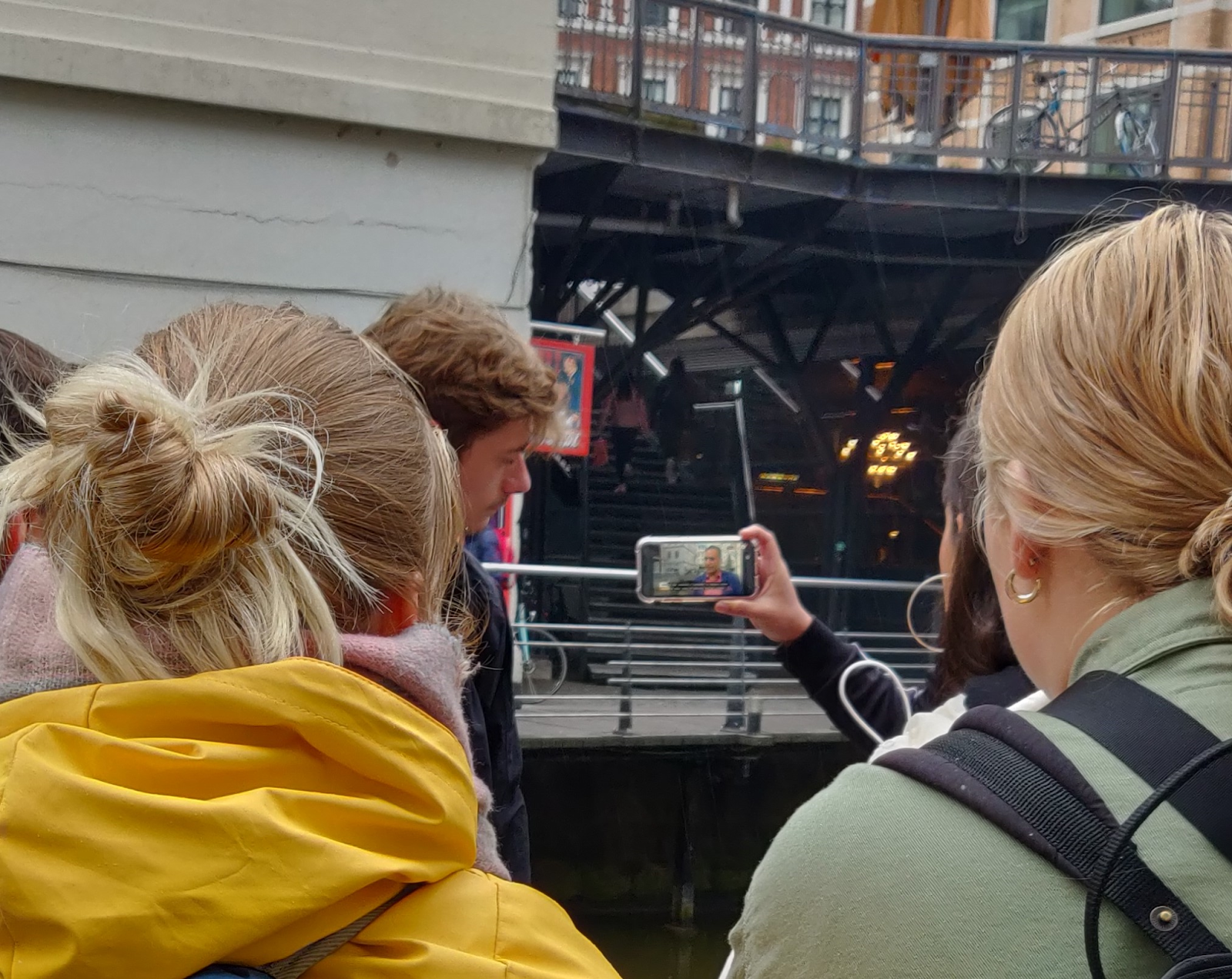
This app demonstrates how this research can lead to innovative reuses in the tourism and entertainment sector. But the development of the screen tourism web-app for Aarhus was also a perfect opportunity for intertwining research and teaching. The app is suitable for teaching film students about silent film and film tourism as well as for presenting a new perspective on the city to international students. As one of the international students testing the app remarked: “I think it made me see the city in a different way, because I guess the mainstream tourist doesn’t go through film spots, so yeah, you get to see a different side of the city that to be honest, I didn’t know before.” (Spanish exchange student, Nov 2019)
But beyond this literal use as an educational tool, the app is also suited for demonstrating to students practical processes and challenges of product development. This experience prepares them for work environments in the creative industries. By becoming an active part of the research process around the app, students can also be trained methods of qualitative user research, which not only helps their development as academic researchers but also prepares them for research & development scenarios in the workplace. BA-students in media studies, for example, performed user-research around the app as part of their training in media reception analyses. They developed independent research projects, conducting and analysing 18 single or group interviews. Their findings contributed to the evaluation and further development of the app. Together with the web portal, the app is one of the vectors of our wider dissemination strategy. Following the pilot experience of DETECt Aarhus App, UNIBO is now working on DETECt Bologna that will feature multimedia material from six crime transmedia series set in the city.
But of course this infrastructure and these tools are mainly conceived to support the research in the project, and the educational activities around it. You can find the main research outputs on the website, including journal articles and book publications.
The views and opinions expressed in this publication are the sole responsibility of the author(s) and do not necessarily reflect the views of the European Commission.
The research reported in this blogpost has received funding from the European Union’s Horizon 2020 research and innovation programme under Grant Agreement No 770151, DETECt – Detecting Transcultural Identity in European Popular Crime Narratives
Written by Didier Goossens, Cultural Studies alumnus
During my bachelor years at KU Leuven, I was told that if I wanted to pursue my true passion, I should be ready to defend it tooth and nail. Certainly, that came true when I discovered metal music studies. What are those? And why are they worthwhile? This is a question that I, following my graduation from the Master of Cultural Studies in 2018/9, have strived to answer and defend.
First, what are metal music studies? Utilizing a metaphor from Deena Weinstein (an American sociologist and one of the first scholars of metal music and culture), the term ‘metal music studies’ blankets an archipelago of disciplines that seek to understand and contextualize metal music and culture.This has brought together cultural theorists, literary and discourse analysts, musicologists, sociologists, psychologists and anthropologists, leading to the constitution of a formal research organization, the International Society for Metal Music Studies (ISMMS), and its associated academic journal, Metal Music Studies. That being answered, why do we practice these studies?
Metal music has a long and at times controversial history that proves fertile soil for social reflection and scholarly research. Issues that made past news, were either conservative accusations that metal causes Satanism, addiction and suicide; or its more extreme exploits, such as church burnings, murder and tendencies towards fundamentalist ideologies. More subliminally present in metal music and culture, and therefore known to a lesser degree, are on the one hand its negative treatment and underrepresentation of women and BIPOC, and on the other its consistent potential for cultural resistance. As such, metal music studies investigate such contradictions from various angles: cultural theorists and sociologists ask what brings fans of metal music together in so-called scenes and how the music and performances in those reflect cultural identities. One outstanding example of this is the reconciliation with traumas of dictatorial regimes in metal bands from Argentine, Peru and Chile. More musicology-oriented studies dissect structures within metal music and performances and analyse these through affect studies, among others. For example, a recent publication discusses the religious associations within drone metal, a brooding subgenre that stretches and distorts single notes.
It is within this cultural theory-oriented part of metal music studies that in 2019, I wrote my master thesis in cultural studies at KU Leuven. In it, I studied how the New Zealand metal band Alien Weaponry builds on their Māori identity in their music and performances, and how this identity is then distributed and received, particularly in western nations. According to theories of cultural globalization, this is where the majority of the metal-consuming masses are, and where thus the most cultural capital in metal still resides. Following my graduation, however, I did not want the thesis to lie around idly, as it reminded me of the fundame(n)tal value of metal music studies: its music and culture thoroughly reflect social dynamics. The inquiries of metal music studies unnerve, as they confront us with substantial elements of sexism and racism within metal music and culture; they also lay bare the explicit and implicit choices in life: how people come together in groups, exhibit taste, deal with different cultural identities in increasingly global and glocal contexts… These questions need to be asked, which has caused misunderstandings and tensions to arise between scholars of metal on the one hand and artists and fans on the other. Metal music studies are either unknown to people outside of academia’s ivory tower, or are accused of “demystifying” and/or “destroying” metal altogether – while the opposite is true. But how can metal music studies convince the world of this?
My proposition is through visibility and co-operation. With these ideas in mind, I submitted my thesis for the Vlaamse Scriptieprijs 2019. And while it did not win any prizes, it was picked up for an article in their newspaper, proving that the subject of metal music and culture, which is often discussed through simplistic and reductive stereotypes, intrigues and fascinates people, especially when dealing with different cultural identities. Following up on this visibility, I also made an appearance on Calling From The Underground, a podcast on (Belgian) metal hosted by popular stand-up comedian Alex Agnew and producer Andries Beckers. In it, I explained that while metal music and its studies are still largely absent from public debate and popular discussion in both Belgium (where I followed my higher education at KU Leuven) and the Netherlands (where I am currently employed at the Erasmus University Rotterdam), this is not necessarily cause for concern. With bands like Amenra and Brutus stepping into the limelight, discussions of metal music become increasingly nuanced, slowly opening the door for those themes of cultural studies that we find in it, and that are of great interest to metal music studies: culture, identity, affect, memory and performance. In order to bring this out in full, I therefore call for co-operation. In order to make the most of metal music studies, scholars need to co-operate with the field of metal production, dissemination and reception. We need to come together with artists, label agents, venue bookers, festival organizers, reviewers, journalists and fans alike to better understand what makes metal tick worldwide and across the world. This is a crucial element of my research that continue to stress in every publication and appearance. I am very positive about this, too: various documentaries on Latin American metal have been produced by scholars and in co-operation with local scene members. And while such efforts are taking place on a smaller scale in Belgium and the Netherlands, they are there, growing in the underground. That is why metal music studies are worthwhile.
Some links to these articles and appearances
the article for the Vlaamse ScriptieKrant (Dutch) can be read here: https://scriptieprijs.be/nieuws/metal-bij-de-maori. It will also give you access to Didier’s full master thesis on Alien Weaponry and glocalization;
the episode of the Calling From The Underground podcast on metal music studies (Dutch) can be viewed here: https://www.youtube.com/watch?v=z3PbX1FP43M&t=334s. It is also available through Google Podcasts, iTunes and Spotify, among others;
one of the documentaries on metal in Latin American countries can be viewed here. It was produced by dr. Nelson Varas-Díaz and his research team, in close co-operation with scenic members in Argentine, Chili, Peru and Mexico: https://www.youtube.com/watch?v=Yb4u3Q1APHk&t=228s.
Written by Andries Haesevoets, Cultural Studies Alumnus and winner of the Passwerk Prijs
Bij de keuze van het onderwerp van mijn masterproef wilde ik absoluut iets rond of over theater maken. Daarnaast ben ik heel blij dat ik Disability Studies heb leren kennen, omdat dit paradigma heel ruimdenkend is en zich niet beperkt tot één essentialistische of reductionistische visie. Al van kleins af aan moet ik regelmatig op doktersbezoek en dat voelt nooit echt prettig aan. Ik voel me daar dan niet helemaal op mijn gemak. Je wordt er enkel bekeken als een medisch subject met abnormale kenmerken waardoor je het gevoel krijgt dat je raar bent. Al die consultaties hebben een diepe indruk bij mezelf nagelaten en het heeft me ook gevormd als persoon.
De vrijheid om jezelf te zijn binnen de podiumkunsten
Een plek waar ik me altijd weer goed voel en geen last heb van mijn disabilities, is op een podium. Daar voel ik me steeds kiplekker. Al heel jong sloot ik me aan bij een lokaal dansgezelschap. Omwille van mijn motorische beperkingen kon ik niet alle dansjes even goed meedoen, maar mijn dansjuf maakte daar geen probleem van. Ze zocht naar oplossingen waardoor ik ook volledig werd opgenomen in de groep. Dat gaf mijn zelfvertrouwen een serieuze boost. Later sloot ik me aan bij een lokale toneelgroep, jeugdtoneel Kaboekie, en daar zit ik nog steeds bij. Ook zij beschouwen me allemaal als een volwaardig persoon die net zoals iedereen sterktes en zwaktes heeft. Ik kan er gewoon telkens opnieuw volledig mezelf zijn. Vandaar dat ik ook zo verknocht ben geraakt aan de podiumkunsten.
Een aantal jaar geleden werkte ik samen met theaterdocent Ingrid Dullens aan de voorstelling ‘Olla Podrida III’. Twee jaar geleden ontdekte ik dat Ingrid theaterlessen zou geven aan kinderen met autisme. Ik was meteen verkocht om hierover mijn masterproef te schrijven. De lessenreeks bestond uit tien lessen waarin de kinderen heel wat improvisatieoefeningen deden en toneelstukjes in kleine groepen maakten. Ze kregen veel vrijheid om te spelen en te onderzoeken. Elke les focuste zich op één element, zoals: locaties (waar), personages (wie), actie-reactie (wat) en emoties. Ik heb twee kinderen in de groep geobserveerd en geïnterviewd gedurende de volledige lessenreeks. De meest dominante modellen van het kennisdomein Disability Studies heb ik op een dynamische manier toegepast op deze data. Op die manier heb ik geprobeerd om dichter bij hun ervaringen van de theaterlessen te komen.
Iedereen is anders
Het doel van deze thesis is om een beter inzicht te krijgen in deze ervaringen. Hoewel beide participanten de diagnose autisme hebben gekregen, werd het duidelijk dat ze de theaterlessen niet op dezelfde manier ervaren. Het zijn twee verschillende kinderen met elk hun eigen karakter en hun unieke persoonlijkheid, ondanks hun autisme. Deze studie wil daarom ook onderzoekers, professionals en andere betrokkenen inspireren en hun blik verruimen. Mensen met autisme zijn meer dan hun diagnose en iedereen is anders. Door naar hen via meerdere brillen te kijken, zullen we hen niet meer als minderwaardig bestempelen en zullen we hen als een volwaardig persoon met unieke en bijzondere talenten opnemen in de samenleving.
Written byAnna Puhr, alumna Cultural Studies 2019-2020
The European Capital of Culture (ECOC) initiative sheds an impressive light on the relevance of cities and their culture for the development of Europe. Every year two cities succeed with their candidacy and receive the title of being ECOC aiming at shaping an extraordinary year of the respective cultural capital as sustainable and ambitious as possible.
In the wake of the COVID-19 pandemic, 2020 counts definitely as one of the most – or even the most – challenging year for the ECOC presidency which was awarded jointly to Galway in the West of Ireland and to Rijeka in Croatia. While the actual program for both cities has not been totally cancelled, their offer has been much reduced by the nature and impact of the global pandemic. Universities often play a major role in the ECOC of their city either in forging research focused on the arts throughout Europe, in working with city councils in evaluating the bid or in defining new cultural and educational initiatives within their local communities.
In Ireland, NUI Galway was due to host the University Network of European Capitals of Culture (UNeECC); an academic network that comprises almost 50 member universities from 20 countries located in cities which have been, are or will be European Capitals of Culture. As the annual conference had to be postponed in view of the current situation, NUI Galway instead invited interdisciplinary contributions to an online Special Issue of the University Network of European Capitals of Culture. This Special Issue provides an opportunity to learn more about how both cities, Ireland and Croatia, have adapted their programmes and to understand better the pan-European responses to the impact on artists, cultural workers, local communities and universities.
The final results have been virtually presented to the city hall’s Arts Advisory Board Meeting in March 2020. In order to reach a wider audience and increase understanding of the potential to include a city’s international audience in cultural activities foreseen with regards to an ECOC year and beyond, the project was submitted and successfully chosen for the Special Issueof the University Network of European Capitals of Culture “The ART of REIMAGINING” which will be published this November (see the call for contributions: “ https://mooreinstitute.ie/2020/07/06/european-capitals-of-culture-the-art-of-reimagining-call-for-contributions/).
We all know the struggles of writing the obligatory Master Thesis, alumni and students alike. Whether it’s choosing a topic, looking for sources or rewriting chapters over and over. I’m not even speaking of all the mental breakdowns that follow in their wake. But to encourage you to press on, I would like to share with you my unexpected journey.
When I enrolled for the Master of Cultural Studies, I already dreaded the idea of having to write a thesis. I wasn’t a fan of writing a bachelor’s paper, so the prospect of having to do it all over again enforced that feeling. Therefore I decided early on that it would be about a topic I truly loved. In my case that meant analysing my favourite comic series, Frank Miller’s Sin City. In hindsight I’m very thankful for making that choice, because if I hadn’t followed my heart and stood behind my decision, I could not have worked so hard and dug so deep into the subject. My love for the Sin City series gave me the motivation to return to the artwork over and over, especially in those moments when my supervisor suggested I returned to the comics once more, even if I was confident I had already found everything in them. Of course, the credit for my perseverance isn’t all mine: my parents had played a huge part in that too. If it weren’t for them, I wouldn’t have seen the similarity between comics and film composition and editing.
So when your supervisor pushes your boundaries, listen, because it will make your thesis even better. Also, it is OK to seek help and support of your parents or friends when you’re feeling down. Their input may be the key to seeing your work from an entirely different angle. At the end of the academic year, I submitted my thesis for the annual Comics Thesis Prize. A friend had tipped me off about it and I figured “what the hell, what have I got to lose”. I was pleased with my “14/20” and my supervisor gladly took care of sending it in for me. That being done, life went on and I started on my Concept Art degree in film. By the end of September, I had already forgotten about my thesis.
So imagine my surprise when I got an email from the Comics Thesis Prize organisation about attending the award ceremony. Still, I thought “OK then, a mere formality, it probably doesn’t mean anything”. At the bottom of the email it said that “if you were among the laureates, you would be notified a few days prior to the ceremony”. I didn’t even take that seriously. Until the day before the ceremony, when I received an email saying that I won the first prize. When I read that, I literally stared at my laptop screen for five minutes. I couldn’t believe it was actually true. I never dreamed I would even make it into the top three, let alone win.
After a few hours, when I came round from the surprise and I realized what it meant, I took up the Comics Thesis Prize’s offer to write a short article for their next summer issue. An extra publication is never a waste. Besides, what’s a mere 6 pages compared to the average university paper and moreover, a thesis.
What I’m trying to say, is that you never know when a trial like your thesis can bring something unexpected around the corner. I thought I was done with academia and writing stuff – but as it turns out, however, academia was not yet done with me. So there you have it: “the flower that blooms in adversity is the rarest and most beautiful of all.” (Mulan, the Emperor)
Why visit Mons? Why visit a city that is no longer the European capital of culture (2015), a place so small that one may overlook its very existence? A place so near-by and so well connected to Leuven that it seems deprived of all exoticism? A place without railway station, that is without actual building, the existing one having been demolished and the new one eternally under construction, a place with no professional football team (and the basketball team did not very well either this year)?
Many questions, but countless answers as well, after a pleasant and very instructive city trip (we were there for business, not just for entertainment), that helped discover not only the rich cultural infrastructure of the city but also the extremely pleasant atmosphere of daily life in Mons.
In a nutshell, this was the program of the day: sight-seeing on the one hand (yes, the station: a ruin in the making, the main church, a grandiose copy of that of Leuven, the belltower and of course the little monkey at the city hall, the collapsed but rebuilt Arne Quinze installation, the new Manège theater – alas due to a strike it was not possible to recite some poetry at the entrance of the local prison, so famous in European literary history) and great cultural activities on the other hand (the city museum BAM, with a great exhibit on performance art and Bill Viola; the Mundaneum with the astonishing Paul Otlet archives as well as an exciting special exhibition on data visualization, big and small, and the artothèque, which a lack of time prevented us to visit from attic to basement).





 Cultural Studies Leuven