Symposium ‘LIFE-WORK: Alternative forms of life writing’

In December the British novelist A.S. Byatt will be awarded the Erasmus Prize 2016 for her contribution to life writing. To mark the occasion, the Centre for Gender and Diversity of Maastricht University and the Praemium Erasmianum Foundation are hosting a symposium on alternative forms of life writing.

croppedimage680680-byatt-as-credit-michael-trevillion

Photo by Michael Trevilion

When? November 17th, from 13:00 to 18:00.

Where? Faculty of Arts and Social Sciences, Soiron building – Spiegelzaal (first floor), Grote Gracht 80-82, Maastricht.

Biography and autobiography are more popular than ever. Biopics and biographical television serials draw masses of viewers while even scholarly biographical tomes such as Maaike Meijer’s biography of the poet M. Vasalis (2011) become unexpected bestsellers. But writing and re-writing our lives’ stories, by ourselves and by others, is a process that also takes place in many other forms than the traditional biography or biopic. And even within these forms many unorthodox approaches are gaining currency. In this symposium we will highlight a number of the new and unexpected forms that life writing is taking in the 21st century. We investigate the challenges posed to such life-work by the arts and the new media, but also explore the opportunities for re-inventing ourselves that they offer.

Presentations will enquire into the performative character of biopics; the challenges of inter-country adoption for (re)-constructing a coherent life story; forms of life writing in film, in the visual arts, and in performance art; the articulation of collective memories in post-communist Romania; the challenges of articulating the self for people with autism or people suffering from dementia, and many other aspects of contemporary life writing outside the traditional forms of the (auto)biographical narrative.

Confirmed speakers are Leni van Goidsenhoven, Louis van den Hengel, Sandra Kisters, Maaike Meijer, Codruta Pohrib, Aagje Swinnen, Christophe Van Eecke, and Lies Wesseling.


Original article: https://www.maastrichtuniversity.nl/events/symposium-life-work-alternative-forms-life-writing

For extra info: http://www.erasmusprijs.org/nieuws?item=Persbericht+Erasmusprijs+2016+toegekend+aan+A.S.+Byatt&mode=detail and http://www.knack.be/nieuws/boeken/a-s-byatt-krijgt-de-ermasmusprijs-2016/article-normal-646841.html

Old Books, New Ideas

By Jan Baetens

Axel’s Castle, an essay by Edmund Wilson on the living literature of its time (the book was published in 1931 and never out of print) is a thrilling read. The subject has everything we can imagine to bore us today: we know, or think we know, what the good modern writing of the first decades of the 20th Century was; the literary essay is no longer a genre with great sex-appeal; the authors under scrutiny are literary monuments that frighten us (Yeats, Valéry, Eliot, Proust, Joyce, and Stein) and what to think of a book that aims to construct a canon, something of which we are now afraid?

Nevertheless, everybody should read this book.

First, is better to address issues of canon formation in an open and direct way, rather than thinking that one can get rid of canons by ignoring them. This applies to literature as well as any other art: without the much criticized institution of the canon, that ultimate example of symbolic power, the power issues and stakes in critical debates remain as fierce as always, and the way they are discussed becomes even more violent and arbitrary. Hence the necessity to shift from emotional to rational criteria, which is always inspiring: if this or that is good, it is not because I like this or that, but for this or that reason.

Second, because it helps us understand that the making of a canon is not the result of the taste of those in power and the subsequent refusal of all the rest. A canon is always multilayered, it may start from the present but look always over its shoulder (each canon results of a struggle of the past, whose traces remain) as well as ahead (the choice of this work or author rather than that one is always risky business and those who try to build canons are perfectly aware of that). In this case, the history of modernist literature is projected onto the age-old dichotomy between romantic and naturalistic tendencies: Modernism appears when Realism has run out of steam, but it does not come back as a farcical return, dixit Marx, of what had been superseded by Realism, namely Romanticism.

Third, because a canon is never a dead object. It is always in the making, and each use, abuse, appropriation, re-appropriation, expansion or continuation involves a passionate debate on the what and the why: what do we want to keep for the future, and why precisely this item or author? This essential stance forces the canon-maker (and later the gunner who will use the canon outside the cultural arsenal, in real life) to make sharp distinctions between failure and achievement, not between authors and works, but within them. Wilson is outstanding in this respect: Ulysses is a masterpiece, but the Lotos-Eaters chapter suffers from serious flaws, while other chapters can quietly be skipped. Stein revolutionizes language, but please reader: do stop after reading five pages. We like Yates, but what a hodgepodge of silly Celtic abracadabra in much of his works, etc.

What Wilson is doing is no longer accepted today. We have become suspicious of canons and even more to canon-making. At least that is what we proudly but stupidly believe. Reading Wilson’s criticism in action, a practice that combines what we are no longer capable of practicing simultaneously, namely creative writing, theory and criticism, should be a great lesson for us.

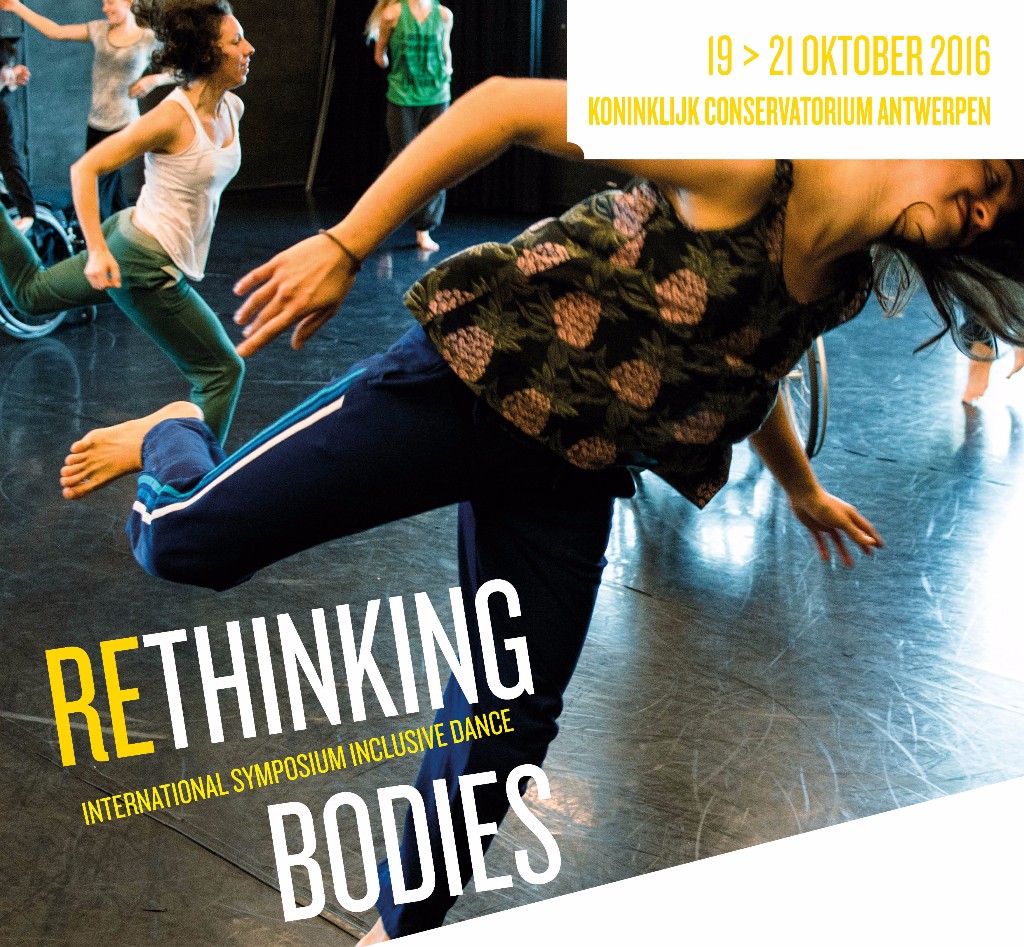
International Symposium Inclusive Dance: Re-thinking bodies

da8a47b3-5a82-424a-b93c-7629caf0de99

International Symposium Inclusive Dance: Re-thinking bodies 19/20/21 October 2016

The contemporary dance department of the Royal Conservatoire Antwerp/AP University College is organizing for the third time an International symposium on Inclusive Dance practices.

Experts, choreographers and performers within the field of inclusive dance practices, education and performing arts will collaborate with students in dance of the Royal Conservatoire Antwerp and the Faculty of Arts & Humanities from Plymouth University. Dancers with different disabilities will join the student dance groups during an intensive program of 3 days: a program with workshops, lectures, debates and performances open for public.

The research project ‘LAB incl.’, initiated by cultural studies student Iris Bouche, stands for ‘LAB Inclusion Dance Platform’. Its aim is to create an inclusive and experimental learning environment that can be used for fundamental artistic research into dance as a means of communication and for the essence of creativity as the ability to solve problems.

By initiating research projects, inviting international practitioners and participating in European exchange programs, the dance department inspires a new, more open-minded generation of dancers and clears the way for the progression of inclusive dance practices in Flanders. Within the context of a University College, artistic and academic research reinforce each other and support the development of inclusive performing arts.

For more information on the Symposium, please visit the following website: https://www.ap.be/koninklijk-conservatorium/evenement/rethinking-bodies-symposium-2016/4654

Facebook page: https://www.facebook.com/International-Symposium-Inclusive-DanceRe-thinking-Bodies-192021-okt-413366288825769/

Faking It? On the pseudo of much neo

By Jan Baetens

Despite all the talk on the end of modernism, our basic cultural regime is still that of the new: what is new is good, the newer is always better and the best is yet to come. The craving for novelty and innovation is definitely worthwhile (after all, it is not easy to find something really new: an original idea is as difficult to find as a good man). Yet the pressure to come up with something different, that is something not yet known to the public, often clashes with the complexity of culture’s history. In many cases, the so-called new, next to be forgotten tomorrow, has already been seen and forgotten many times before. In short: only the flaws of our cultural memory and the excessive emphasis on the present’s creative destruction prevent us from taking a more critical stance toward so-called innovations or experiments.

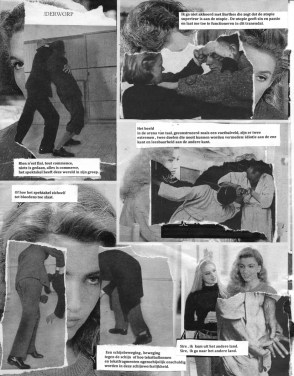
roman-1All this to say that I was cruelly disappointed by two recent “new” works, which both claim a certain form of novelty, if not avant-garde aura, but which rapidly collapse in light of the longer history of their art: first “Roman”, a parodic collage (mindlessly labeled “graphic poem” by the journal that devotes a special issue to the newest kid on the graphic novel block) by Luc Fierens (a Flemish artist enthusiastically embraced by the in-crowd as a representative of the post-neo-avant-garde); second Carpet Sweeper Tales, an equally parodic photo-cum-captions collage by Julie Doucet (best known for the feminist punk comics she published in the 1990s).

Both works roughly apply the same protocol: they cut-and-paste images from old photonovels (at least what they call “old”, for it is clear that the “original” or “primitive” works are overlooked), while adding captions that do not match the images but manage to foreground the ridiculous character of the genre they are parodying. Parody is of course great, but in the case of the photonovel it is anything but new. The parody of the photonovel is as old as the photonovel itself and to imagine that photonovel readers (allegedly lower-class women) are the dupes of their reading is a form of snootiness that is no less questionable than the laughable content of what is more than “only entertainment” (to quote Richard Dyer’s famous defense of that other despised genre, the Hollywood musical). It is the neglect of previous –cover_carpet_sweeper_talesand much harder and harsher forms– of parody in the pale and dull remakes by Fierens and Doucet that prove disappointing. No mention here of the Situationnist détournements, those for instance by Marcel Mariën who already in the 60s critically appropriated the aesthetics and ideology of the photonovel. No mention either of Barbara Kruger’s later attacks on consumer society through the combination of photographs and overlaid stereotypical statements. And one could go back to Surrealist Max Ernst (whose collage picture novels are now being reissued) or the political art of John Heartfield –the list is almost endless (in the comics field, why not remember Art Spiegelman’s early collages or the many constrained works produced by the Oubapo group and their many sympathizers).

There is a moral to be drawn from these fake attempts to sell the new. If Fierens’ “Roman” and Doucet’s Carpet Sweeper Tales can be presented as belonging to the avant-garde of today, it is only because cultural criticism is neglecting one of its duties, which is not only to praise or condemn, but to give the context and the larger framework that explains why we do so.


Luc FIERENS, “Roman”, in DWB 2016, n° 3 (special issue on the graphic poem)

http://www.dwb.be/nieuws/vers-van-de-pers-dw-b-2016-3-graphic-poem

Julie Doucet, Carpet Sweeper Tales (Montreal: Drawn and Quarterly, 2016)

https://www.drawnandquarterly.com/blog/2015/06/dq-25-pr-carpet-sweeper-tales-julie-doucet

“Europeana Space: Creative with Digital Heritage” – Enroll now!

Screenshot

Online courses – MOOCs: Massive Open Online Courses – have become a popular means to access information freely, explore new subjects, update one’s knowledge, and learn something new.

In the past months, Cultural Studies Professor Fred Truyen has been organizing the online course Europeana Space: Creative with Digital Heritage. The mission of this MOOC is to show how people can become creative with Europeana and digital cultural content, to demonstrate what Europeana can bring to the learning community, and to bring about the essential concept that cultural content is not just to contemplate, but to live and engage with. This is an extremely topical subject since the online availability of digital cultural heritage keeps growing; it is therefore more and more necessary that users, from passive readers, learn to find, understand, reuse and remix the online resource in an active and creative fashion.

The course feeds into the experiences of the Europeana Space (E-Space) Pilots and brings you the results of their research, analyses and test cases. The educational idea behind the E-Space MOOC is to lower barriers to the access and reuse of cultural heritage content on Europeana and similar sources, providing tutorials and trial versions of applications and tools alongside with reading materials and useful tips and best practices gathered during the course of the project.


Pick one of these inspiring modules, or just take them all!

Photography: In this module you will learn how to create your own stories with vintage photographs online, using Europeana and other open content, and remixing it with personal narratives and images.

Open and Hybrid Publishing: In this task-based module you will learn how to put together an online book by studying aspects of Photomediations: An Open Book as a case study. Materials included in this session range from online articles on photography and other arts, some visual material, to guidance notes about the use and reuse of CC-licensed material, Open Access and Open and Hybrid Publishing model. The most exciting part of this module is a freewheeling and playful challenge exercise which involves students reusing and remixing pre-existing material from Photomediations: An Open Book in order to create their own resource.

TV: Europeana Space developed a series of multiscreen applications for TV, focusing on reuse scenarios of cultural heritage. You will learn different ways in which archive footage can be re-used online, which formats exist, and which technology and coding languages can be utilized to make video available in a TV setting.

Dance: The E-Space Dance Pilot MOOC offers a series of activities for learners at different stages, ranging from undergraduates to PGR students, to showcase and encourage uptake of the dance pilot tools. The activities will enable learners to build personal dance collections on selected themes and discover how an online annotation tool can support the creation and analysis of dance.

Museums: This module will help you designing web-based and mobile services tailor made not only for the visitors but also for museums and memorials staff, especially for those who are in charge of  designing educational paths, by sharing lessons learned and best practices.

IP for the Cultural Entrepreneur: This module will guide you through the process of managing intellectual property rights from an initial idea through to a start-up business. You will learn how to develop a clear strategy when it comes to intellectual property rights associated with digital cultural content and its commercial re-use. You will be introduced to E-Space tools and case studies which will demonstrate how to clear copyright, source open re-usable content, carry out IP audits and risk assessments, and how to approach licensing and the IPR associated with hackathons, business modelling and incubation.

Creative Marketing: The aim of this module is to stimulate creative ideas on communicating cultural contents with the use of new media and to show how a greater audience can be reached by combining the power of social media and storytelling and how audiences can be better engaged.


Whether you are a student or teacher with an interest in cultural heritage, a GLAM professional, a developer or a cultural heritage amateur, this MOOC is for you. Every module is in fact organized on three levels in order to satisfy the needs of all the learners:

  • Students or teachers? Or just a culture fan? The information provided here concerns digital cultural heritage in a broad sense; different kinds of content are presented and it is explained how to easily reuse them. No technical skills or understanding of the underlying mechanisms of the cultural sector are needed for this level of information.
  • GLAM professionals (galleries, libraries, archives and museums). The information provided here presuppose a professional knowledge of the sector. The aim is to help GLAM professional discovering and understanding useful tools – such as those on the E-Space platform and Europeana Labs – that can be used to enhance, remix, rethink, play with collections in new and fascinating ways.
  • Nothing of the above: you are a serious developer! This is the most technical part of each module and it is intended as a way for developers to discover the tools they can work with (e.g. the multiscreen toolkit, the Europeana APIs, …)


The Europeana Space MOOC Creative with Digital Heritage is planned to take place during the first semester of 2016/2017 academic year and will begin the 10th of October 2016. The enrollment has opened this month on the KU Leuven channel of the edX platform.

Digital cultural heritage is online and ready to be creatively reused: enroll now and start learning!

Fred Truyen and Clarissa Colangelo

A Book, An Endless Love Affair

By Jan Baetens

BUS SPOTTING + A STORY, a collaborative work by Paula Roush (images) and Mireille Ribière (text) is a work to fall in love with. It is also the perfect example of what Borges called a book of sand – that is, a work that is apparently simple but actually infinite, since each time one reopens the book, it proves to have lost the pages one already knew while surprising the reader with new pages that she had never seen before (Borges’s book of sand is of course the symbol of what great literature should be and what it can do with a reader, but this is another discussion).

paula-roush-bus-spotting-photobook-msdm-publications-orphan1-147

Dedicated to ‘transport enthusiasts’ and short-listed for the Photo-Text Award at Les Rencontres de la photographie Arles, the world’s most famous photo festival, BUS SPOTTING + A STORY is generically defined by the authors as a ‘photo-essay’. This term, however, is slightly misleading (but don’t worry: after all this is a book of sand!), for it does not draw attention to another dimension: BUS SPOTTING + A STORY is also an artist book, that is ‘a limited hand-made book, which is usually exhibited and, with a lot of luck, purchased by a museum or a collector (which basically covers the costs of production)’. Roush and Ribière’s work is a superb example of craftsmanship and invention and demonstrates that a book is not only what can be found between two covers. BUS SPOTTING + A STORY has no cover in the traditional sense of the word, it is more a collection of various items of various forms, content and sizes, whose profound unity is the world of bus-spotting (of course the book includes a discussion on why the term of bus-spotting is not appropriated to characterize the love of transport). As a book object, BUS SPOTTING + A STORY is deeply linked with the rediscovery of the sculptural dimension of texts and pictures, which are not only 2D objects, but also 3D objects. There is more than a hidden relationship between BUS SPOTTING + A STORY and Chris Ware’s Building Stories (Pantheon, 2013), which is equally fascinated with the idea of the book as ‘container’ of many different objects and treasures.

At the same time, BUS SPOTTING + A STORY is a very personal and creative appropriation of a vital strand in modern photography and writing, namely found footage, more precisely: found photographs. However, since these pictures happen to contain a dizzying variety of words and inscriptions, found photographs are also found texts (it is, of course, not a coincidence that Mireille Ribière is not only writer but also photographer and that Paula Roush similarly combines word and image in her various assignments). BUS SPOTTING + A STORY is based upon found images of double and single-decker buses, mainly from the fifties and the sixties, which are arranged in such a way that the new sequences – for there is of course more than just one rearrangement – suggest not only a bus ride through time and space (reading the book becomes a kind of armchair bus-spotting) but prove capable of generating a fictional thread, logically linked with the passionate love the original photographers experienced with the subject of their images. The fiction that appears as a kind of watermark through the pictures and that is elaborated in one of the parts of BUS SPOTTING + A STORY is not surprisingly indebted to the world of melodrama, romance and photo novel. Text and image fit so well that one no longer knows whether the latter has inspired the former, or vice versa.

Roush and Ribière have composed a work of endless fascination and of great visual and textual beauty. Moreover BUS SPOTTING + A STORY is an intriguing case of blurring the boundaries between two auras: that of the unique and individual work of art (the book is not part of the trade publishing industry) and that of daily life, to which the authors pay a deeply felt tribute, which calls to mind, among many other things, Georges Perec’s praise of the infra-ordinary – one more thread to follow in this eye-opening creation.

http://www.msdm.org.uk/pr/portfolio/bus-spotting-a-story

Paula Roush and Mireille Ribière, BUS SPOTTING + A STORY (London: msdm publishers, 2016; edition of 250)

paula-roush-bus-spotting-photobook-msdm-publications-orphan1-152

An eternal dilemma: too much or not enough?

By Jan Baetens

Judith Schlanger, a French writer and philosopher and professor emeritus at the University of Jerusalem, is best known for her research on the notion of “invention” (what does it mean to produce “new” knowledge, how can we recognize it, what is the relationship between the new and the old that does not necessarily disappear, etc.). But her work also encompasses a vital rhetorical strand, where she addresses similar questions in a more literary context. I can’t recommend enough the reading of books like La Mémoire des œuvres (2008, new edition), Présence des œuvres perdues (2010) or Le neuf, le different et le déjà là. Une exploration de l’influence (2014) – none of them translated into English, alas. This work is exactly what literary scholarship should be doing today: a fresh and thought-provoking reflection on the stakes of literature, and the forms it should take. In other words: the why and the how, but all in one. William Marx, Gilles Philippe, Pierre Bayard are other examples of what is not a “school” but a living set of (French) examples to follow (in my memoirs I will say more on the examples not to follow, but only retirement will set me free of certain institutional constraints).

61ASEGgGTJLSchlanger’s newest book, Trop dire ou trop peu. Essai sur la densité littéraire (Paris, Hermann, 2016) addresses a question that no one who takes writing seriously can ever avoid: Where do I stop? How can I be sure that I have said enough (for to say more would be a bore to the reader)? And how do I know that I have to say something more (for if I don’t my reader will discard my text as opaque or incomprehensible). Very simple questions, but real questions, which can never be fully answered.
Schlanger takes a double approach toward the “density problem”.  First of all, she reframes the old rhetorical question in modern media-theoretical ways. With the help of McLuhan’s distinction between hot and cold media (a hot medium being a medium that says “too much” and so for that reason “chills” the reader, making her passive and lazy; a cold medium being a medium that “doesn’t” say “enough” and therefore excites the reader, making her curious and challenging her wit and intelligence), she manages to discuss the complex and often very paradoxical relationships between a given form (ranging between too dense and not dense enough) and a given readerly reaction (ranging between excitement and boredom, which Schlanger acknowledges as an essential dimension of reading, just as forgetting is of culture). Second, she then examines the density problem from different point of views (for instance that of genre).

Trop dire ou trop peu is a book in which one learns on every page. Schlanger’s erudition is fabulous, but never heavy. She asks the right questions, problematizes the answers that we think are the good ones, and generously offers us wonderful quotations from very different literary and linguistic traditions. It is also a book that can be read as a user’s manual. One feels throughout that each word, each sentence, each paragraph has been written with the density question in mind. Yet this does not mean that Schlanger simply tries to shorten her text, in order to obtain maximum density. She knows when and where to repeat, and she also knows how do to it in a way that makes repetition and lack of density interesting and appealing (her mastery of the rhetorical figure of synonymic enumeration is breathtaking!).

Resilience in Striving: ‘When Breath Becomes Air’ by Paul Kalanithi (January 2016)

By Laura Smith


When Breath Becomes Air is a memoir written by Paul Kalanithi and published in January 2016. Educated in English literature, human biology, philosophy and medicine, specializing in neurosurgery, Kalanithi writes that he was always interested in learning about the “life of the mind” and particularly, what makes for a meaningful life – he rejected the personal pursuit of one’s own happiness as this end. The question of a meaningful life becomes all the more urgent, when, from the first page of the book’s forward – and the inside of the book’s jacket – the reader already finds out that the author of this book has died – in March 2015 – during the process of writing, and at the age of just 37. Diagnosed with advanced lung cancer in 2013, Kalanithi explains that this devastating news forced him to prioritize his personal values in the face of his immediately palpable finiteness. In this challenging situation, Kalanithi turned immediately to literature; finding solace in the language of poetry and philosophy, and pursuing the drive to write; in his youth, Kalanithi believed he would someday become a writer. Lucy Kalanithi brought the manuscript to publication this January after her husband’s death. She has written a beautiful epilogue to the book.

Kalanithi’s book is a weave of the personal ambition to cultivate a meaningful existence and to attain excellence in his chosen profession; a career that he saw as a “calling” rather than a “job” (69). Kalanithi writes that he “ha[d] started in this career [neurosurgery] to pursue death” (81): to understand its intersections with life and meaning. After completing a Master’s degree at Stanford in English literature, under the tutelage of renowned philosopher Richard Rorty, Kalanithi struggled between continuing on this path of literature and philosophy and the pull he felt to gain a deeper understanding of the life of the mind through practice (40). Kalanithi writes that he, “studied literature and philosophy to understand what makes life meaningful [and] studied neuroscience […] to understand how the brain could give rise to an organism capable of finding meaning in the world” (35). Before finding an answer in neuroscience, Kalanithi wondered: “where [do] biology, morality, literature, and philosophy intersect?” (41)

Interwoven in childhood stories and early adulthood experience are the tough choices that arise from negotiating the relationship between doctor, patient and families and how these relations changed with the shifting of his own identity from doctor to patient himself. Kalanithi explains that, more than the highly demanding technical skills of striving for perfection in the operating room, the task of the neurosurgeon is also that of crucially assisting patients and their families with existential questions. As a doctor, Kalanithi explains that: “when there’s no place for the scalpel, words are the surgeon’s only tool” (87). The importance of language as both a mediator of communication and yet, always already bound to a certain failure (a limitation) – as Alberto Manguel, describes in his recent book, Curiosity – is the thread that runs throughout Kalanithi’s book: striving for communication and meaning-making, alongside the humility of one’s own limitations.

Struggling with the difficult choices of prolonged suffering versus shortened lives with his patients, Kalanithi explains that sometimes he found himself working as “death’s ambassador” (87). In his description of working in the constant presence of death, Kalanithi displays his own affinity for language as he describes this experience as, at times, “palpable” like a “humid muggy day” wherein he felt “trapped in an endless jungle summer” (78). With an interest in life’s larger philosophical questions, Kalanithi did not turn away from death in his profession or personal life, as it became clear that his own time was shortened. In discussing his experience of time in illness, Kalanithi notes the paradoxes of wanting to hurriedly achieve all that one had hoped to in a life-time, and the reality of not having the energy to do so. The image he elucidates is that of a hare, he writes: “it is a tired hare now who races” (196). The mental image of this emerges in the reader’s mind as an illustration found in children’s books – eliciting, perhaps, familiarity and comfort – and yet, he who races forward is confined to slowness and bodily decay, complicating the innocent allusion to the tortoise and the hare.

In Lucy and Paul Kalanithi’s decision to have a child after his diagnosis – a little girl named Cady, to whom the book is lovingly dedicated – it was ultimately a decision to not let the fear of potential suffering define their lives. In an interview with CBC radio host, Shad Kabango, Lucy Kalanithi explains her late husband’s reaction to her worry that having a child might “make dying that much more difficult”: Lucy explains that Paul Kalanithi responded: “but wouldn’t it be great if it did?”, indicating that life, for Kalanithi, was about leaning into experience rather than avoiding suffering (February 2016). In his 2014 essay published in The New York Times, Kalanithi turns to Samuel Beckett and finds strength to continue in the writer’s words: “I can’t go on, I’ll go on”.

This book is at times a difficult read, it is also a joyful and humorous read. Most of all it is a confronting read that puts into stark light the values that we choose to live by every day and the hope we might find in the words: I’ll go on. It reminds the reader of the changing and malleable roles in life, and that indeed, as John Irving wrote in The World According to Garp: “we are all terminal cases”. The beauty of the book resides both in its hope, interwoven with despair, and the intersections between and across philosophy, literature, and the human sciences – Kalanithi describes with care the beautiful organ of the human brain and the confrontation between doctor and cadaver. The many questions that arise from this book include: what makes life worth living? what makes for a meaningful life? how might one pursue one’s own values in the face of one’s limited time? And how to balance a life of reflecting on these questions, with a life of practical living? These questions of course reflect the current debates on ‘dying well’, having a say in one’s own death, and maintaining dignity in these highly personal choices. The experience of navigating life and death as Kalanithi describes it – his experience – remains imprinted as a ghostly companion in the mind of the reader.

In the Shadow of Europe

By Jan Baetens

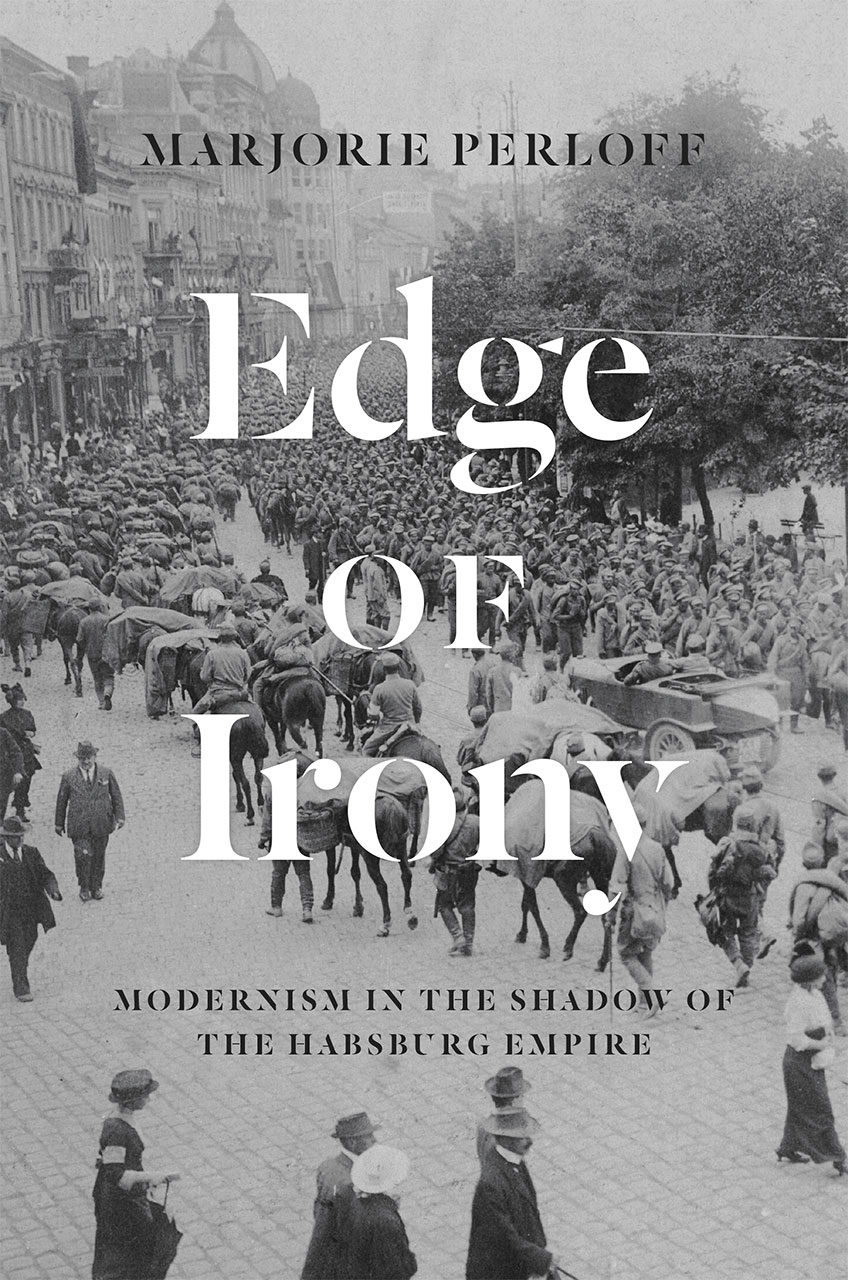
On: Marjorie Perloff, Edge of Irony. Modernism in the Shadow of the Habsburg Empire. Chicago: Chicago University Press, 2016

9780226054421

This book, this truly great book, should be read without further delay by all those who feel concerned by the idea –past, present and future– of Europe.  At first sight, it is only a book on a rather overlooked form of Modernism; that is, the Austrian Modernism of the post-World War I period (Modernism, as we know, is more commonly studied in other linguistic and geographical areas, and Austrian Modernism remains strongly associated with pre-World War I culture). Moreover, the Modernism in question is only rarely seen as the sparring partner of the more fashionable avant-garde: the authors studied in this book are not Kafka but, in this order, Karl Kraus, Joseph Roth, Robert Musil, Elias Canetti, Paul Celan and Ludwig Wittgenstein; that is, authors whose writing style is – rightly or not – less often considered traditional than avant-garde. At second sight however, it becomes clear that Perloff’s study of Austrian Modernism is much more than an attempt to fill in an (important) gap of our knowledge of Modernism. It addresses a crucial redefinition of Modernism itself, which cannot be separated from a certain idea of Europe, in this case the multilingual and multicultural Austro-German Empire shattered by the war.

What then, is Modernism in a county that, literally overnight, was born; a state with a suddenly oversized capital (Vienna), a tiny country  left over after the breakup of an immense Empire, a supposedly monolingual and no less supposedly mono-cultural  entity that could not really be the home for its numerous ‘new outsiders’? For many citizens of the former Austro-German Empire, many of them Jewish (but the category of Jewish covers a wide range of positions and situations), were no longer accepted as ‘real’ Austrians. To Marjorie Perloff, the Modernism developed by these great outsiders can be approached by the two terms that form the title of this book. ‘Edge’, to start with, refers to the necessarily external point of view of the outsider, both the one living in the periphery of power and excluded from it. ‘Irony’, second, designates the refusal of closure. This irony, however, is never a triumphant one: it is less the desire to enlarge one’s life with some supplementary identity positions as the struggle against the streamlining and monopolizing pressure of the center. In that sense, the ‘edge of irony’ is fraught with incurable nostalgia: it is the melancholy that comes with the consciousness of a lost paradise, that of the no longer existing imagined community, whose reconstruction is no longer judged possible, hence the reluctance to radical politics in the work of these progressive writers and their focus on ethical practice rather than ethical theories.

What all this has to do with Europe is clear. It is Europe’s multiculturalism and multilingualism that actually engendered this form of Modernism –very different from the Modernisms that developed in the Soviet Union or in North-America. And it is today’s Europe that helps us understand why American or Soviet visions of Modernisms –not to speak of the contemporary vision of ‘global Modernism’– are too homogeneous and linear to be capable of disclosing the many internal tensions and contributions of Austrian Modernism, perhaps the most European of all Modernisms.

As demonstrated by the corpus studied in this book, there is also something deeply nostalgic and melancholic in Edge of Irony. Not only because the book is written by an author of the edge (Marjorie Perloff was born in Vienna and her family was brutally hit by the dismantling of the Empire) with an exceptional sense of irony (each of the chapters offers a dramatically rich rereading of authors we thought we knew, but whose work is here radically reframed). But also because one feels that by choosing a set of writers whose work covers the whole gamut of the genre system (journalism, theater, novel, memoir, essay, philosophy, poetry), while charting all the possible relationships one can have with one’s ‘mother’ tongue (sometimes one’s ‘first’  language”, sometimes an adopted language,  sometimes written against other languages, sometimes  a language rediscovered in or through  exile, but never a language that is self-evident or natural), Perloff has tried to reproduce the very structure of the culture whose vanishing she deeply mourns. At the same time, her great sense of irony prevents her from all attempts to ‘close’ the works and authors she is reading. From that point of view as well, this book should be compulsory reading, and not just in Europe.

Hermes: Contemporary Perspectives on Media and Genre Interactions (12-16/06)

By Gert-Jan Meyntjens

How do media affect and change literary genres? Which new literary genres emerge under the influence of different media? How do genres work as classification instruments in different media? These are the main questions that will concern us during the Hermes-symposium that will be organized in Leuven from June 12 until 16.

The Hermes Doctoral Consortium for Literary and Cultural Studies is a collaboration between eleven universities (10 European, 1 American) that annually organizes a symposium about a specific theme. During one week PhD-students from the different partner-universities present their own work, a keynote lecture and seminar are given by a specialist in the field, and activities are organized alongside.

This year, Cultural Studies staff-members at KU Leuven will be organizing the symposium. On Monday, they will welcome professor Jim Collins (University of Notre Dame, author of the inspiring Bring on the Books for Everybody) for an introductory keynote lecture and a seminar. After that, over the course of the week, PhD-students will give talks about topics as seemingly diverse as the narrating of pornographic images, Shakespeare’s execution scenes in contemporary performances and spatiality in horror literature and video games.

All those who are interested are welcome at the Auditorium Wolfspoort, Schapenstraat 34 from Sunday evening 12/06 until Thursday 16/06.

More details and the programme can be found through the following link: https://www.arts.kuleuven.be/literatuurwetenschap/HERMESSymposium

hermes_banner02_1025x270