Much More than a Franchise

By Jan Baetens

Laurent de Sutterjack sparrow
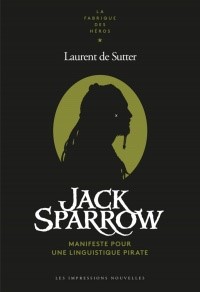
Jack Sparrow. Manifeste pour une linguistique pirate

Bruxelles, Les Impressions Nouvelles, 2018, 1128 p., 12 euros

ISBN : 9782874496479


If popular culture is culture for the millions, entertaining and easy to understand, many great readers and critics are well aware of the fact that this fundamental openness is not to be confused with shallowness or lack of sophistication. Popular culture has a lot to tell –not always of course, but this also applies to high culture, many forms of which are equally dead matter. The truth of drawing is told by Hergé as well as Rembrandt. If you want to understand the unconscious, a Hitchcock movie proves no less useful than Un chien andalou. And for the mysteries of the heart, it is not forbidden to prefer a romance comic to Jane Austen.

The Pirates of the Caribbean may not be compulsory viewing in serious film classes (and to make things even worse: this is a Disney franchise, based on a Disney theme park attraction, catering to Disney fans, etc.) but this brilliant and crispy essay by Laurent de Sutter shows that it is time to put all prejudices aside.

A specialist of law theory and prolific author and lecturer (will he be called one day the Belgian Zizek?), Laurent de Sutter explores in Jack Sparrow the theme of piracy from a linguistic point of view. For to be a pirate is not only to make the choice of a way of life that rejects the ruling order, based on fixed rules imposed by a ruling class. Such a pirate choice is only possible thanks to a special use of language, which de Sutter calls the pirate use, based on the radical combination of the fireworks of verbal performance and the denial of language’s referential function. In Jack Sparrow, de Sutter analyzes this piracy in a permanent braiding of the Johnny Depp character and a wide range of cultural theories on the role and nature of language in society.

It should not come as a surprise that Baudrillard’s ideas on seduction and Lacan’s rethinking of the relationship between truth and desire occupy a key place in his argumentation. These high-cultural references, however, do not hinder the joyful anarchy Laurent de Sutter is defending. His book is a roller-coaster of intellectual provocations and exhilarating formulas, of language transformed into a sound and image spectacle as well as high philosophy mixed with fun and laughter. Serious readers will not be changed into pirates after having read this book, but Jack Sparrow is definitely a work they are in need of.


Writing the Revolution

 By Jan Baetens

Écrire la révolution: De Jack London au Comité invisible

La Licorne, N° 131, 2018 (Rennes : Presses Universitaire de Rennes)

ISBN: 978-2753574960

Journal website: http://licorne.edel.univ-poitiers.fr/


licorne

History did not end after the collapse of the Berlin Wall in 1989 and since 9/11 many new forms of historical consciousness as well as experiencing time and history have emerged, sometimes rather slowly, in the wake of theoretical efforts to restore the focus on our ever changing world, but occasionally also very abruptly and unexpectedly. In this new historical paradigm, the notion of “revolution”, that is the radical event, often unplanned or unforeseen, that suddenly breaks the continuous chain of moments, situations, contexts and frameworks, has achieved once again a central position –next to, for instance, the apocalyptic stance of much ecocriticism or the ongoing nihilism of no future movements.

Well-known and much appreciated for its thematic issues on all aspects of literary studies, the French journal La Licorne presents an excellent overview of the ongoing debates. It takes as its starting points the two perspectives on revolution that have been defended by respectively Jacques Rancière (“how to prepare as well as produce a revolution?”) and Slavoj Žižek (“what to do once the revolution is there?”). However, this double question is not addressed in abstract or general terms. The 246 pages volume edited by Émilie Goin and Julien Jeusette opens with an excellent discussion of what is at stake in the recent return of the revolutionary sensibility and its interactions with a wide range of social transformations and dismays and ends with three interviews of key agents in the field (Nathalie Quintane, Ana Bertina, and Leslie Kaplan –a selection that crosses media as well as generations). Yet the central part of the book is made of excellent close readings of works and authors that illustrate the various and more than once contradictory meanings of revolution as a concept but in the very first place as a practice, be it a real one or an imaginary or utopian one.

Although the French Revolution and its afterlife continues of course to remain at the very heart of any reflection on the idea of revolution, and not only in France, and although the interpretation of this Revolution is currently once again more leaning toward the extreme left version of it, this collection of essays has the great merit of including a certain number of themes and topics that provide us with a much wider angle. Next to excellent readings of, for instance, the revolutionary rhetoric of “Le Comité invisible”, the collective pseudonym of a group of authors calling for an actual revolution, and inspiring interpretations of texts on May 68, the issue contains meticulous interpretations of works that are less easy to pigeonhole on the ideological spectrum, such as for instance Döblin’s unsentimental novelistic report on the failure of the German revolution in 1918 or Antoine Volodine’s postapocalyptic prose. In addition, it also tackles works and authors that are clearly anti-revolutionary, such as for instance the French writers who travelled to Germany in the Nazi period, before and during the war, in order to study and praise what they considered a necessary counter-revolution, or the nowadays forgotten novel by Paul Nothomb, Un délire logique (“A Logical Madness”), in which the author tries to justify the betrayal of his World War Two resistant friends.

In conclusion: an important collection, not only for its intrinsic scholarly qualities and the great diversity of themes and angles, but also for its courage to foreground the importance of writing and literature. Revolution may be made by ideas, but to perform it, one still needs words, and those made by writers are vital in this regard.

“The serial self”: the Influence of Autobiography on contemporary television and internet series

BOZAR, December 14th 2018, 11:00

Today we witness a sharp rise in autobiographical series, probably with Girls as the most popular example. Writer Lena Dunham, who plays the main character Hannah Horvath, has often been confused with her creation. Actor, stand-up comedian and screenwriter Louis C.K. also wrote several series – Lucky Louie (2006) and Louie (2010) – around a character that resembled him very strongly. In the Australian series Please Like Me, screenwriter Josh Thomas plays the main character Josh. Closer to home, Leander Verdievel made a beautiful series, Gevoel voor Tumor (Sense of Tumour), about his battle with cancer. And what about the reality formats that focus on specific personalities, like the tragic TV chef Anthony Bourdain? In the world of YouTube, finally, it is the personality of the YouTuber or vlogger that carries the series.

Nothing seems easier than writing about yourself, but autobiographical writing entails a lot of choices. How close does one stay to reality, or can fiction and reality be mixed? How far can one go in playing with reality and fiction? How can the audience relate to a character that originates in a very personal experience? What are the consequences for a maker (and his or her environment) who is identified with a character and a series? Can you control what happens with your person in the public arena? Since the second half of the twentieth century we see in all domains of storytelling a huge increase of autobiographical narratives. This has even been called a ‘memoir boom’, that today is still ongoing. In television, reality formats remain popular, but also in quality TV series autobiographical stories have become more important. The medium raises interesting new questions: can an autobiographical series be created by a team and how should it be serialized? The rise of YouTube, finally, has brought us examples of autobiographical narratives that are no longer narrative in the strict sense of the word.  YouTubers and vloggers today are hugely popular and offer interesting role models and formats for young makers.

The questions that we would like to raise on December 14th address the complicated relation between autobiography, series and television/internet. What happens to series when they become autobiographical, and what happens to autobiography when it becomes serial? Which new forms and ways of writing are arising and why are they so popular today? We will pose these questions to a specialist in autobiography, Prof. Julia Watson (Ohio State University), who co-authored with Sidonie Smith the standard work Reading Autobiography: A Guide for Interpreting Life Narratives (second edition, 2010) as well as to Marida Di Crosta (Lyon 3) who researches autobiography and television series/vlogs. These speakers will bring their ideas to a broad audience using case studies. They will also enter into dialogue with young makers and screenwriters, like Leander Verdievel, creator of Gevoel voor Tumor about his experiences with cancer, Israeli creator Tom Salama, who just finished Miguel, about his experience as a gay man who wants to adopt a child. Joining them at the table will be Caroline Taillet, creator of the web series La théorie d’Y and last but not least, feminist YouTuber Marion Séclin. During the day Leander Verdievel and Marion Séclin will also conduct workshops.

For more info:

https://www.bozar.be/nl/activities/148735-the-serial-self-the-influence-of-autobiography-on-contemporary-television-and-internet-series


Keynote lectures:

Miroirs audacieux. Entre télévision et Internet, l’émergence d’une forme Web-narrative sérielle et autobiographique? (Marida Di Crosta, Lyon 3)

Regard-caméra, plans rapprochés, « Je narrant », adresse directe au public… Emblématique des formes audiovisuelles spécifiques au Web, le vidéoblog déploie des stratégies de narration et d’implication du public particulières spécifiques aux écrans connectés, tout en renvoyant aux formes d’énonciation et de représentation éminemment télévisuelles. L’analyse de quelques productions sérielles et Web-sérielles récentes permettra de montrer les inventions et influences réciproques – sur le plan de l’écriture de soi particulièrement.

Between the Edge and the Abyss: The Serial Performances of Anthony Bourdain (Julia Watson, Professor Emeritus of Comparative Studies, The Ohio State University)

Because an American television serial on a major network requires the collaboration of several writers, directors, producers, and camera crews, a serial autobiographical show seems at best a viewer’s illusion about the projection of a personal image and speaking voice concocted by many hands and brains. Under what conditions might a genuinely autobiographical TV series be made? And how is the late Anthony Bourdain’s Parts Unknown both an example of autobiographical issues and a remarkable, indeed unique, fulfillment of their possibilities?

Bozar

This Is Not A Translation

By Jan Baetens

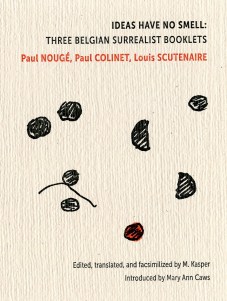
Paul Nougé & Paul Colinet & Louis Scutenaire

Ideas Have No Smell: Three Belgian Surrealist Booklets

Edited, translated and facsimilized by Michael Kasper; introduced by Mary Ann Caws

Brooklyn, NY: Ugly Duckling Press

Box set of three booklets and fold-out poster
ISBN 978-1-946433-13-8

This Is Not A Translation

My apologies for the silly title of this review, which is the umpteenth variation on a worn-out cliché, but this time it perfectly does the job since the new book by Michael Kasper, a fascinating American book artist and essential middleman in the literary dialogue between Belgium and the US, is precisely anything but a translation. Like all great Renaissance artists, Kasper approaches translation as a comprehensive process, which entails careful editing, editorial comments, creative rethinking and rephrasing of well-crafted translations, and an exceptional commitment to typography, page layout, and book design.

Content-wise Kasper’s work offers the first English translation of three short essential Belgian Surrealist works: Transfigured Publicity, by Paul Nougé; Abstractive Treatise on Obeuse by Paul Colinet; and For Balthazar, by Louis Scutenaire, which gives an excellent overview of both the diversity and the unison of Belgian Surrealism, as committed and transgressive as its better-known French counterpart, but much less concerned by questions of the occult and the unconscious.

The combination of the words “short” and “essential” is no oxymoron: Modernity has a preference for short forms, and Surrealism, certainly in the case of Belgian Surrealism, tends to favor the (shock) effect of the text, which does not leave room for lengthy and distracting developments. The aphorism, the short poem and the appropriated publicity slogan but also the estranging title of an apparently academic painting are thus among the preferred formats of the Surrealists, helping them to turn their texts into real arms.

As a printed object, Ideas Have No Smell adopts a form that perfectly fits this strategy. The facsimile version of the original publications (some of them handwritten) gives a good idea of the DIY philosophy of most Surrealist publications (an author like Nougé tended to reject publication at all) and highlights the identity of nonmainstream writing formats and radical messages. Moreover, the small size of the booklets and the folded poster with a reproduction 1926 handwritten sign of Nougé’s visual poems and the introduction by Mary Ann Caws offers a playful and clever example of the interaction between the part and the whole, that is between the whole that refuses to be a closed unity (the box is “open” and contains various heterogeneous items, exactly as in the Duchamp boxes) and a series of parts that each try to become a world in themselves.

Surrealism has suffered a lot from its recuperation by the cultural establishment. In many cases, it appears as silly and stereotyped as the Impressionist paintings that used to appear on the annual calendar of the postal services. Ideas Have No Smell: Three Belgian Surrealist Booklets is the perfect opportunity to question the limits of this recuperation and to (re)discover a literary and political movement that is far from having lost its relevance.

Between Two Worlds. Russia, Perception and Dialogue

By Gert-Jan Meyntjens

Particularly interesting for cultural studies students with an interest in Eastern Europe and Russia is the lecture series on Russia’s place in the world organized by KU Leuven’s Centre for Russian Studies in collaboration with Bozar. The lecture series is free for students. The majority (6/8) of the lectures are in English. Two talks take place in Bozar.

Blog Russia

In his book ‘In-between two worlds. Studies on the inhabitants of Eastern Europe’ (1943), the somewhat controversial Utrecht professor Lodewijk Grondijs presented a historical-ethnographic analysis of Eastern Europe from such a biased, patriarchal perspective that one would think it completely outdated. Nowadays however, the perception of the post-Soviet region – and especially Russia – is still not devoid of bias and more often than not entails a perception of threat.

This semester, KU Leuven’s Centre for Russian Studies organizes a series of fall lectures on the place and perception of Russia in the world. The talks will focus on the different regions that turned out to be of great importance to Russia at different times in history: its ‘Near Abroad’, but also the Middle East, Asia, and the West. Not only will they look at the role that Russia took upon itself throughout the centuries, but the lecture series also aims to assess where Russia found common ground with these regions, yet also what set Russia apart from the rest of the world. In eight lectures by distinguished scholars, Russia’s place, influence and perception in the world will be discussed from a multidisciplinary perspective.

In the opening lecture of the series “The Confrontation between Russia and the West: a New Order in the Making?”, prof. Tom Casier will discuss relations between Russia and the West. Relations between Russia and the West are going through the deepest crisis since the end of the Cold War. Moscow has blamed this on the humiliating treatment it underwent. Referring to the West’s renewed containment policy, Putin stated: ‘If you compress the spring all the way to its limit, it will snap back hard.’ Many in Europe, in contrast, see the current crisis as the result of the assertive and imperialist foreign policy of reemerging Russia.

Both views are simplistic accounts of a much more complex reality. How then did we get into today’s confrontation? How deep is the crisis? This lecture seeks to grasp the essence of the conflict against the background of culminating tensions in the years before the Ukraine crisis. The story is one of power struggles at different levels, diverging perceptions and narratives of humiliation and threat. The question is raised whether the crisis between Russia and the West is part of a global reconfiguration of forces. Do we see a coalition arising that challenges Western hegemony? And is Russia as powerful as it seems or will the current confrontation only catalyze a return to what Putin’s aide Vladislav Surkov called a return to ‘one hundred years of geopolitical solitude’?

For more info and registration:
https://www.arts.kuleuven.be/crs/english/news/lecture-series-2018
https://www.facebook.com/events/328740034340525/


PROGRAMME:

3/10 – Opening lecture – Global perceptions and the discourse of humiliation in Russia. Prof. Tom Casier, Jean Monnet Chair, School of International Studies, University of Kent (Faculty of Arts)

10/10 – Alexander I in het post-1815 Europese veiligheidsbestel. Prof. Beatrice de Graaf, Universiteit Utrecht. De lezing begint uitzonderlijk om 20:00u. (Faculty of Arts)

24/10 – Russia’s first ‘Orient’: the Crimea in the 18th Century. Prof. Sara Dickinson, University of Genova (Bozar)

7/11 – The U.S.-Russia Relationship under Trump: a story about the limits of a Bromance. Prof. Bart Kerremans, Leuven Institute International and European Studies, KU Leuven. (Faculty of Arts)

21/11 – Western elite art collections in the Hermitage. Dr. Catherine Phillips, Hermitage Saint Petersburg (Bozar)

28/11 – Een vergeten episode in de Rusland-Japan relatie: de moordpoging op de toekomstige tsaar Nicholaas II in Japan 1891. Prof. Dimitri Vanoverbeke, KU Leuven (Faculty of Arts)

12/12 – Russian Hajj. The Russian Empire and the Pilgrimage to Mecca. Prof. Eileen Kane, Connecticut College (Faculty of Arts)

19/12 – Closing lecture – Russia and the West, the challenges of a Structured Dialogue. Ambassador Paul Huynen, OSCE (Faculty of Arts)


PRACTICAL INFORMATION

Time: Wednesday 19.30 – 21.00.

Place: the location of the lecture is always indicated: Justus Lipsiuszaal, Faculty of Arts KU Leuven (Blijde Inkomststraat 21, Leuven 3000) or Rotonde Bertouille zaal, Bozar (Ravensteinstraat 23, Brussel 1000).

Language: English or Dutch

Entrance fee: 10 € per lecture, 70 € for the entire lecture series. Students and KU Leuven staff can attend the lectures for free.

Relaunching the European Avant-Gardes

By Jan Baetens

Bru

The publisher calls it an “introduction” to the works, the authors, the currents, and the contexts of the European avant-gardes in the period 1905-1935 (three decades that in Anglo-Saxon criticism are often called “High Modernism”, a powerful streamlining of the exceptional dynamism and diversity of these years). But this is really not the best word to qualify the “portable guide” proposed by one of the leading voices in the field. Granted, the book offers more than everything one would like to know about both the so-called historical avant-garde and the many –isms that have come to illustrate it. But reducing the book to its encyclopedic or toolkit function would definitely neglect the real stakes of an intellectual that goes beyond the careful and lavishly illustrated presentation of its material.

First of all, one should welcome the refreshing and innovative way of organizing the currently available knowledge of the European avant-gardes. The book finds the perfect balance between familiar and new ways of structuring the information: on the one hand, it does not reject the classification in –isms (it is important however to mention that each of them is systematically described in the plural: not “expressionism” but “expressionisms”, etc.); on the other hand, it succeeds in building a new architecture or intellectual design, easy to unpack as well as stimulating surprising montage effects, which foregrounds three major perspectives: first that of the concept (the relationship or tension between art and avant-garde), second that of the places where avant-gardes appeared or that were created or reinvented by them (this section makes us travel from the café to globalized cultures), third that of time, for past, present and future do no longer mean the same after the avant-gardes have revisited these traditional frameworks.

Second, the book does not only showcase the ambitions and failures as well as the meaning and importance of the European avant-gardes. It also reshapes our idea of the avant-garde. Key in this regard is the systematic use of the plural, which also makes room for the “non-avant garde” aspects of the avant-gardes, often much closer to the core of European culture than we generally assume. But also the properly European dimension is rightly underlined as a factor of diversity: linguistic plurality, context-sensitivity, unequal development in time and place appear to be at the heart of the various avant-gardes, which cannot be understood in homogeneous or teleological perspectives.

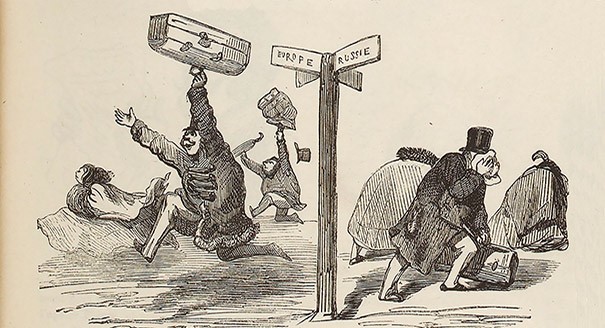
Third (but of course not finally), this book is not just a suitcase that one opens to find answers to specific queries (the very detailed index will prove dramatically useful in this regard), it is also a door that one can open to discover new or never thought-of questions, less known or never disclosed examples (and here the exceptional iconography is vital), and simply enjoy the writing, a perfect mix of intellectual sympathy and critical distance.


Homepage of the book:

https://edinburghuniversitypress.com/book-the-european-avant-gardes-1905-1935.html

Homepage of the European network for Avant-Garde and Modernism studies:

http://www.eam-europe.be/

French Cartoon Art in the 1960s and 1970s

By Jan Baetens

Michallat1

Wendy Michallat

French Cartoon Art in the 1960s and 1970s

Pilote hebdomadaire and the Teenager Bande Dessinée

http://upers.kuleuven.be/en/books/authors/wendy-michallat


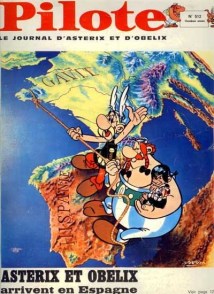
Launched in 1959 by René Goscinny and Jean-Michel Charlier, partially in reaction to the unfair labor conditions offered by the then leading comics magazines, Pilote is considered today the publication that made the bridge between traditional children and adolescent comics magazines such as Tintin or Spirou and adult comic journals such as Fluide Glacial and Métal Hurlant (which will even develop a US sister publication[1]). As the publication that translated and creatively appropriated some material of Kurtzman’s MAD magazine, Pilote also played a vital role in the transatlantic dialogue between US nonmainstream, if not underground production, and the new European comic artists.

Michallat2Although there exist quite some studies on the journal, the study by Wendy Michallat is the very first one to rethink its history in a broader perspective, not just that of comics culture, but that of culture at large. And the result is absolutely breath-taking. First of all because Michallat gives a very detailed yet nuanced and well written overview of the various periods of the magazine, whose history is one of nearly permanent crisis and eternal attempts to relaunch new formats and formulas in a publication niche that was much less profitable than it was often thought. Second, and most importantly, because the author succeeds in doing what other studies fail to do, namely explaining the systematic changes in the magazine’s policy.Michallat3

This explanation is not an a posteriori enumeration of hits and misses, but a scrupulous examination of the various contextual aspects that influence the zigzag transformations of the journal. As such, Michallat’s study is a model for all those who would like to write the history of a mass media form. More particularly, it takes into account issues such as:

  • The need to come up with a concept that is ‘in sync’ with social and political expectations (in this case the obsession with “education” in postwar France, which helped turn away from the pure entertainment of comics and introduce a more text-oriented magazine).
  • The competition with similar titles, which cannot be reduced to a matter of style and content, but has a lot to do with distribution networks and good or bad relationships with backing groups in society.
  • The legal constraints that burden the necessity to always change even a winning formula, in this case, the (in-)famous law of 16 July 1949 on Publications for Youth, censoring all publications depicting crime, violence and moral debauchery (initially a measure of protectionism, for the law helped ban all American import, it rapidly became a dangerous arm in the hands of all those eager to police this type of publications).
  • The necessity to find a place in the existing mediascape, for instance via new forms of collaborations with newspapers and radio stations (at that moment, just after the invention of the transistor, the dominating medium in youth culture).
  • The obligation to adapt to a rapidly changing cultural environment, for instance by taking into account that the comics medium during the sixties gradually became an important vector of the counterculture.
  • The challenges raised by the internal changes of the magazine format itself, torn between different and always unstable logics, as revealed for instance by the emergence of the comics album as the new hegemonic format.[2]
  • The labor conditions within a collective enterprise such as a comics magazine, which has to find a balance between the creative freedom offered to its collaborators and the basic obligation to make money (we shouldn’t forget that May 68 did not start in May 68, but had been prepared by a decade of growing unease with a mainstream culture that was no longer capable of keeping its great promises of the postwar period).

The great achievement of Michallat is that she shows the complex interaction between these (and many other) dimensions, which prove often mutually incompatible. She does so in a way that retells the whole story as if we were in the driver’s seat, facing problems as well as opportunities and having to take decisions whose consequences remain unsure. This approach gives the reader the impression that she is making history herself, including when it comes down to find an answer to failures and dead ends (even if the magazine will last till 1989, its life as a weekly ends in the early seventies, which is also the moment in which its influence in the field is reduced to almost nothing).


[1] Nicolas Labarre, Heavy Metal, l’autre Métal Hurlant. Bordeaux: Bordeaux UP, 2017, see : https://www.noosfere.org/icarus/livres/niourf.asp?numlivre=2146594729).

[2] On this dramatic change, see the exhibition curated by the GREBD research group of the University of Lausanne: https://wp.unil.ch/grebd/evenements/expositions-du-grebd/

Traversals: The Use of Preservation for Early Electronic Writing

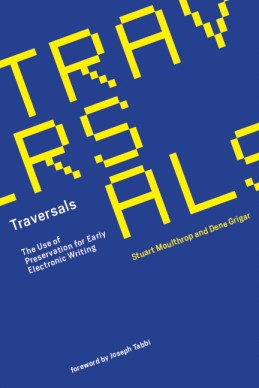
A reading suggestion for the summer: Traversals: The Use of Preservation for Early Electronic Writing by Stuart Moulthrop and Dene Grigar and with foreword by Joseph Tabbi, described as “An exercise in reclaiming electronic literary works on inaccessible platforms, examining four works as both artifacts and operations.”

Many pioneering works of electronic literature are now largely inaccessible because of changes in hardware, software, and platforms. The virtual disappearance of these works—created on floppy disks, in Apple’s defunct HyperCard, and on other early systems and platforms—not only puts important electronic literary work out of reach but also signals the fragility of most works of culture in the digital age. In response, Dene Grigar and Stuart Moulthrop have been working to document and preserve electronic literature, work that has culminated in the Pathfinders project and its series of “Traversals”—video and audio recordings of demonstrations performed on historically appropriate platforms, with participation and commentary by the authors of the works.

If you are still unconvinced, you should first read Jan Baetens’ review of the book. Quoting directly from the review:

The very classical, perhaps eternal, topic of the author speculating on, day-dreaming or boasting of the afterlife of her or his works, is something that the successive new media revolutions of the last decades are forcing us, as readers as well as writers, to reconsider in radical ways […] True, the loss of literary and other works is far from a new phenomenon (most works are almost immediately forgotten; many works are destroyed, by accident or on purpose; still others get simply lost), but the issue of their technical accessibility is becoming one of the major problems of our contemporary, electronic culture. […] If one decides that just moving ahead in order not to miss the next new thing and that just forgetting about the past is what matters, then technical obsolescence is not a problem. But if one believes instead that “we must struggle never to forget” (p. 237, last words of the text), then the situation becomes quite different (it should be reminded here that in cultural semiotics, as illustrated by the School of Tartu of Yuri Lotman, culture is defined as “non-hereditary memory”). The keyword of this book’s subtitle is therefore twofold: it is about preservation, but even more about the use of preservation, a way of saying that it should be read as a double warning: first, against the illusion of the very possibility of such an enterprise (nothing can be “really” preserved –– what is being preserved is always only a certain form or version of it); second, against the confusion between material conservation (which is a necessary step in the larger process but nothing more) and preservation in the broader sense of the word (which refers to the need of making meaning of the object of preservation, here and now but also in the future).

You can access the full review here.

Traversals


Traversals: The Use of Preservation for Early Electronic Writing

by Stuart Moulthrop and Dene Grigar; foreword by Joseph Tabbi

The MIT Press, Cambridge, MA, 2017
296 pp., illus 30 b/w. $45.00
ISBN: 9780262035972

Adaptation studies after the fidelity issue

By Jan Baetens

For many decades, scholars of adaptation studies have been quarreling on the flaws and merits of the so-called fidelity issue, that is the (biased) idea that the novel is always better than the film and that the value of a movie thus depends on its more or less faithful recreation of the original, whatever all these terms (recreation, faithful, original) may mean.

Current research has a more relaxed take on these problems, what does not mean of course that fidelity is no longer an interesting field of research. Simone Murray has done excellent work in the economic reframing of fidelity: the decision to select a work for adaptation and to rework it in a way that acknowledges the form and content of the adapted work is less determined by aesthetic than by financial issues (cf. The Adaptation Industry, 2012). Jean-Louis Jeannelle has foregrounded the necessity of making a genetic analysis of the adaptation process, making room for trial and error, if not for failures, censorship, and other types of obstacles (cf. Cinémalraux, 2014). Jean Cléder and Laurent Jullier, whose book Analyser une adaptation (2017) was reviewed here a couple of weeks ago, strongly advocate for the creative practice of adaptation as interpretation.

Adaptation

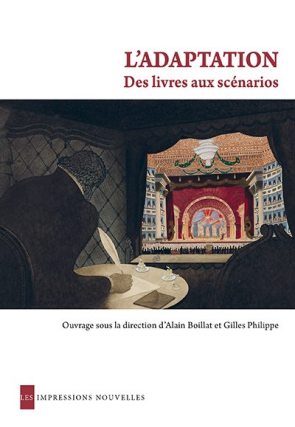
In this broader context, L’Adaptation. Des films aux scenarios (Les Impressions Nouvelles, 2018), a collection of essays edited by Alain Boillat and Gilles Philippe, respectively professor of cinema studies and linguistics at the University of Lausanne, can be seen as both an admirable synthesis of the abovementioned tendencies and a groundbreaking study that helps rethink the very process of adaptation.

On the one hand, one finds here many elements that were highlighted by Murray, Jeannelle, and Cléder and Jullier: a strong focus on the industrial aspects of cinema, a sharp awareness of the inevitable difficulties and dead ends of the adaptive process, and the healthy reminder that adaptations do not have to save the original but give it a new life –on screen and elsewhere. On the other hand, their work on the archive of a famous, although today not always much appreciated director, Claude Autant-Lara, a typical representative of the “French Quality” school of the 1940s and 50s, allows them to correct a certain number of historical errors and misunderstandings as well as to propose a different methodological and theoretical framework for the study of filmic adaptations. As an example of the former, I am thinking of their new reading of François Truffaut’s debunking of Autant-Lara and “French Quality” in his 1954 article “A Certain Tendency of French Cinema”. Their historical reconstruction clearly demonstrates how critically and ethically unfair Truffaut’s attack actually was, and how urgent it is to abandon the caricature of “French Quality” that the young Turks of the New Wave have managed to establish as an eternal truth. As an example of the latter, it is key to emphasize the work that this book is doing on the redefinition of the very process of adaptation. Instead of being a single process of changing words into images, adaptation is a multilayered and temporally very complex procedure that involves a great number of intermediary agents such as, for instance, the person that transforms the book into a filmable idea, the person that further transforms this idea into a shooting script, the person that writes and edits the dialogues –not to mention the many feedback and interaction processes between them that determine the making of a movie.

All the essays in this book, written by some of the best film scholars in French today, share these same convictions. Hence the exemplary cohesion of the book, whose use-value is increased by the exceptional stylistic and conceptual fluency of all the articles and the elegant layout. Currently the best that is being said and written on cinema in French, this book should be translated in English with no further delay.

Arty as Experience

By Jan Baetens

Updike.jpg

John Updike

Always Looking. Essays on Art

New York: Alfred A. Knopf, 2012

This is not a new book and many readers may find it pathetically old-fashioned. Yet this collection of writings on art with a capital A by an author often discarded as typically WASP is doing what so much modern art criticism seems no longer “capable and willing” of doing, as we are asked by the air hostess when boarding the plane and being offered an exit seat: to make critical judgments, taking into account one’s personal, subjective, individual point of view, but always in a kind and gentle way, written in an elegant and jargon free language, and addressing the reader as a partner in a polite and cheerful conversation.

Updike is never on the lookout for the new or the surprising. The selection of the art shows he discusses may even seem horribly conformist and conservative, unpleasantly biased toward the Western canon, and dramatically reluctant to revise canonical values and classifications. With some slight American exceptions, Updike’s taste –even in the hypothesis that he is doing nothing else than accepting well-paid commissions– almost naturally brings him to the masterpieces of Western painting (things become suddenly American when sculpture is involved, and this sculpture is always bigger than life as in the case of Oldenburg and Serra). And his writing is that of the mild and smiling guide, who hints at what is to be seen and discusses what others –mostly the authors of the catalogue, which is as important a part of a big budget exhibit as the works themselves– have to say on it. It reads marvelously, a real feel good experience for those who do not want to read romance novels.

img769

Yet Updike is also a very sharp and ruthless judge, who is not afraid of saying things nobody else would say. As an outsider –after all, he did not have to make his living as an art critic– he is not only repeating what the artistic community so noisily repeats, he also dares to show the emperor’s new clothes. His remarks on Serra are exemplary in this regard. While underscoring the strength of some of his sculptures but quoting some sophisticated babble of the specialists, Updike concludes “All this steel devoted to scrambling our habitual perceptions? Wouldn’t the funhouse or Ferris wheel at the country fair do just as well?” (p. 192).

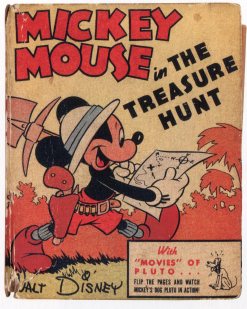
This remark ties in with the preface of the book, in which Updike, who first wanted to become a cartoonist, shows the modest, if not “silly” books that made him an artist: the Mickey Mouse “Big Little Books” of the 1940s serious readers would no longer allow their children to read. That a high-brow and apparently conservative writer such as Updike opens a book like this with praise of what is anything but “the best of the best” is a kind of manifesto –no fists raised of course, since this is Updike, but a lesson on the lasting effects of a real artistic experience (to quote John Dewey, that forgotten founding father of cultural studies).

img770