DigiLab: where the future is now

As students of the Faculty of Arts, we study literature, art, language, history, music, culture, ancient civilizations… Surely, we don’t need to know about all this fancy new technology, like 3D printing or VR, right? Wrong!

In the field, these modern technologies become more and more common. Cultural institutions such as museums and archives, universities and performing arts companies use 3D technology, digitization tools and many other forms of modern technology. So we, as students, have to keep up! Knowing about what is available and what is happening in technology right now is also important for us.

To help students of Arts and Humanities, Agora Learning Centre has created DigiLab, a space where you can familiarize yourself with 3D printing and scanning, AR and VR. You can get help with a project if you want to try something new, or just play around by printing your very own tiny desktop figurine, for example.

ImageLogoTo learn even more about technology and what it can mean in the field of Arts and Humanities, a group of students from the Master of Cultural Studies have developed Feature the Future – an event for all students that want to learn about the possibilities of technology.

During the event, you will be able to have a look at the 3D printer in action and play with some of the fun stuff at DigiLab. With Art Plunge, for example, you can step into a painting through VR and see what it’s like to be inside it. And maybe you’ve sometimes dreamed about making your drawings come to life? With the augmented creativity app we’re exhibiting that’s also possible! Careful, the song of that app will be stuck in your head for the rest of the week…

But we’ll also show you some more serious pieces. Several museums have digitized their collection by 3D scanning their objects, and those are available on platforms like Sketchfab. You can have a very close look at some of the most famous sculptures such as Degas’ Dancer or The Thinker. BBC has also developed an app to interact with heritage pieces that you can get a closer look at.

Even more fun tech applications in the Arts and Humanities can be found on the Facebook page of the event, where we post about many of the cool and exciting new things that have caught our eye.

If you want to know more about all of this, or if you just happen to be hungry on March 3rd between 3pm and 6pm somewhere near Agora, definitely come check DigiLab out in room Zurich. Who knows what inspiring new things you might find!

“Creating a Digital Cultural Heritage community”: Enroll now!

By Fred Truyen and Ana Schultze

Do you want to know what happens behind the scenes of museums, archives and libraries? Have you ever wondered what these organisations do to share their collections with audiences? Would you like to learn how to build a strong digital community for cultural heritage?

If your answer is yes, then the MOOC “Creating a Digital Cultural Heritage Community” is for you! In this MOOC, professionals and volunteers in cultural heritage institutions, as well as teachers, students and amateurs, can learn how to create user engagement with digital cultural heritage. Professors and staff members from the KU Leuven master’s program in Cultural Studies will dive deeper into both theory and practice of digital curation, annotation and many other topics.

What you’ll learn

  • How to create and reflect on user engagement with online collections
  • How to curate and annotate digital cultural heritage
  • What strategies can be used to educate audiences
  • How to access and use digital repositories and platforms
  • How to creatively engage with photography and dance content.

Have you ever wondered how to use digital collections to create new ways of engaging and inspiring audiences? Enroll now and take this course for free!

This MOOC is developed by the Fifties in Europe – Kaleidoscope and CultureMoves projects, which are co-financed by the Connecting Europe Facility of the European Union.

course_image

Be an actor of our culture: we want your tags!

WITHCrowd

Nowadays with social platforms we are used to comment on any kind of picture, sometimes with no other purpose than the comment itself. What if a comment could be used to contribute actively to our culture? This is the goal of WITHCrowd, which by promoting annotation campaigns is helping cultural heritage institutions improving the quality of the metadata of their collections.

WITHCrowdAnnotation sprint

In attempt to help WITHCrowd reach its goals before the end of the campaigns, a student team from KU Leuven’s Master of Cultural Studies came up with the idea of an annotation sprint. The idea is to complete the currently active campaigns on WITHCrowd as much as possible (see below).

On February 19th the team members will welcome you from 13:00 to 17:00 in room 06.30 at the Eramushuis in the KU Leuven campus for the annotation sprint.

Guests are required to bring with them their personal laptop. However if it’s necessary, four additional laptops will be at your disposal. There will also be a catering service with snacks and drinks.

Active campaigns on WITHCrowd:

– Style & Design Campaign: Pompadours, kitten heels, head scarfs and horn rimmed glasses: the fabulous fifties are back (from never really having been gone)…! Seven decades on, the 1950s remain an iconic decade when it comes to design. Explore inspiring outfits, characteristic architecture and stylish interiors, describe what you see and help others find their way to these Europeana collections.

– Transport & Travel Campaign: The 1950s mark the start of the golden age of mass tourism. As the first jet airplanes brought transcontinental traveling within reach, car constructors launched some of their most iconic models, while vespas, motorcycles and even motorized three wheelers provided the ultimate freedom to the more adventurous globetrotter. Browse these sets of Europeana images and label what you see – your tags will help guide vintage photography to our 1950s gems!

– Film & Theatre Campaign: Western, fantasy, comedy, animation, melodrama: the 1950s boasted a plethora of filmic genres, ranging from Disney to Kurosawa and from old-school vaudeville to cutting-edge science fiction. While an increased use of color aimed at whisking away the audience from their television screens, many icons of the film industry – think James Dean and Marlon Brando – started their career in this era. This picture collection goes out to today’s enthusiasts of the big screen and the small stage, and celebrates the fifties’ writers, crews and performers that have contributed in their own unique way to mid-century cultural heritage.

– All the ladies Campaign: The 1950s are often viewed as an age of conformity in which gender roles were clearly defined and uncritically adhered to. But beneath the surface, discontent with the status quo was growing. Having been part of the working force during the war, not all women were eager to return to being a housewife. This set of photographs features women in many different roles and guises, from glamour queen to business woman, and from homemaker to heartbreaker.

Sally Cauwelier, Héloïse Depluvrez, Pepijn Geeraerts, Vincent Leenaerts, Vic Temmerman 


More information :

https://withcrowd.eu/en

https://www.facebook.com/events/2044693359009409

https://www.eventbrite.com/e/withcrowd-annotation-sprint-tickets-94028982217

WREK NOT WORK

By Ana Schultze

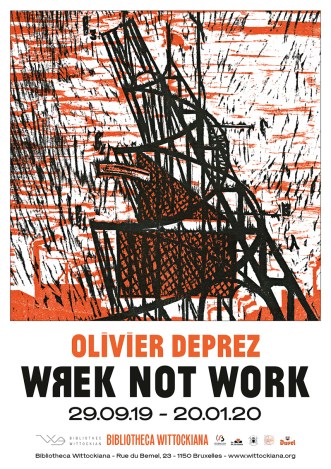
affiche-wrek-wrk02.inddThe Bibliotheca Wittockiana is the museum of book arts and bookbinding in Brussels. Besides maintaining a prestigious collection of both historical and contemporary books (and having a weirdly large number of baby rattles), they also host a few temporary exhibitions each year. From September 19th until January 20th, the artist Olivier Deprez (Binche, 1966) presented his project WREK in the exhibition WREK NOT WORK, curated by Géraldine David and Jan Baetens.

Deprez is an engraver and thus shows his woodcuts, also known as xylographs, in the Wittockiana. However, sharing his sources of inspiration and creative processes seems to be just as important to him. Central in the very impressive scenography of the exhibition stands a booth with a small printing press, as well as chisels and a stack of drawing plates. Manual labour truly is key in the lengthy process of wood engraving, making Deprez both artist and artisan. In a way, the materiality of wood engraving and printing is a focus point throughout the exhibition. The technique does not only go way back to ancient eastern Asia, but is also recognised in the work of – among many others – Albrecht Dürer, Frans Masereel, Lynd Ward and movements such as French Japonism and German expressionism. Still, the technique of wood engraving has been seriously underrated throughout traditional art history.

The title of the exhibition entails more than just an anagram of werk (work). Through the technical aspects and materiality of Deprez’ oeuvre, the viewer is invited to dive into the imaginary wold of the artist. His woodcuts represent storytelling, remixing and recycling. Deprez himself is the first one to acknowledge his rich visual archive of inspirational sources: literature, video, animation and comics have received a prominent place in the exhibition.

These influences are also clear in his artworks, where artists, authors and characters within a wide spectrum show up, from Malevich and Tatlin, to Beckett and Kafka, to Donald Duck and Nancy. Other artworks are based on stills from the digital age, such as YouTube videos and other captures of social media. Reinterpretations of these result in woodcuts that examine consumer society via parody and satire. Thus the almost obligatory question concerning intellectual property and authorship is also touched upon. And: what is the role of artists within this debate? The exhibition is not a random selection of works, but a well though-out unity that tells a story about the engagement of an artist in the twenty-first century.

The exhibition has already closed, but you can still check out the amazing catalogue. It consists of three booklets: a first one contains an interview with Deprez and a second one presents a selection of woodcuts from the project WREK. The third one, NOISE, shows some of the joint works of Deprez and Adolpho Avril, artist in residence of the creative atelier La “S”, the two previously collaborated on the book Après la Mort, après la vie.

At the moment, we can already start looking forward to the book version of the project, WREK: les indigènes de l’abstraction. Later this year, it will be published by FRMK. For more information about Olivier Deprez and the exhibition, please check out http://www.olivierdeprez.info/ and https://wittockiana.org/.

3223AB40-6FB5-4DB8-A86C-D6207CC52313