Beyond & MuPop – The new heritage experience

By Fred Truyen

b1From February 28th until the 14th of March, the exhibition “Beyond”, produced by 7 students of the MA in Cultural Studies[i] featured at the Agora Learning Centre in Leuven. The opening was attended by Yiannis Mouzalas, the former Greek Minister for Migration.

The exhibition “Beyond” explores why people choose to migrate and how they experience their journey. By zooming in on the story of twelve individuals, the students tried to give an image on migration nowadays in a first part of the exhibition. Their stories vary from fleeing from war zones to moving for love and are brought back alive through an object unbreakably linked to their path towards Belgium. It also contains video footage of interviewees telling their stories.


These images of migration stories today are juxtaposed to heritage photos from Europeana collections. A selection was made from the exhibition “Thousands are Sailing[ii] by Sofie Taes, Research Assistant at Cultural Studies in Leuven, who is the main curator of the Europeana Photography and Migration collections. b4This original exhibition, created in collaboration with Photoconsortium, was shown in Pisa in October of 2018 and already traveled to Leuven for the Day of Science at the University in late November 2018.
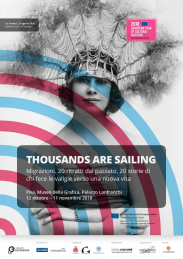
“Thousands are Sailing” reprints vintage photographs from major archives and major collections in Europe, and tries to capture stories of migration through the centuries of classic photography. The exhibition was part of an EC funded project “Migration in the Arts and Sciences” produced by a consortium led by Europeana Foundation in which KU Leuven was in charge of selection and curation. The physical exhibition complements the virtual exhibition on the Europeana site “People on the Move”.

b6

Instead of telling a synthetic, historic narrative, an aesthetic, observational stance is taken in which images are telling their own story, which are then contextualized. It starts with looking at the image, like Beyond starts with listening to stories. It is more memory and recollection than history, as our main aim at Europeana is to deliver and open up the archival, museum and library material in a way that (art) historians can start to work with it from a bird’s eye perspective on Europeana’s massive collections. But it cannot be limited to just showcasing heritage. The goal is to engage audiences and communities in contributing to and taking ownership of their heritage, to make it a living memory that intertwines with today and helps shape visions for the future.
b7

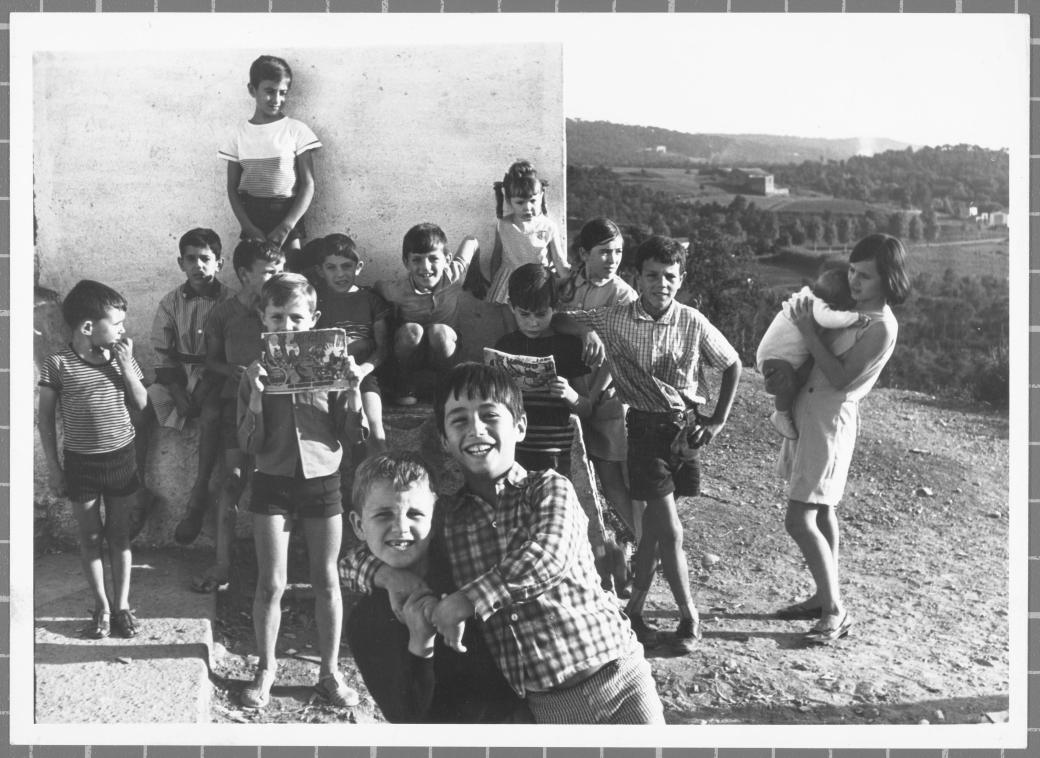
Children in the suburbs of Girona, 1960. Ajuntament de Girona/CRDI CC-BY-NC-ND

Citizen contributions

For this Europeana developed the idea of “Europeana Collection Days”, where citizens are invited to contribute their stories by means of an object of memory, which is then digitized and published together with the testimony in the Europeana collections. This way, memories of the past are linked to today’s experiences and become a shared heritage. Collection days for the topic of Migration were held in more than 10 European cities including Athens, Belgrade, Brussels, Budapest, Cardiff, Dublin, Pisa, Sibiu, Utrecht, Zagreb and others.

Inclusion

A next step is envisioned in the project “WeAre#EuropeForCulture” which Cultural Studies will run in 2019 together with Photoconsortium, a non-profit organisation for the protection and promotion of photographic heritage, and Noterik, a media development company. In 10 European cities a workshop will be run with a selected group of people who normally do not have a specific interest or access to cultural heritage, in an effort to further inclusion. They will be invited to engage with their own stories with selected collections, and help with the curation of lead stories and interactions. These will be put to use on large interactive TV screens in accessible spaces where the general public will be able to interact with the contents using their smartphone.


In each city an opening event will take place with the co-created content. A final event at the House of European History in Brussels will wrap it all up, attended by representatives from the different workshops. The project takes the idea of the Collection Days one step further by adding playful interactions: the audience will be able to control the content display and engage in quizzes, votes and gaming activities. This way, not only the content of the exhibitions will be the result of crowdsourcing, but also the activities will leave the safe confinement of the heritage institutions and meet the audience in public spaces.

This corresponds to an evolution in which our vision and expectations towards the mission of Cultural Heritage institutions is profoundly changing through online technologies. One of the leading thinkers in this field, Pier Luigi Sacco, speaks about a move from an approach of cultural heritage which can be called “patronage”, involving curation by professionals, over a “culture 2.0” phase involving scaling up and a market approach towards the development into “open communities of practice” in what can be called Culture 3.0[iii].  Whatever the names we give to these shifts, the reality of shifting city populations in European Cities both through generational change as well as influx and migration means that Cultural Heritage institutions face the challenge of reaching out to new audiences, outside of their comfort zone.


[i] Alja Kiseleva, Esther Plasschaert, Malou Vandevorst, Maria Panagiotou, Natai Herremans, Nikita Artamov and Stella Cheng

[ii] See previous blog https://culturalstudiesleuven.net/2018/10/15/exhibition-thousands-are-sailing/

[iii] P.L. Sacco, Culture 3.0: A new perspective for the EU 2014-2020 structural funds programming, EENC Paper, April 2011, https://www.interarts.net/descargas/interarts2577.pdf
The Screenwriter’s Bible

By Jan Baetens

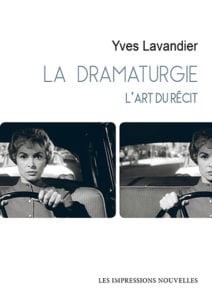
Yves Lavandier, La Dramaturgie. L’Art du récit

Les Impressions Nouvelles, 2019

https://lesimpressionsnouvelles.com/catalogue/la-dramaturgie/


There are countless books on “how to write”, and the number of topics they cover, the types of audiences they cater to, the dreams and ambitions they may help or fail to realize, the styles they use, the tricks of the trade they offer (for free or for sale), the profiles of authors that take the risk of giving advice to future competitors, is even bigger. It should therefore not come as a surprise that many colleagues in cultural studies have taken the literary advice business–hovering between vocational training and personal development and many other things in-between or beyond these two extremes–as one of their favorite study topics.

Screenwriter

Their job will become easier and I guess also more exciting thanks to the new edition of what is considered the screenwriter’s bible, the one and only that actually deserves this title: Yves Lavandier’s Dramaturgy, a seven hundred (large) page book that revisits the fundamentals of storytelling as defined by Aristotle in his Poetics, and that rethinks, enlarges, deepens, and illustrates them with examples of contemporary narrative from different media (theater, cinema, comics, television, fantasy, etc.).

Trained at Columbia University by František Daniel, Stefan Sharff and Milos Forman, Yves Lavandier is both author and script doctor, and his book is a brilliant synthesis of this twofold life-long experience. Of all the (yes, countless) books on scriptwriting and storytelling and how to do it, this is by far the best one I know of, and frankly the only one I have on my desk when asking questions about the relative qualities and problems of specific plot structures. Lavandier does not pretend to reinvent narrative theory; his major aim is to help writers, professional as well as non-professional ones, to solve the many questions that emerge when one tries to tell a good story. He does so by emphasizing the fundamental role of general, classic laws, often forgotten or discarded, and by illustrating them in an extremely original way.

Rather than exclusively focusing on positive examples, such as the inevitable: this is how Hitchcock shows the superiority of suspense on surprise, he also gives negative examples, highlighting what can go wrong when one forgets the basic rules of the game. These examples all are extremely convincing for three reasons: 1) they are all motivated by a larger theoretical framework (Aristotle’s poetics), 2) their number is close to infinite: almost every page of the book discusses various examples, 3) they also concern masterpieces and great authors: Lavandier is not afraid of drawing our attention to what goes wrong in this or that scene of, for instance, Lubitsch’s To Be or Not To Be (which is also praised as an example of nearly perfect dramaturgy), what could have been improved in this or that sequence by Hitchcock or Spielberg, or which detail or plot element should have been removed, modified, or simply used differently by Truffaut, Brecht or Chaplin.

Lavandier’s Dramaturgy is not a must-read: it is a must-use, for starting as well as for experienced writers. One of the many lessons one can learn from it, is that storytelling remains both very simple and highly mysterious. Anybody can do it, at any time, and anybody can always enjoy improving, provided one accepts to critically judge one’s own achievements.

Much More than a Franchise

By Jan Baetens

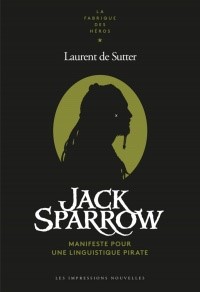
Laurent de Sutterjack sparrow

Jack Sparrow. Manifeste pour une linguistique pirate

Bruxelles, Les Impressions Nouvelles, 2018, 1128 p., 12 euros

ISBN : 9782874496479


If popular culture is culture for the millions, entertaining and easy to understand, many great readers and critics are well aware of the fact that this fundamental openness is not to be confused with shallowness or lack of sophistication. Popular culture has a lot to tell –not always of course, but this also applies to high culture, many forms of which are equally dead matter. The truth of drawing is told by Hergé as well as Rembrandt. If you want to understand the unconscious, a Hitchcock movie proves no less useful than Un chien andalou. And for the mysteries of the heart, it is not forbidden to prefer a romance comic to Jane Austen.

The Pirates of the Caribbean may not be compulsory viewing in serious film classes (and to make things even worse: this is a Disney franchise, based on a Disney theme park attraction, catering to Disney fans, etc.) but this brilliant and crispy essay by Laurent de Sutter shows that it is time to put all prejudices aside.

A specialist of law theory and prolific author and lecturer (will he be called one day the Belgian Zizek?), Laurent de Sutter explores in Jack Sparrow the theme of piracy from a linguistic point of view. For to be a pirate is not only to make the choice of a way of life that rejects the ruling order, based on fixed rules imposed by a ruling class. Such a pirate choice is only possible thanks to a special use of language, which de Sutter calls the pirate use, based on the radical combination of the fireworks of verbal performance and the denial of language’s referential function. In Jack Sparrow, de Sutter analyzes this piracy in a permanent braiding of the Johnny Depp character and a wide range of cultural theories on the role and nature of language in society.

It should not come as a surprise that Baudrillard’s ideas on seduction and Lacan’s rethinking of the relationship between truth and desire occupy a key place in his argumentation. These high-cultural references, however, do not hinder the joyful anarchy Laurent de Sutter is defending. His book is a roller-coaster of intellectual provocations and exhilarating formulas, of language transformed into a sound and image spectacle as well as high philosophy mixed with fun and laughter. Serious readers will not be changed into pirates after having read this book, but Jack Sparrow is definitely a work they are in need of.

Writing the Revolution

 By Jan Baetens

Écrire la révolution: De Jack London au Comité invisible

La Licorne, N° 131, 2018 (Rennes : Presses Universitaire de Rennes)

ISBN: 978-2753574960

Journal website: http://licorne.edel.univ-poitiers.fr/


licorne

History did not end after the collapse of the Berlin Wall in 1989 and since 9/11 many new forms of historical consciousness as well as experiencing time and history have emerged, sometimes rather slowly, in the wake of theoretical efforts to restore the focus on our ever changing world, but occasionally also very abruptly and unexpectedly. In this new historical paradigm, the notion of “revolution”, that is the radical event, often unplanned or unforeseen, that suddenly breaks the continuous chain of moments, situations, contexts and frameworks, has achieved once again a central position –next to, for instance, the apocalyptic stance of much ecocriticism or the ongoing nihilism of no future movements.

Well-known and much appreciated for its thematic issues on all aspects of literary studies, the French journal La Licorne presents an excellent overview of the ongoing debates. It takes as its starting points the two perspectives on revolution that have been defended by respectively Jacques Rancière (“how to prepare as well as produce a revolution?”) and Slavoj Žižek (“what to do once the revolution is there?”). However, this double question is not addressed in abstract or general terms. The 246 pages volume edited by Émilie Goin and Julien Jeusette opens with an excellent discussion of what is at stake in the recent return of the revolutionary sensibility and its interactions with a wide range of social transformations and dismays and ends with three interviews of key agents in the field (Nathalie Quintane, Ana Bertina, and Leslie Kaplan –a selection that crosses media as well as generations). Yet the central part of the book is made of excellent close readings of works and authors that illustrate the various and more than once contradictory meanings of revolution as a concept but in the very first place as a practice, be it a real one or an imaginary or utopian one.

Although the French Revolution and its afterlife continues of course to remain at the very heart of any reflection on the idea of revolution, and not only in France, and although the interpretation of this Revolution is currently once again more leaning toward the extreme left version of it, this collection of essays has the great merit of including a certain number of themes and topics that provide us with a much wider angle. Next to excellent readings of, for instance, the revolutionary rhetoric of “Le Comité invisible”, the collective pseudonym of a group of authors calling for an actual revolution, and inspiring interpretations of texts on May 68, the issue contains meticulous interpretations of works that are less easy to pigeonhole on the ideological spectrum, such as for instance Döblin’s unsentimental novelistic report on the failure of the German revolution in 1918 or Antoine Volodine’s postapocalyptic prose. In addition, it also tackles works and authors that are clearly anti-revolutionary, such as for instance the French writers who travelled to Germany in the Nazi period, before and during the war, in order to study and praise what they considered a necessary counter-revolution, or the nowadays forgotten novel by Paul Nothomb, Un délire logique (“A Logical Madness”), in which the author tries to justify the betrayal of his World War Two resistant friends.

In conclusion: an important collection, not only for its intrinsic scholarly qualities and the great diversity of themes and angles, but also for its courage to foreground the importance of writing and literature. Revolution may be made by ideas, but to perform it, one still needs words, and those made by writers are vital in this regard.

“The serial self”: the Influence of Autobiography on contemporary television and internet series

BOZAR, December 14th 2018, 11:00

Today we witness a sharp rise in autobiographical series, probably with Girls as the most popular example. Writer Lena Dunham, who plays the main character Hannah Horvath, has often been confused with her creation. Actor, stand-up comedian and screenwriter Louis C.K. also wrote several series – Lucky Louie (2006) and Louie (2010) – around a character that resembled him very strongly. In the Australian series Please Like Me, screenwriter Josh Thomas plays the main character Josh. Closer to home, Leander Verdievel made a beautiful series, Gevoel voor Tumor (Sense of Tumour), about his battle with cancer. And what about the reality formats that focus on specific personalities, like the tragic TV chef Anthony Bourdain? In the world of YouTube, finally, it is the personality of the YouTuber or vlogger that carries the series.

Nothing seems easier than writing about yourself, but autobiographical writing entails a lot of choices. How close does one stay to reality, or can fiction and reality be mixed? How far can one go in playing with reality and fiction? How can the audience relate to a character that originates in a very personal experience? What are the consequences for a maker (and his or her environment) who is identified with a character and a series? Can you control what happens with your person in the public arena? Since the second half of the twentieth century we see in all domains of storytelling a huge increase of autobiographical narratives. This has even been called a ‘memoir boom’, that today is still ongoing. In television, reality formats remain popular, but also in quality TV series autobiographical stories have become more important. The medium raises interesting new questions: can an autobiographical series be created by a team and how should it be serialized? The rise of YouTube, finally, has brought us examples of autobiographical narratives that are no longer narrative in the strict sense of the word.  YouTubers and vloggers today are hugely popular and offer interesting role models and formats for young makers.

The questions that we would like to raise on December 14th address the complicated relation between autobiography, series and television/internet. What happens to series when they become autobiographical, and what happens to autobiography when it becomes serial? Which new forms and ways of writing are arising and why are they so popular today? We will pose these questions to a specialist in autobiography, Prof. Julia Watson (Ohio State University), who co-authored with Sidonie Smith the standard work Reading Autobiography: A Guide for Interpreting Life Narratives (second edition, 2010) as well as to Marida Di Crosta (Lyon 3) who researches autobiography and television series/vlogs. These speakers will bring their ideas to a broad audience using case studies. They will also enter into dialogue with young makers and screenwriters, like Leander Verdievel, creator of Gevoel voor Tumor about his experiences with cancer, Israeli creator Tom Salama, who just finished Miguel, about his experience as a gay man who wants to adopt a child. Joining them at the table will be Caroline Taillet, creator of the web series La théorie d’Y and last but not least, feminist YouTuber Marion Séclin. During the day Leander Verdievel and Marion Séclin will also conduct workshops.

For more info:

https://www.bozar.be/nl/activities/148735-the-serial-self-the-influence-of-autobiography-on-contemporary-television-and-internet-series


Keynote lectures:

Miroirs audacieux. Entre télévision et Internet, l’émergence d’une forme Web-narrative sérielle et autobiographique? (Marida Di Crosta, Lyon 3)

Regard-caméra, plans rapprochés, « Je narrant », adresse directe au public… Emblématique des formes audiovisuelles spécifiques au Web, le vidéoblog déploie des stratégies de narration et d’implication du public particulières spécifiques aux écrans connectés, tout en renvoyant aux formes d’énonciation et de représentation éminemment télévisuelles. L’analyse de quelques productions sérielles et Web-sérielles récentes permettra de montrer les inventions et influences réciproques – sur le plan de l’écriture de soi particulièrement.

Between the Edge and the Abyss: The Serial Performances of Anthony Bourdain (Julia Watson, Professor Emeritus of Comparative Studies, The Ohio State University)

Because an American television serial on a major network requires the collaboration of several writers, directors, producers, and camera crews, a serial autobiographical show seems at best a viewer’s illusion about the projection of a personal image and speaking voice concocted by many hands and brains. Under what conditions might a genuinely autobiographical TV series be made? And how is the late Anthony Bourdain’s Parts Unknown both an example of autobiographical issues and a remarkable, indeed unique, fulfillment of their possibilities?

Bozar

This Is Not A Translation

By Jan Baetens

Paul Nougé & Paul Colinet & Louis Scutenaire

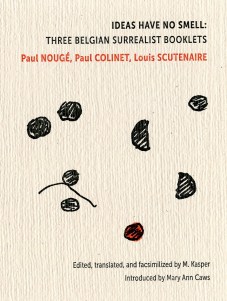
Ideas Have No Smell: Three Belgian Surrealist Booklets

Edited, translated and facsimilized by Michael Kasper; introduced by Mary Ann Caws

Brooklyn, NY: Ugly Duckling Press

Box set of three booklets and fold-out poster
ISBN 978-1-946433-13-8

This Is Not A Translation

My apologies for the silly title of this review, which is the umpteenth variation on a worn-out cliché, but this time it perfectly does the job since the new book by Michael Kasper, a fascinating American book artist and essential middleman in the literary dialogue between Belgium and the US, is precisely anything but a translation. Like all great Renaissance artists, Kasper approaches translation as a comprehensive process, which entails careful editing, editorial comments, creative rethinking and rephrasing of well-crafted translations, and an exceptional commitment to typography, page layout, and book design.

Content-wise Kasper’s work offers the first English translation of three short essential Belgian Surrealist works: Transfigured Publicity, by Paul Nougé; Abstractive Treatise on Obeuse by Paul Colinet; and For Balthazar, by Louis Scutenaire, which gives an excellent overview of both the diversity and the unison of Belgian Surrealism, as committed and transgressive as its better-known French counterpart, but much less concerned by questions of the occult and the unconscious.

The combination of the words “short” and “essential” is no oxymoron: Modernity has a preference for short forms, and Surrealism, certainly in the case of Belgian Surrealism, tends to favor the (shock) effect of the text, which does not leave room for lengthy and distracting developments. The aphorism, the short poem and the appropriated publicity slogan but also the estranging title of an apparently academic painting are thus among the preferred formats of the Surrealists, helping them to turn their texts into real arms.

As a printed object, Ideas Have No Smell adopts a form that perfectly fits this strategy. The facsimile version of the original publications (some of them handwritten) gives a good idea of the DIY philosophy of most Surrealist publications (an author like Nougé tended to reject publication at all) and highlights the identity of nonmainstream writing formats and radical messages. Moreover, the small size of the booklets and the folded poster with a reproduction 1926 handwritten sign of Nougé’s visual poems and the introduction by Mary Ann Caws offers a playful and clever example of the interaction between the part and the whole, that is between the whole that refuses to be a closed unity (the box is “open” and contains various heterogeneous items, exactly as in the Duchamp boxes) and a series of parts that each try to become a world in themselves.

Surrealism has suffered a lot from its recuperation by the cultural establishment. In many cases, it appears as silly and stereotyped as the Impressionist paintings that used to appear on the annual calendar of the postal services. Ideas Have No Smell: Three Belgian Surrealist Booklets is the perfect opportunity to question the limits of this recuperation and to (re)discover a literary and political movement that is far from having lost its relevance.

Exhibition “Thousands are Sailing”

By Frederik Truyen and Sofie Taes

On Friday October 12th the exhibition “Thousands are Sailing” was launched in the Museo della Grafica at the Palazzo Lanfranchi in Pisa. The exhibition is one of the main outputs of the project “Migration in the Arts and the Sciences”, funded by the EC under the Connecting Europe Facilities call “Europeana Generic services 2016”. The call funds projects that want to contribute to Europeana: the main portal to Europe’s cultural heritage.

Pisa1

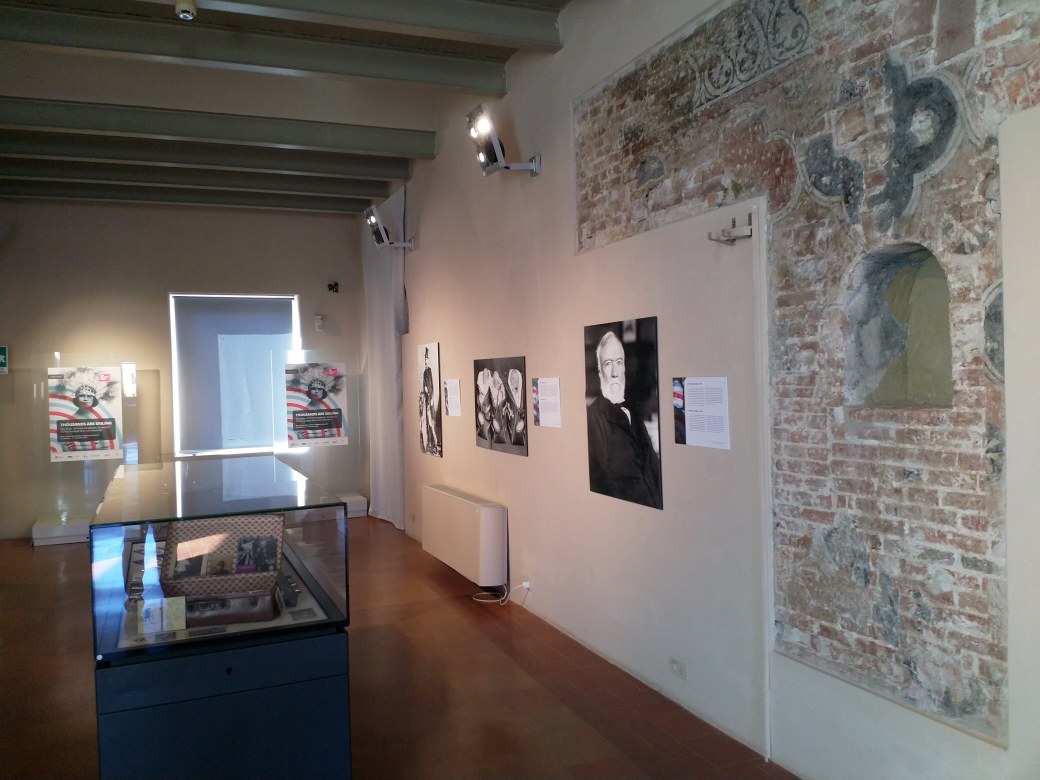
The exhibition at Palazzo Lanfranchi – photo: Frederik Truyen – CC-BY

This particular project aims at bringing together and at disseminating a collection of digitised materials relating to the theme of migration on Europeana. Several partners contribute new content to this collection: Stichting Europeana (the project coordinator), Stichting Nederlands Instituut voor Beeld en Geluid, Katholieke Universiteit Leuven, Narodowy Instytut Audiowizualny, National Archives of Hungary,  Martynas Mažvydas,  the National Library of Lithuania and Narodna biblioteka Srbije – ustanova kulture od nacionalnog značaja.

The selection and curation is in the hands of KU Leuven, Cultural Studies. Curator Sofie Taes, research assistant at the research unit Literary Theory and Cultural Studies, produced a virtual exhibition and several galleries and blogs on Europeana for the migration theme. She is also the curator of the physical exhibition presented in Pisa.

The virtual exhibition “People on the Move” sheds light on how migration has changed the world in six chapters. The first, “Crossing frontiers”, tells the stories of famous migrated scientists, such as Marie Skłodowska Curie and Albert Einstein.  “The land of opportunity”, the second chapter, focuses on migrant workers.  “Mixing traditions” highlights the richness in traditions and culture that migration has brought about, while “Itinerant artists” follows the life of travelling artists. Of course, the “Rising stars” of popular culture deserve their separate chapter.  In “Faces of migration”, the exhibition zooms in on particular stories of individuals and  families whose lives have been heavily impacted by migration.

Pisa2

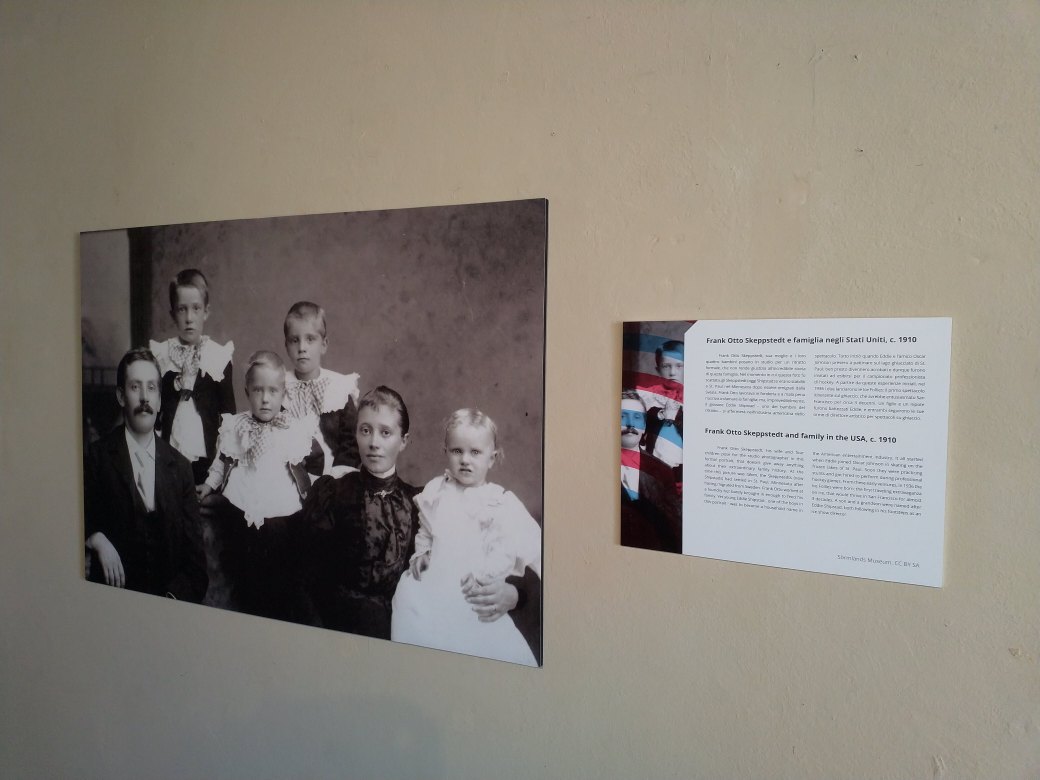
Frank Otto Skeppstedt and Family in the USA – Sörmlands Museum – CC-BY-SA

In the physical exhibition “Thousands are Sailing” – developed in collaboration with Photoconsortium, the aggregator for photography on Europeana – , the key theme of migration is exemplified in 20 portraits and mini-stories about people’s migration experiences, their motives, hopes and wishes, adventures and accomplishments. The photos are of exceptional quality and have a direct face-to-face appeal. Visitors feel transported in the often precarious but sometimes joyful world of people in their newfound home. At the launch of the exhibition Sofie Taes explained the motives behind the selection and the long journey of discovery to find a set of images that tell a common narrative through individual stories.

Pisa3

Curator Sofie Taes at the opening – photo: Frederik Truyen – CC-BY

With this exhibition, Cultural Studies Leuven continues its work of contributing curated collections and stories to Europeana, in particular to the Thematic Collection on Photography. This effort has recently entered the next stage with the new project “Kaleidoscope: the fifties in Europe”, launched in September 2018.

The opening of the exhibition, which will run until November 11th 2018, coincided with a successful Europeana migration collection day, where citizens were invited to bring an object to share their migration story. We collected a number of very compelling stories which will shortly be published on the Europeana portal!

Pisa4

Collecting objects and stories at the collection day – photo: Frederik Truyen – CC-BY

An Evening with Mike Dibb in Cinema ZED

By Anneleen Masschelein

An Evening with Mike Dibb in Cinema ZED October 10 2018

             Organized by Courtisane and KU Leuven (philosophy, cultural studies and contemporary art history)

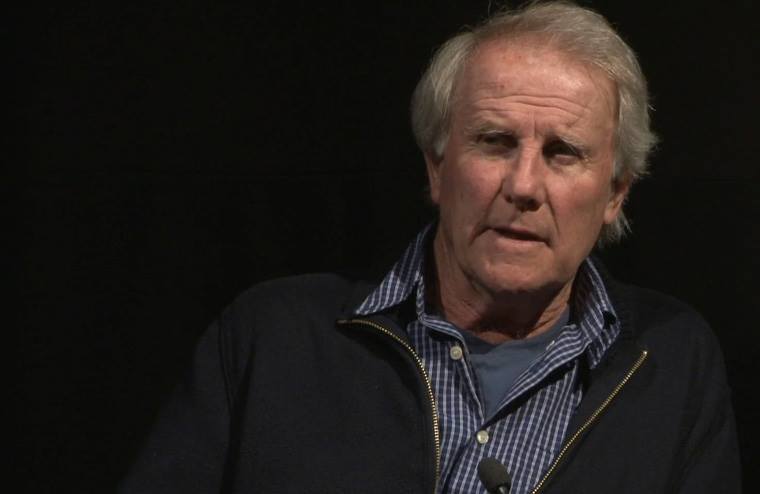
The name Mike Dibb may not immediately ring a bell to younger generations, though his contributions to British television and to British cultural studies cannot be underestimated. Mike Dibb (1940) began his career as a trainee at the BBC in the early sixties and remained there for more than 2 decades as a director and producer for the Music and Arts department, where he made documentaries about literature, music, history, painting and ideas.

Dibb is probably most well-known for the groundbreaking TV series Ways of Seeing (1972) that he made with author John Berger. This award-winning series about the gaze in Western art history and contemporary culture (still available on YouTube) popularized the views of Walter Benjamin for a broad audience. Nearly 50 years old, Berger’s text is still being re-issued time and again by Penguin, but Dibb’s original imagery and playful collages cannot be overlooked. Although Dibb has a healthy suspicion of “academics,” his career testifies to the influence of British Cultural studies in its heyday. In 1976, he made a beautiful, poetic film-essay about Raymond Williams’ classic book, The Country and the City (also on YouTube) and about Beyond Boundaries, the personal and cultural history of cricket, by C.L.R. James, the Trinidadian intellectual. For the BBC, he developed a number of groundbreaking series on ideas, like the notion of ‘play,’ ‘time,’ or ‘drawing.’

In the early 1980s, Dibb left the BBC to work as an independent documentary maker, both for the BBC and for Channel 4. Continuing to explore his lifelong passions – music, literature and history – Dibb also made portraits of some of the defining intellectuals of his time, like oral historian Studs Turkel and literary theorist Edward Said. Dibb typically combines collage with conversation in his work. Sometimes brilliantly original, he also offers a fresh take on very simple forms. His long, in-depth interviews with Edward Said and Stuart Hall, both at the end of their lives, are very moving portraits showing these thinkers doing what they do best: talking in dialogue, extending ideas into the future. We have been able to invite Mike Dibb to STUK in Leuven and will have plenty of time for discussion with him, browsing through fragments of his work. At 20.00, Dibb will also show his latest film, Painted with My Hair, about his search for Donny Johnson, a prisoner who managed to survive more than 20 years in solitary confinement in the US through the discovery of painting.

https://www.cinemazed.be/en/node/4387

Mike Dibb


Between Two Worlds. Russia, Perception and Dialogue

By Gert-Jan Meyntjens

Particularly interesting for cultural studies students with an interest in Eastern Europe and Russia is the lecture series on Russia’s place in the world organized by KU Leuven’s Centre for Russian Studies in collaboration with Bozar. The lecture series is free for students. The majority (6/8) of the lectures are in English. Two talks take place in Bozar.

Blog Russia

In his book ‘In-between two worlds. Studies on the inhabitants of Eastern Europe’ (1943), the somewhat controversial Utrecht professor Lodewijk Grondijs presented a historical-ethnographic analysis of Eastern Europe from such a biased, patriarchal perspective that one would think it completely outdated. Nowadays however, the perception of the post-Soviet region – and especially Russia – is still not devoid of bias and more often than not entails a perception of threat.

This semester, KU Leuven’s Centre for Russian Studies organizes a series of fall lectures on the place and perception of Russia in the world. The talks will focus on the different regions that turned out to be of great importance to Russia at different times in history: its ‘Near Abroad’, but also the Middle East, Asia, and the West. Not only will they look at the role that Russia took upon itself throughout the centuries, but the lecture series also aims to assess where Russia found common ground with these regions, yet also what set Russia apart from the rest of the world. In eight lectures by distinguished scholars, Russia’s place, influence and perception in the world will be discussed from a multidisciplinary perspective.

In the opening lecture of the series “The Confrontation between Russia and the West: a New Order in the Making?”, prof. Tom Casier will discuss relations between Russia and the West. Relations between Russia and the West are going through the deepest crisis since the end of the Cold War. Moscow has blamed this on the humiliating treatment it underwent. Referring to the West’s renewed containment policy, Putin stated: ‘If you compress the spring all the way to its limit, it will snap back hard.’ Many in Europe, in contrast, see the current crisis as the result of the assertive and imperialist foreign policy of reemerging Russia.

Both views are simplistic accounts of a much more complex reality. How then did we get into today’s confrontation? How deep is the crisis? This lecture seeks to grasp the essence of the conflict against the background of culminating tensions in the years before the Ukraine crisis. The story is one of power struggles at different levels, diverging perceptions and narratives of humiliation and threat. The question is raised whether the crisis between Russia and the West is part of a global reconfiguration of forces. Do we see a coalition arising that challenges Western hegemony? And is Russia as powerful as it seems or will the current confrontation only catalyze a return to what Putin’s aide Vladislav Surkov called a return to ‘one hundred years of geopolitical solitude’?

For more info and registration:
https://www.arts.kuleuven.be/crs/english/news/lecture-series-2018
https://www.facebook.com/events/328740034340525/


PROGRAMME:

3/10 – Opening lecture – Global perceptions and the discourse of humiliation in Russia. Prof. Tom Casier, Jean Monnet Chair, School of International Studies, University of Kent (Faculty of Arts)

10/10 – Alexander I in het post-1815 Europese veiligheidsbestel. Prof. Beatrice de Graaf, Universiteit Utrecht. De lezing begint uitzonderlijk om 20:00u. (Faculty of Arts)

24/10 – Russia’s first ‘Orient’: the Crimea in the 18th Century. Prof. Sara Dickinson, University of Genova (Bozar)

7/11 – The U.S.-Russia Relationship under Trump: a story about the limits of a Bromance. Prof. Bart Kerremans, Leuven Institute International and European Studies, KU Leuven. (Faculty of Arts)

21/11 – Western elite art collections in the Hermitage. Dr. Catherine Phillips, Hermitage Saint Petersburg (Bozar)

28/11 – Een vergeten episode in de Rusland-Japan relatie: de moordpoging op de toekomstige tsaar Nicholaas II in Japan 1891. Prof. Dimitri Vanoverbeke, KU Leuven (Faculty of Arts)

12/12 – Russian Hajj. The Russian Empire and the Pilgrimage to Mecca. Prof. Eileen Kane, Connecticut College (Faculty of Arts)

19/12 – Closing lecture – Russia and the West, the challenges of a Structured Dialogue. Ambassador Paul Huynen, OSCE (Faculty of Arts)


PRACTICAL INFORMATION

Time: Wednesday 19.30 – 21.00.

Place: the location of the lecture is always indicated: Justus Lipsiuszaal, Faculty of Arts KU Leuven (Blijde Inkomststraat 21, Leuven 3000) or Rotonde Bertouille zaal, Bozar (Ravensteinstraat 23, Brussel 1000).

Language: English or Dutch

Entrance fee: 10 € per lecture, 70 € for the entire lecture series. Students and KU Leuven staff can attend the lectures for free.

Relaunching the European Avant-Gardes

By Jan Baetens

Bru

The publisher calls it an “introduction” to the works, the authors, the currents, and the contexts of the European avant-gardes in the period 1905-1935 (three decades that in Anglo-Saxon criticism are often called “High Modernism”, a powerful streamlining of the exceptional dynamism and diversity of these years). But this is really not the best word to qualify the “portable guide” proposed by one of the leading voices in the field. Granted, the book offers more than everything one would like to know about both the so-called historical avant-garde and the many –isms that have come to illustrate it. But reducing the book to its encyclopedic or toolkit function would definitely neglect the real stakes of an intellectual that goes beyond the careful and lavishly illustrated presentation of its material.

First of all, one should welcome the refreshing and innovative way of organizing the currently available knowledge of the European avant-gardes. The book finds the perfect balance between familiar and new ways of structuring the information: on the one hand, it does not reject the classification in –isms (it is important however to mention that each of them is systematically described in the plural: not “expressionism” but “expressionisms”, etc.); on the other hand, it succeeds in building a new architecture or intellectual design, easy to unpack as well as stimulating surprising montage effects, which foregrounds three major perspectives: first that of the concept (the relationship or tension between art and avant-garde), second that of the places where avant-gardes appeared or that were created or reinvented by them (this section makes us travel from the café to globalized cultures), third that of time, for past, present and future do no longer mean the same after the avant-gardes have revisited these traditional frameworks.

Second, the book does not only showcase the ambitions and failures as well as the meaning and importance of the European avant-gardes. It also reshapes our idea of the avant-garde. Key in this regard is the systematic use of the plural, which also makes room for the “non-avant garde” aspects of the avant-gardes, often much closer to the core of European culture than we generally assume. But also the properly European dimension is rightly underlined as a factor of diversity: linguistic plurality, context-sensitivity, unequal development in time and place appear to be at the heart of the various avant-gardes, which cannot be understood in homogeneous or teleological perspectives.

Third (but of course not finally), this book is not just a suitcase that one opens to find answers to specific queries (the very detailed index will prove dramatically useful in this regard), it is also a door that one can open to discover new or never thought-of questions, less known or never disclosed examples (and here the exceptional iconography is vital), and simply enjoy the writing, a perfect mix of intellectual sympathy and critical distance.


Homepage of the book:

https://edinburghuniversitypress.com/book-the-european-avant-gardes-1905-1935.html

Homepage of the European network for Avant-Garde and Modernism studies:

http://www.eam-europe.be/